
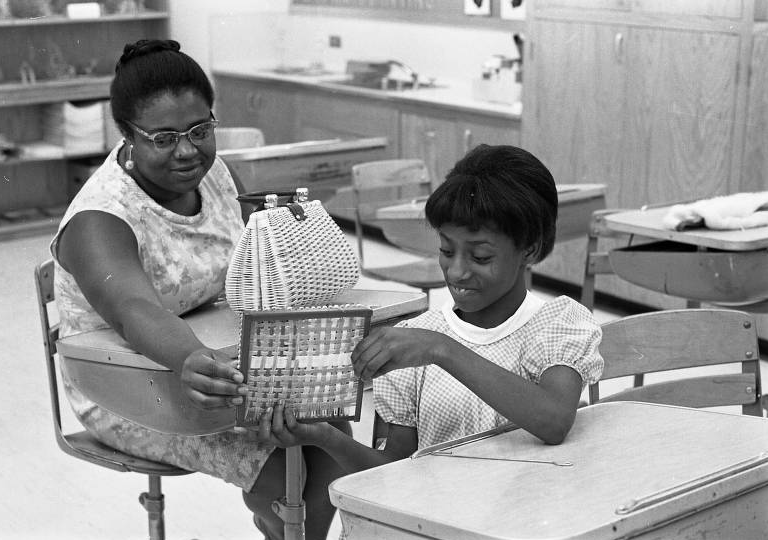
Omaha’s segregated schools are part of the fabric of the city today. However, few people will admit that Jim Crow made Black schools here, or that racial segregation continues existing in Omaha Public Schools, or that white people continue benefiting from the racial imbalance of the city’s public education system. This article is a history of segregated schools in Omaha.
Why Segregation?

Omaha was founded in 1854, seven years before the Civil War. The United States had been fighting over whether enslavement should continue for at least 25 years by then, and the argument was erupting into warfare. The Nebraska Territory was established in the terrorism of white supremacy, actively allowing enslavers to dominate early politics and pretend they wanted statehood above all else.
When they were beaten and couldn’t continue enslavement, white supremacists became committed to writing laws, policies, and rules for the state and their local governments to ensure Black people were discriminated against. Sometimes, their blatant racial discrimination in law, aka de jure segregation, was defeated. This left them to enact informal rules, social norms and “everyday understandings” that enforced their discriminatory agenda. This is called de facto segregation.
Segregation is intended to keep Black people physically, mentally, economically, socially, culturally and otherwise separate and apart from white people. Segregationists seek to isolate, demean and oppress people who are not seen as white.
In Omaha Public Schools, racial discrimination happened through both de jure and de facto segregation. This article explores what that specifically looked like.
Many Causes for Omaha’s Reality
In the 1970s, the federal Department of Education successfully argued that Black people weren’t allowed to move into white neighborhoods, and since Omaha only had neighborhood schools, Black students naturally “pooled” into their local buildings. Since the 1920s, real estate agents pushed white people to move away from North Omaha in order to capitalize on selling west Omaha houses.
As white flight gripped North Omaha, white families ripped their children from historically white and mixed schools and placed them in all-white public schools in west Omaha, as well as private schools spread throughout the city. This led to the segregation of public schools in North Omaha.
Racism in Omaha Public Schools isn’t confined to student placement. It isn’t just a historical fact, either. Today, racism in Omaha continues to be prevalent in teacher hiring, school leadership, district leadership, school board elections, school curriculum and teaching practices, testing, and discipline.
This article is limited to addressing the first issue of segregating student populations; however, the other issues should be addressed too. In 1977, the United States Supreme Court found that the Omaha School District practiced segregation in several ways, including discriminatory faculty assignments, school site selection, student transfer policies, feeder patterns, and school maintenance.
There were at least two instances of de jure segregation in Omaha’s history: The first was the Omaha Colored School from 1865 to 1872, and the second was the Catholic Archdiocese of Omaha’s school for Black students only called St. Benedict School from 1928 to 1968.
Omaha Public Schools are de facto segregated, which is enforced by housing practices, economic limitations and cultural “understandings.” Following is an exploration of what Jim Crow look like in Omaha Public Schools historically, and how it appears today.
School Segregation in Pioneer Omaha

The Nebraska Territorial Legislature blatantly discriminated against students of color in an 1856 law that stated,
“It shall be the duties of the directors… to take… an enumeration of all the unmarried white youths… between the ages of five and twenty-one years… for the purpose of affording the advantage of free education to all the white youth of this territory, the territorial common school fund shall hereafter consist of such sum as will be produced by the annual levy and assessment of two mills upon the dollar valuation on the grand list of the taxable property of the territory…”
—Section 60, 5th Session of the Territorial Legislature, Complete Neb. Sess. Laws, 1855 to 1865, 92 (1886)
Black people weren’t counted or taxed for public school purposes until 1867. Early that year, a group called the Educational Association met in Omaha and proposed, “That the Legislative Assembly of Nebraska ought to amend the School Laws so as to provide for the education of colored children in this Territory.” The group shared this in the Nebraska Territorial Legislature, which met in Omaha, as a “Bill to Remove all Distinctions on account of race or color in our public schools.”
The Legislature rejected the proposal though and stated,
“The people of Nebraska are not yet ready to send white boys and white girls to school to sit on the same seats with negroes; they are not yet ready to endorse in this tacit manner the dogma of miscegenation, especially are they yet far from ready to degrade their offspring to a level with so inferior a race.”
—January 25, 1867, House Journal 95 (12th Terr. Sess. 1867)
With anti-slavery Republican Territorial Governor Alvin Saunders gone from the Territory on business, Territorial Secretary A.S. Paddock added his rejection to the bill writing, “Permit me, however, to suggest that better results could be expected in the education of both white and colored youths, if separate schools could be provided for each.”
With Paddock’s rationale, starting in 1867 the Omaha school board opened a segregated school for Black students in an old building that was literally falling over. Referred to as the Colored School, school superintendent Howard Kennedy approved it and oversaw a teacher there. The Daily Herald called for separate but equal schools in 1867, and that’s when the school board instituted a policy for Jim Crow schooling by renting a heated room on 10th Street between Dodge and Douglas to use as the new official “colored school.”
Led by community leader Edwin Overall, a number of African American parents challenged the district segregation policy. Their advocacy worked, and in the fall of 1872, the Jim Crow school was permanently closed and Black students were sent to the schools nearest to their homes. These homes were spread out; however, the vast majority of African American students lived and went to school north of Dodge Street, and at that point, east of North 24th Street. After the Omaha Colored School was closed in 1872, there were 1,576 students in nine public schools in Omaha. Of them, 47 Black students total attended eight of those schools, with 25 of them at the “colored school” when it closed.
Early History of School Segregation in Omaha

After the Omaha colored school was closed, the city still had segregated schools. Before 1900, they were clustered nearer to the present-day downtown core where the originally segregated Black neighborhood was. Located from North 5th Street to North 20th and from Dodge to Capitol Avenue, the original Near North Side neighborhood was a mixed place. There were a few clusters of Black residents in the city.
In 1890, Black students in Omaha mostly went to these schools :
- Dodge Street School, 11th and Dodge Street (1876-1896)
- Izard Street School aka North Omaha School, N. 17th and Izard Street (1871-1900)
- Cass Street School, N. 14th and Cass Street (1879-1936)
Lucille Gamble, one of Omaha’s first African American teachers, taught at Cass Street School from 1895 to 1899. Eula Overall (1882-1966) was another one of the first Black teachers in Omaha Public Schools.
The first Black student to graduate from a high school in Omaha Omaha High School was Henry Clay Curry in July 1876. It was 1879 before Ida Overall (1860-1925), the first African American girl graduated from Omaha High School.
Another dubious first belongs to Ida Overall, who completed normal school in Omaha and applied to the school board to be a teacher. However, the school board turned her away because they didn’t hire Black teachers. Along with her sister Victoria (1867-1918), she moved to Kansas City and became a teacher there.
The numbers of Black students in Omaha varied dramatically over the early decades, and I haven’t found the reasons why yet. For instance, in 1889 there were 504 African American students. However, just six years later in 1895, there were only 196 African American students attending Omaha schools, with “most of them at Dodge, and another 20 at Long, Izard, Central and Cass Schools.”
Before 1900, there were fewer than 20 Black graduates from Omaha High School.
Entrenched School Segregation

As African Americans moved north beyond the old “Near North Side,” the neighborhood they lived in was colloquially referred to as the “North Side” and included everywhere from Douglas Avenue north to Lake Street, from North 14th to North 33rd Street in some places. By 1900, North Omaha was home to all of the city’s strictly segregated Black schools. Over time, these buildings were…
- Lake School, N. 20th and Lake Street
- Kellom School, N. 24th and Paul Street
- Howard Kennedy School, N. 30th and Wirt Street
- Lothrop School, N. 22nd and Lothrop Street
- Long School, N. 25th and Franklin Street
These five schools were the only elementary schools serving African American students. In Omaha, as well as many cities nationwide, schools for Black students were older buildings that weren’t taken care of well, had fewer resources of all kinds, and paid their teachers less than in white schools.
In 1907, there were 458 Black students out of 19,567 total in all Omaha public schools. Between 1910 and 1930, Omaha’s Black population grew dramatically, going from 4,426 Black residents forming 3.6% of the city’s population of 124,096 people to 11,125 African Americans living in Omaha in 1930 who made up approximately 5.2% of the city’s population.
As the only high school in the until 1911, Omaha High School notoriously discriminated against Black students. It was 1913 before the school’s band integrated for the first time. Even after several other high schools were opened, there was a rumored limit to the number of African American students allowed to attend the high school in the 1930s.
Overtly Racist District Leaders

Throughout its 160+ year history, there surely have been several racist superintendents, including the city’s first person in the position. Between his term as superintendent in 1859 and ten years as a school board member, including as the president and vice president of the board, the decisions the school district made during Howard Kennedy’s leadership were consistently segregationist and anti-Black students.
However, towards modern times an overtly racist Omaha superintendent had the honor of a high school being named after him.
Dr. Harry A. Burke, namesake of Omaha Burke High School, used racism to run Omaha Public Schools from 1946 to 1962. David Bristow, now an official with the Nebraska State Historical Society, wrote about an interview with Herb Rhodes, a North Omaha civil rights leader in the 50s and 60s. Rhodes said that Harry Burke once “proclaimed that as long as he was superintendent, there would not be a black educator in the school system, other than the two schools that served the black community,” because Burke opposed having black teachers “where white children would see a black person in a role of prominence or authority.”
There were other incidents of Burke’s forked tongue showing, including newspaper accounts and a lot of personal anecdotes from faculty and students. During his tenure, Burke strictly segregated schools, denied Black students to attend white schools, wouldn’t hire Black teachers, would only hire Black teachers for Black schools, wouldn’t allow Black principals to supervise white teachers, denied funding relief for overcrowded Black schools, and was almost single-handedly responsible for the district being sued by the US government for racial segregation.
All of that is why it seems surprising today that in 1967, a new high school was completed in a cornfield on the outskirts of Omaha with the explicit purpose of promoting white flight from North Omaha. While it seems right that this specific building in this location for this reason was named after an overt racist, today it is clearly inappropriate and the name should be changed immediately.
United States v. School District of Omaha (1976)

In 1976, the United States Supreme Court found that Omaha Public Schools was guilty of segregating K-12 schools in the case of United States v. School Dist. of Omaha, 418 F. Supp. 22 (D. Neb. 1976).
In 1972, the total number of students in Omaha Public Schools was 63,125. That included 19.4 percent blacks, 1.6 percent Hispanics, 0.6 percent American Indians, and 0.3 percent Asian Americans. Of 2,585 faculty members in 1972, there were 202 blacks, 8 Hispanics, 5 Asian Americans, and 1 American Indian. During the 1977-78 school year, 1 of 12 school board members was black.
In the 1970s, a group of mothers became synonymous with attempts to force Omaha schools to integrate. Through their tireless campaigning, Lurlean Johnson, Zenolia Hilliard, Lillie Gunter, Irene Gunter, Charlotte Stropshire, Nellie Mae Webb, and Dorothy Eure successfully forced the launch of Omaha’s first attempt to racially integrate it’s schools.
Between 1974 and 1976, the US government took the Omaha Public Schools to court because of its segregated schools. The US circuit court ordered Omaha to use busing to desegregate the district. They ordered the district to desegregate Omaha’s public schools, starting in September 1976. Suddenly, white flight swept through North Omaha, with hundreds of residents fleeing to the city’s western suburbs where there were few African Americans. White student enrollment in the district tanked, and African-American students were encouraged to travel across the city to predominantly white schools.

In 1999, the school district adopted an open enrollment policy based on income instead of race, effectively ending busing.
Resistance to Segregation

There was significant and sustained resistance to Omaha’s racial segregation in schools. Starting in with Edwin Overall’s 1872 campaign to end the Omaha “Colored School,” Black parents have advocated, activated, organized and won several efforts to stop white supremacy within OPS. In June 1926, “a delegation pleaded for colored teachers” to the Omaha school board. They were turned away though, and few deliberate attempts were made to hire African American teachers for another 25 years.
In February 1968, African Americans in Omaha formed a “Negro School Board” to dismantle white supremacy in Omaha Public Schools. Members of the Negro School Board were Mike Adams, Ernie Chambers, Ruth Jackson, Raymond Metoyer, Wilbur Phillips and Charles Washington.
Their primary objectives were to:
- Facilitate the immediate desegregation of all schools;
- Insurance of proper channeling of Federal, state and local school funds to problem areas;
- Establishment of a board of appeals for parents seeking redress of grievances;
- Uplift of standards and quality of education through improvement of programs, facilities and training;
- Promote vehicle for registering and fielding of complaints and suggestions, and;
- Promotion of the incorporation of courses and materials which present achievements, culture and history of Blacks in America into the regular citywide school curriculum.
There was no further mention of this group after its formation though. Of course, member Ernie Chambers has continued to fight for justice to this day, along with several other members of the group.

Continuing to Ernie Chambers’ sustained work from the 1960s through the 2020s, African Americans in Omaha have been working to stop Jim Crow and address white supremacy in Omaha Public Schools in nearly countless ways.
The struggle continues today with a campaign to renamed Burke High School, a fight to recognize Black history and more throughout curriculum, and efforts to end racist mascots in the district’s schools.
Ernie’s Plan

After ending segregated busing in 1999, public schools in Omaha re-segregated along strict racial lines. Magnet schools almost immediately began failing and few students opted for non-mandatory busing.
In 2006, Chambers offered an amendment in the Nebraska State Legislature that would have created three separate school districts in Omaha, one with majority Black residents, one with majority white residents, and one with majority Hispanic residents. Seemingly, his goal was to give community control of each district to each population. In reality though, OPS wanted to start annexing suburban districts engulfed by the city into the Omaha school district in order to make its taxation area larger. This “one tax, one school” system was also said to allow the district to create magnet programs to increase diversity in now predominantly white schools. Chambers believed a different solution was needed, and proposed his plan in order to give the Black community the chance to control their own district where their children were the majority. Immediately controversial, opponents described it as “state-sponsored segregation”.
It was only after Chambers’ proposal that conversations about the roles of race and ethnicity in OPS’ education policy came back on the radar in the city. However, after a lot of resistance from various parties including the NAACP, the governor repealed the bill in which Chambers’ proposal was accepted. Later in 2006, the U.S. Commission on Civil Rights held a briefing in Omaha to learn about Chambers’ proposal.
The outcome of Chambers’ work was the development of the Learning Community focused on equitable funding, local control and integration. According to their website in 2024, “The Learning Community works with children and families to challenge the opportunity gap through early childhood education, family engagement and future teacher preparation. Valued partners come from public education, higher education, non-profit organizations and the philanthropic community. Our investments look to the future, focused on creating stronger communities and a better future for everyone.”
Operating independently of the school district, the two parts to the Learning Community (North and South) are credited by community members as successful. Their website also shows there have been positive student, family and classroom outcomes throughout the initiative.
Re-segregation in Omaha Schools Today

Since the release of Omaha from the order by the US Supreme Court to become integrated in 1999, Omaha Public Schools have become re-segregated. According to OPS data, percentage of white students enrolled in Omaha Public Schools is decreasing while the percentage of students of color is rising, especially in schools with predominantly African American and Hispanic / Latino student populations. This is happening while the general Omaha population has increasing numbers of white people and a decreasing population of African Americans.
Modern Racial Statistics

According to the U.S. Department of Education, the 2018-2019 racial demographics for Omaha Public Schools are:
- Hispanic or Latino: 10,648
- Non Hispanic or Latino: 73,217
- Students of one race: 80,257
- White alone: 53,974
- Black or African American alone: 18,578
- American Indian or Alaska Native alone: 861
- Asian alone: 1,160
- Hawaiian or other Pacific Islander alone: 49
- Some other race alone: 5,635
A variety of schools in North Omaha have large percentages of African American students that demonstration racial unevenness in school. For instance, at North High, Blackburn High, and Northwest High, African American students comprise the largest racial populations in the school. Other schools that are predominantly African American include Hale, King, Monroe, Morton, and McMillan; as well as the Transitions Program, Career Center and Parrish, which are also predominantly African American. In the 2015-16 school year, the trends of racial isolation in Omaha Public Schools are even more pronounced in elementary schools. Belvedere, Central Park, Conestoga, Druid Hill, King, Franklin, Lothrop, Miller Park, Mountain View, Saratoga, Skinner and Wakonda are all majority African American schools.
The UNO Middle College Program and the Gateway to College Program are predominately white, as well as Burke High, Alice Buffet Middle, and Davis Middle. Vastly white student populations also exist at Caitlan, Columbian, Dundee, Florence, Fullerton, Picotte, Pinewood, Saddlebrook, Standing Bear, and Washington elementary schools.
This is all evidence of the ineffective administration of resources among Omaha Public Schools, and demonstrates how North Omaha is routinely afflicted by racial segregation. A more thorough analysis of per school spending, neighborhood economic status or other factors would corroborate these findings.
In the meantime, its easy to see that racial segregation is trending throughout the city of Omaha today, and that its schools are clearly reflective of that trend.
Directory of Historically Segregated Schools in Omaha

Segregation in Omaha Public Schools has been generally confined to a group of schools north of Dodge Street and east of North 72nd Street. As de facto segregation, Black students are limited to only attending schools in the neighborhoods where they live. In Omaha, housing is limited to African Americans according to their income, which in turn is afforded by income and credit. Income and credit are reliant on education.
This cycle disallowed several generations of Blacks to move away from the segregated schools their children attended; these schools hosted succeeding generations of African American students. Even when the Black population was allowed to move away from the Near North Side by the 1964 Fair Housing Act, school segregation in Omaha moved along with the Black population. This has led to the simplistic reality that wherever African Americans live, Black students attend the schools in those neighborhoods. This has allowed Omaha Public Schools to stay segregated by allowing white people to simply move away from schools Black students attend. This has proven to be the case over the last 50+ years since housing integration.
In 1976, the US Supreme Court identified the following schools as segregated and ruled that Omaha Public Schools integrate the students in these buildings.
- Tech High School, 3215 Cuming Street
- Tech Junior High School, 3215 Cuming Street
- Mann Junior High School, 3720 Florence Boulevard
- Webster Elementary School, 618 North 28th Avenue
- Franklin Elementary School, 3506 Franklin Street
- Howard Kennedy Elementary School, 2906 North 30th Street
- Fairfax Elementary School, 3708 North 40th Street
- Druid Hill Elementary School, 4020 North 30th Street
- Monmouth Park Elementary School, 4508 North 33rd Street
- Saratoga Elementary School, 2504 Meredith Avenue
- Lothrop Elementary School, 3300 North 22nd Street
- Lake Elementary School, 2410 North 19th Street
- Connestoga Elementary School, 2115 Burdette Street
- Kellom Elementary School, 1311 North 24th Street
Today’s Black Schools in Omaha

According to recent data, there are several schools in Omaha Public Schools today that are predominantly African American, despite the currently segregated schools in Omaha have included or currently do include…
- North High School, 4410 North 36th Street
- Blackburn High School, 2606 Hamilton Street
- Northwest High School, 8204 Crown Point Avenue
- Hale Middle School, 6143 Whitmore Street
- Monroe Middle School, 5105 Bedford Avenue
- McMillan Magnet Center, 3802 Redick Avenue
- Transitions Program, 2504 Meredith Avenue
- Career Center, 3230 Burt Street
- Parrish Program, 4315 Cuming Street
- Belvedere Elementary School, 3775 Curtis Avenue
- Central Park Elementary School, 4904 N 42nd Street
- Conestoga Elementary School, 2115 Burdette Street
- King Elementary School, 3706 Maple Street
- Miller Park Elementary School, 5625 N 28th Avenue
- Mountain View Elementary School, 5322 N 52nd Street
- Skinner Elementary School, 4304 N 33rd Street
- Wakonda Elementary School, 4845 Curtis Avenue
Note that I didn’t pick from North Omaha’s schools only; its coincidental to my list that all of Omaha’s segregated schools are in North Omaha.
Schools in Omaha are clearly re-segregated today. More white students in Omaha attend private schools within the city’s boundaries than ever before. Fewer teachers of color are available for students of color and white students than ever before.
Private Segregated Schools

There were at least two private segregated schools in Omaha’s history. The first was St. Benedict’s Catholic School, which was located at North 24th and Grant Street and operated for 40 years as a school exclusively for African American students who Catholics did not want integrating with white students.
The other was Hope Lutheran School, which was operated for 14 years by Hope Lutheran Church. It was “coincidentally” segregated because it served only neighborhood students from the neighborhood around its building at North 27th and Wirt Streets, which was wholly Black during the school’s existence.
Segregation in Suburban Omaha
Suburban school districts around Omaha also grow exponentially. This is happening because of population growth on the edges of the city, because even as their municipalities are annexed by the City of Omaha, their school districts are not absorbed by Omaha Public Schools. This has been true of Elkhorn Public Schools, Arlington Public Schools, Bennington Public Schools, Ralston Public Schools, Westside Community Schools, and Millard Public Schools. Neighboring Bellevue Public Schools has grown exponentially, too.
With recent struggles still in the rear view mirror, it is absolutely necessary to keep moving forward. Only time will tell whether that will happen though.
Omaha Schools Named for Racists

Throughout Omaha Public Schools today, there are several schools named for racists. Some of them include Burke High School, Morton Middle School, Miller Park Elementary, and perhaps most egregiously, Howard Kennedy Elementary.
In 1867, the Nebraska Territory governor asked the legislature to consider a “revision or amendment of the school law” to allow Black children to attend public schools. For a decade before that Black students were denied entry to schools in Omaha and elsewhere. The legislature did what the governor asked; however, the law didn’t specify whether the schools should be integrated, and racist school leaders in Omaha took the opportunity to create a segregated school for Black children. The Omaha School District created a so-called “colored school” which served at least 27 students from 1865 to 1872. The superintendent who would have made that decision for Omaha Public Schools then was Howard Kennedy (1849-1914). In 1910, a new school building for the old Omaha View School was named in honor of him, and today the Howard Kennedy Elementary School continues serving a predominantly African American student body, as it’s done for more than 70 years.
Today, J. Sterling Morton (1832-1902) is recognized as an important Nebraska statesman, federal government leader, and the founder of National Arbor Day. However, during his life he made it known he was also a deep racist who stood really committed to white supremacy, for enslavement, against equality, and with the South before and after the Civil War. In 1865 he wrote, “It will be more manly to accept negro suffrage by legal enforcement than to humiliate ourselves by its voluntary adoption as the price of admission to the Union… We take n—-r only when forced to it by Congress and therefore are for remaining at present a territory.” In 1965, Omaha Public Schools named a new junior high school for him, and Morton Magnet School continues by that name today.
When a territorial legislator from Otoe County named William H. Taylor (1827-1865) introduced the first bill to end slavery in Nebraska in 1859, Dr. George Miller (1830–1920) protested as a Nebraska legislator. He claimed slavery did not exist in the territory, and if it did what right was it of the government to take away private property? Taylor responded saying, “There has never been a federal officer… in this territory who has not brought with him into the territory a negro or negroes who have been and are now held in slavery.” Taylor also enumerated several businessmen who kept slaves. After a newspaper in Omaha called the Daily Nebraskian published its support of slavery, the anti-slavery proposal failed. Dr. Miller went on to establish the Omaha Daily Herald, which later became part of the Omaha World-Herald. Taylor is largely forgotten today, and Dr. Miller has Miller Park Elementary School named in his memory.
Dr. Harry A. Burke (1896-1962) was a superintendent who used racism to run Omaha Public Schools for 15 years, from 1946 to 1962. David Bristow, now an official with the Nebraska State Historical Society, wrote about an interview with Herb Rhodes, a North Omaha civil rights leader in the 50s and 60s. Rhodes said that Harry Burke once “proclaimed that as long as he was superintendent, there would not be a black educator in the school system, other than the two schools that served the black community,” because Burke opposed having black teachers “where white children would see a black person in a role of prominence or authority.” Omaha’s In 1967, Harry A. Burke High School was named in his memory five years after he died, and a 2020 movement to rename the school in 2020 received no traction within the Omaha school board. The high school continues honoring this racist as of 2023.
Other schools in OPS are named also problematically. General William T. Sherman (1820-1891), a leader of the US Army during the Civil War, was an avowed white supremacist and has been memorialized by Sherman Elementary since the 1880s. John H. Kellom (1817-1891) was an early Omaha School Board member and the first principal of Omaha High School who prevented Black students from attending the school for several years. Kellom Elementary School was named in his memory.
Omaha Public Schools named for racists include…
- Burke High School
- Howard Kennedy Elementary School
- Miller Park Elementary School
- Morton Magnet School
- Sherman Elementary School
- Kellom Elementary School
Segregation in Omaha Schools in the Future?
There is still not a widespread reconciliation of Omaha Public Schools’ racist history. District leaders, including the superintendent and school board, have never acknowledge their complicity in school segregation, perpetuating white supremacy, maintaining the school-to-prison pipeline, or otherwise degrading the Black students they are responsible for educating. By failing their responsibilities, they are failing democracy and the well-being of ALL students in Omaha.
Maybe in the future, there will be professional development for educators on this painful, true and necessary history. Perhaps the district will rename the buildings honoring hateful racists. They could institute widespread Black history education at the elementary, middle and high school levels. And maybe they’ll stop the ongoing segregation of African American students from white students throughout the city.
In the meantime, we must share and advocate for this history and the changes that are needed throughout the education system in order to stop it from continuing. Until then, knowledge is what we have.
You Might Like…
MY ARTICLES ABOUT THE HISTORY OF SCHOOLS IN NORTH OMAHA
GENERAL: Segregated Schools | Higher Education
PUBLIC GRADE SCHOOLS: Beechwood | Belvedere | Cass | Central Park | Dodge Street | Druid Hill | Florence | Fort Omaha School | Howard Kennedy | Kellom | Lake | Long | Miller Park | Minne Lusa | Monmouth Park | North Omaha (Izard) | Omaha View | Pershing | Ponca | Saratoga | Sherman | Walnut Hill | Webster
PUBLIC MIDDLE SCHOOLS: McMillan | Technical
PUBLIC HIGH SCHOOLS: North | Technical | Florence
CATHOLIC SCHOOLS: Creighton | Dominican | Holy Angels | Holy Family | Sacred Heart | St. Benedict | St. John | St. Therese
LUTHERAN SCHOOLS: Hope | St. Paul
HIGHER EDUCATION: Omaha University | Creighton University | Presbyterian Theological Seminary | Joslyn Hall | Jacobs Hall | Fort Omaha
EDUCATORS: Eugene Skinner | Lucinda Williams nee Lucy Gamble | Edmae Swain
COMMUNITY EDUCATORS: George McPherson | Florentine Pinkston | “Professor” PJ Waddle | Christine Althouse | Bertha Calloway | Beverly Blackburn
COMMUNITY EDUCATION ORGANIZERS: Edwin Overall | Lerlean N. Johnson | Nellie Mae Webb | Ernie Chambers | BANTU
MORE: Fort Street Special School for Incorrigible Boys | Nebraska School for the Deaf and Dumb
Listen to the North Omaha History Podcast on “The History of Schools in North Omaha” »
MY ARTICLES ABOUT SEGREGATION IN OMAHA:
EXAMPLES: Omaha Black-Owned Businesses | Segregated Schools | Segregated Hospitals | Segregated Hotels | Segregated Churches | Segregated Newspapers | Segregated Baseball | Early Jim Crow Laws
RELATED: Racism | African American Politics
MY ARTICLES ABOUT BLACK HISTORY IN OMAHA
MAIN TOPICS: Before 1850 | Black Heritage Sites | Black Churches | Black Hotels | Segregated Hospitals | Segregated Schools | Black Businesses | Black Politics | Black Newspapers | Black Firefighters | Black Policeman | Black Women | Black Legislators | Black Firsts | Social Clubs | Military Service Members | Sports
EVENTS: Stone Soul Picnic | Native Omahans Day | Congress of Black and White Americans | Harlem Renaissance in North Omaha
RELATED: Enslavement in Nebraska | Underground Railroad in Nebraska | Racist Laws Before 1900 | Race and Racism | Civil Rights Movement | Police Brutality | Redlining
TIMELINES: Racism | Black Politics | Civil Rights | The Last 25 Years
RESOURCES: Book: #OmahaBlackHistory: African American People, Places and Events from the History of Omaha, Nebraska | Bibliography: Omaha Black History Bibliography | Video: “OmahaBlackHistory 1804 to 1930” | Podcast: “Celebrating Black History in Omaha”
MY ARTICLES ABOUT CIVIL RIGHTS IN OMAHA
General: History of Racism | Timeline of Racism
Events: Juneteenth | Malcolm X Day | Congress of White and Colored Americans | George Smith Lynching | Will Brown Lynching | North Omaha Riots | Vivian Strong Murder | Jack Johnson Riot
Issues: African American Firsts in Omaha | Police Brutality | North Omaha African American Legislators | North Omaha Community Leaders | Segregated Schools | Segregated Hospitals | Segregated Hotels | Segregated Sports | Segregated Businesses | Segregated Churches | Redlining | African American Police | African American Firefighters | Lead Poisoning
People: Rev. Dr. John Albert Williams | Edwin Overall | Harrison J. Pinkett | Vic Walker | Joseph Carr | Rev. Russel Taylor | Dr. Craig Morris | Mildred Brown | Dr. John Singleton | Ernie Chambers | Malcolm X | Dr. Wesley Jones | S. E. Gilbert
Organizations: Omaha Colored Commercial Club | Omaha NAACP | Omaha Urban League | 4CL (Citizens Coordinating Committee for Civil Rights) | DePorres Club | Omaha Black Panthers | City Interracial Committee | Providence Hospital | American Legion | Elks Club | Prince Hall Masons | BANTU
Related: Black History | African American Firsts | A Time for Burning | Omaha KKK | Committee of 5,000
Elsewhere Online
- “The Status and Perceptions of Black School Administrators in Omaha” by Wilbert H. Bledsoe, Oklahoma State University (1984)
- “Editorial: Omaha school segregation,” by Mildred Brown for the Omaha Star.
- United States v. School Dist. of Omaha, State of Nebraska, 367 F. Supp. 179 (D. Neb. 1973)
- “Education in Omaha” by the Making Invisible Histories Visible Project of Omaha Public Schools
- “Law to Segregate Omaha Schools Divides Nebraska” by Sam Dillon on April 15, 2006 for The New York Times.
- “Segregation Nation” by Sharon Lerner on June 9, 2011 for The American Prospect.
- “‘Learning Community’ Nebraska Program Brings Diversity To Some Highly Segregated Public Schools” by Susan Eaton for Huffington Post on January 8, 2013.
- Nebraska Profile – National Coalition on School Diversity
- “‘School transfer case study: Omaha’ in PERSISTENT RACIAL SEGREGATION IN SCHOOLS: Policy Issues and Opportunities to Address Unequal Education Across New Jersey’s Public Schools” for The Fund for New Jersey.
- “A history of the Omaha public school system: 1859-1933” by Kathryn M. Holland in 1933 for Creighton University.
- United States v. School District of Omaha, 521 F.2d 530 (1975)
- “Martin Luther King Middle School and the Integration of Omaha Public Schools” by Natalie
BONUS PICS



Leave a Reply