
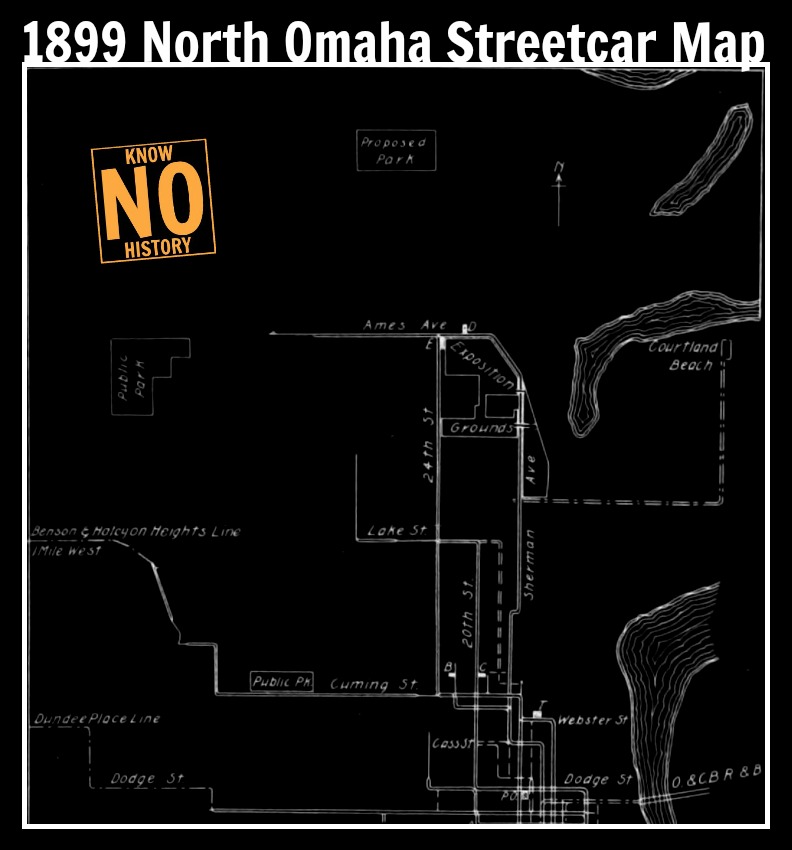
When the Trans-Mississippi Exposition happened in North Omaha in 1898, the city wanted to make sure all visitors knew how easy it was to get to the site. Using some promotional materials from that time, I’ve written a history of streetcars in North Omaha in the 1890s.
This history surely changed a lot between then and 1955, when the last streetcars ran in the city. However, this account provides some details about what the lines looked like at their height in the city’s north end. Here is a history of streetcars in North Omaha.
Streetcars in North Omaha

In the 1890s, Omaha’s streetcar system was operated by private companies, with the majority of the lines owned by the Omaha Street Railway Company. The lines served Omaha, Dundee, Florence, Council Bluffs, and South Omaha, totaling 126.5 miles long with 445 cars and almost 600 employees. It cost $.5 to ride anywhere in Omaha. In the late 1880s, the city was home to the Omaha Motor Railway Company, the Omaha Horse Railway, the Omaha and Southwestern Railway Company, the Omaha Cable Company, and the Omaha Cable Tramway Company as well as the Omaha and South Omaha Street Railway Company. By the end of streetcar service in 1955, the Omaha-Council Bluffs Railway and Bridge Company owned all of the lines and cars and employed all the operators and mechanics.
In the 1890s, there were three competing companies serving North Omaha. One was the Omaha Horse Railway Company, a horse-power streetcar company; another was the Omaha Cable Trolley Company, a cable car company, and they were powered by a constantly moving cable under the trolley tracks like San Francisco. Then there was the Omaha Streetcar Company. Eventually, the smaller companies were bought out and they were all merged into one company.
Where Did They Go?

A.J. Hanscom and James G. Megeath were the city’s first boomers for streetcars. After donating the land for Hanscom Park in 1872, lots of people wanted to have a streetcar line that ran to it. It took a decade for that to happen though, and in 1882 Sunday service there started. Here’s a nice, short history of the city’s companies.
In North Omaha, the first streetcars operated in the Near North Omaha neighborhood. Their first spread northward was along North 16th and North 24th towards the fashionable Kountze Place neighborhood; soon afterwards they reached the Miller Park neighborhood along North 24th and North 30th.
North Omaha was so packed with streetcars that there were several maintenance barns in the community. The original one was at North 26th and Lake and was made for the horses that worked for the Omaha Horse Railway Company. There was an early barn at North 21st Avenue and Ames Avenue, and another at North 19th and Nicholas. Later there was another streetcar barn at North 22nd and Nicholas and a large one at North 24th and Ames. None of these structures stand today.

The streetcar schedules actually played a role in many North Omaha neighborhoods growing and transforming. As their schedules became more reliable and frequent, the fancy, exclusive neighborhoods along North 16th, Wirt Street, Sprague Street and north Florence Boulevard went from being upscale with mostly high-end single family residences towards mixing in multi-family buildings including duplexes, flats, and and apartment buildings. This happened throughout North Omaha.
The streetcars were vital to the health and well-being of the North Omaha community.

When the lines were taken out of North Omaha, the neighborhood began its decline. Since 1955, more than 60% of the multi-family units that were built in North Omaha have been demolished.
Many single-family suburban neighborhoods that eventually comprised North Omaha were also enabled to grow because of streetcars, including Minne Lusa, Miller Park, Benson, and Dundee.
North Omaha Streetcar Routes

In 1898, the streetcar lines throughout North Omaha looked like this:
Dodge and North 20th Street Line
- Route: From Lake south on 20th to Dodge, east on I lodge to 10th, south on 10th to Pacific.
Transferred at 10th and Pierce to Harney line going east:
- At 13th street going east to 13th line going south.
- At 13th street going west to Walnut Hill line going north or south.
- At 14th street going west to Sherman Avenue and South Omaha line going north or south.
- At 16th street going west to Park and 24th street line going north or south.
- At 20th and Dodge going south to Harney line south or west.
- At 20th and Dodge going north to Harney line west. At 20th and Cuming to Walnut Hill line west.
- At 20th and Cuming going north to Park and 24th street line west.
- At 20th and Lake streets to Lake street line going west.

Hanscom Park and North 24th Street Line
- Route: From Sprague south on 24th to Cuming, east on Cuming to 16th, south on 16th to Leavenworth, west on Leavenworth to 29th Ave, south on 29th Ave. to Hickory, east on Hickory to 29th, south on 29th to Dupont, west branch from 29th Ave. west on Pacific to 32nd. south on 32nd to Center.
Transferred at 24th and Cuming going south to Walnut Hill line going east or west:
- At 24th and Cuming, going north to Walnut Hill line going west
- At 20th and Cuming, going east to Dodge street line going south.
- At 16th and Dodge to the Dodge line going east.
- At 16th and Farnam to Farnam line going west.
- At Leavenworth and Park Avenue to Leavenworth line going west.
- At Pacific street going west or south.
- At 16th and Harney streets going north to Harney line going east or west.
- At 24th and Lake streets, going west on Lake street.
- At 24th and Ames Avenue on Ames Avenue going west.
- At 16th and Leavenworth going north to South Omaha and Sherman Avenue line going north or south.

The Sherman Avenue and South Omaha Line
- Route: From 36th east on Ames to Commercial, southeast on Commercial to Sherman Avenue, south on Sherman Avenue to Clark, west on Clark to 17th, south on 17th to Cass, east on Cass to 14th, south on 14th to Howard, west on Howard to 16th, south on 16th to Vinton, west on Vinton to 24th, south on 24th to South Omaha.
Transferred at 24th and Ames Avenue east to I and 24th street line going south.
- At Locust street to East Omaha line.
- At Dodge and 14th street to Dodge street line going east.
- At 14th and Harney streets to Harney line going east.
- At 24th and N streets to L street line going south.
- At 24th and N streets to Albright line going south.
- At 16th and Leavenworth to Park Avenue and 24th street line going west.

The Farnam and 41st Street Line
- Route: From William north on 10th to Farnam, west on Farnam to 41st.
Transferred at 16th street going east to Park Avenue and 24th street line going north or south.
- At 20th street going east to Harney line going north.
- At loth and Pierce to Harney line going north or east.
- Also to Dodge street line going north.
- At 13th street going east to Walnut Hill and south 13th Street line going south.
Walnut Hill and South 16th Street Line
- Route: From 45th southeast on Military Avenue to Hamilton, east on Hamilton to 40th, south on Win to Cuming, east on Cuming to 16th, south on 16th to Webster, east on Webster to 13th to B.
Transfers at 84th and Cuming going east to Park and 24th street line going north and east.
- At 18th and Dodge going south to Dodge street line going east At 13th and Farnam going north to Farnam street line going west.
- At 80th and Cuming going east to Dodge street line north and south.
- At 13th and Dodge going north to Dodge street Line going west.
- At 45th street to Benson line.
- At 84th and Cuming going west to Park and 34th street line going north.

Lake Street Line
- Route: From 80th west on Lake Street to 30th street, north on 30th to Bristol.
Transferred at 84th and Lake Hanscom Park line north or south.
- At 80th and Lake to Dodge street line going south.
- Route: From 45th northwest and west on Military Avenue to Benson.
Transferred to Walnut Hill line at 15th and Military Avenue.
Dundee Line
- Route: From Farnam north to Dodge, east on Dodge to 40th, north on 19th to California, west on California to 51st
Transferred to Farnam street line at list and Farnam.
East Omaha Line
- Route: From Sherman Avenue east on Locust to 29th street, Bast Omaha. Cortland Beach branch extends north from Locust on 13th street, East Omaha, to Cortland Beach.
Transferred to Sherman Avenue line at Locust and Sherman Avenue.
In the decade after the Trans-Mississippi Exposition, streetcar service was expanded greatly throughout North Omaha, connecting Florence to the city, drawing in Ames Avenue, Fort Street, and other commercial areas along N. 16th, N. 24th and N. 30th Streets. Walnut Hill, Benson, Dundee, and several western neighborhoods in North Omaha were also served for the first time.

North Omaha Streetcar Hubs

As streetcars grew and developed throughout North Omaha, an ecosystem began to evolve around their usage. Recently, government entities in Omaha began surveying these former “nodes,” the places where streetcars had the greatest influence over commercial development and residential growth patterns. Some of their findings included individual streets that were important to streetcars, particular intersections that benefited from streetcar usage and whole neighborhoods that were particularly boosted by streetcars.
According to the government study, specific neighborhoods that benefited from streetcars included:
- Kountze Place
- Long School
- Saratoga
- Prospect Hill
- Gifford Park
- Cathedral
- Orchard Hill
- Radial Hills
- Clairmont Heights
- Country Club
- Dundee
In North Omaha, the former cities of Florence and Benson also benefited greatly from streetcars, as well as the old town of East Omaha. Specific streets that were cited by the City of Omaha include:
- North 16th Street
- North 17th Street*
- North 24th Street
- North 30th Street
- North 33rd Street
- North 42nd Street
- North 45th Street
- Military Avenue
- Ames Avenue
- Locust Street
- Lake Street
- Cuming Street
- California Street
- Underwood Avenue
There were some intersections throughout the neighborhoods that were very benefitted from streetcar traffic. These intersections grew exponentially, booming with commercial life of all kinds. Most of them seemed to have certain staples, like grocery stores, pharmacies and bakeries. Others also had hardware stores, movie theaters, 5&10 stores and clothing stores. These businesses were intricately tied to the streetcars, and when they left the intersections with all these amenities often began to fail. Some of these streetcar hubs included…
- 24th and Lake
- 40th and Ames
- 40th and Hamilton
- 42nd and Grand
- 30th and Ames
- 24th and Fort
- 30th and Fort
- 30th and Redick
- 30th and Willit
- 24th and Ames
- 16th and Locust
- 20th and Lake
- 45th and Military
- 24th and Cuming
- 16th and Cuming
- 16th and Commercial
- 24th and Sprague
Streetcars Were Segregated

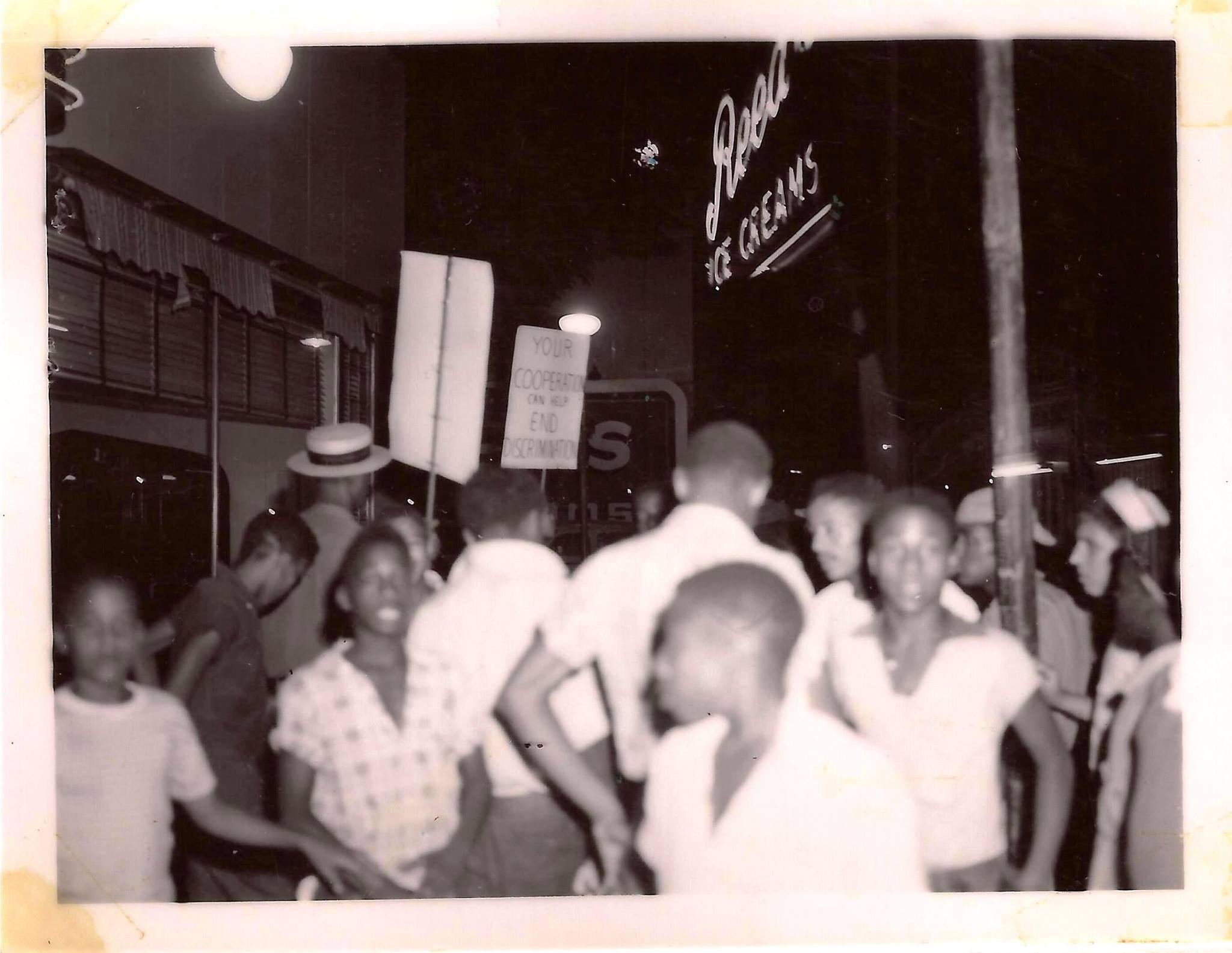
Not everyone loved North Omaha’s streetcars all the time. No people of color were allowed to be drivers for Omaha’s streetcars, and with Omaha’s segregated norms, African Americans were expected to sit away from white people while riding.
The Omaha-Council Bluffs Streetcar and Bridge Company was largely segregated through 1954. Hiring only white conductors, the African Americans who worked for the company and its predecessors were only allowed to work in the machine shop and as cleaners. This made the company an obvious target for civil rights protests.
Starting in the late 1940s they were the target of a general boycott called by the DePorres Club, a central group in Omaha’s civil rights movement. The group targeted the railroad for its segregation practices and poor service to the Near North Side neighborhood. African Americans were also segregated to sitting in the back of streetcars throughout the entire existence of the service.
There Were Labor Problems

There was a lot of labor strife between the streetcar company owners and the workers who ran the services and kept the cars running.
In 1935, a strike led to the shutdown of the city’s lines for more than a week. There were beatings, riots and a lot of violence associated with this particular strike. Other smaller strikes had happened, but this one caused a lot of change in the system.
Other Details

Florence Boulevard and the rest of North Omaha’s boulevard system was renowned for not having tracks, and as a result, people called the boulevard “the only suitable driveway in the city.”
There was a streetcar that ran throughout Omaha that only collected mail. The lines ran right to the back of the downtown post office, and the mail delivery was known to be rapid and effective. That didn’t last long though.
In 1899, after the Trans-Mississippi Exposition, many of the large streetcars that carried big numbers of people were taken out of service. Residents in North Omaha’s Walnut Hill suburb got so frustrated they took over several streetcars in the city to protest. The company responded by increasing the service to their neighborhood for a short time.
Omaha’s streetcars were built in Omaha, which was a rarity at the time.
Early advertisements for the Minne Lusa neighborhood, which was founded in 1914, flaunt the streetcar lines on North 24th and North 30th. The same advertisements for individual homes do not discuss detached garages, since they weren’t relevant for the streetcar commuter.
Public transportation routes in North Omaha started switching from electric streetcars to gas buses in 1952, and the last streetcar in Omaha ran in 1955. Since then, there’s been no form of light rail, trolleys, streetcars or otherwise in the city.
A few years ago, a major study concluded that modern streetcars are one of the best ways Omaha’s mass transit can develop in the years to come. Only time will tell if this actually happens though…

The End of Streetcars

In 1955, the last streetcar in Omaha was run in a ceremonial way. It was March 3 when city officials and other dignitaries rode around the city one last time. They had been surreptitiously removing streetcar lines throughout the community throughout the five years previous. Overwhelmingly influenced by the growing car culture after World War II, the City of Omaha decided to rip out the rails and expand the streets, making walking passé and ensuring car service and sales for nearly the next century. Overhead wires were ripped out, streetcar poles were removed and tracks were either covered with asphalt or removed entirely.
As of 2023, elders in the community who remembered riding the streetcars or working on them and for the streetcar company are still around, but they’re fading away quickly. There are rails popping out of the street at North 29th and Lake Streets, and a few other hints. But…
- The old streetcar barn that was at North 24th and Ames burned down in 1983;
- The streetcar barn that was Micklin Hardware at North 19th and Nicholas was demolished in 2019; and
- The streetcar barn owned by the City of Omaha at North 26th and Lake was demolished in 2019, despite having been included on the National Register of Historic Places. They did install the top frontispiece of the building mentioned as an homage to the location’s history after they wrecked the rest of the structure.
Little exists today to commemorate the legacy of streetcars in North Omaha. There is an effort afoot by the City to install one in the Midcity area, but it will be a light rail and doesn’t have universal support in Omaha. No placards or other commemorations exist otherwise throughout the community.
North Omaha Streetcar Tour

Want to drive or walk in North Omaha where streetcars and their passengers went? Here’s a tour of historical locations, including the streets, stations and other points along the way! In 1889, there were three kinds of cars that ran on rails in North Omaha: horse-drawn, electric, and cable cars. By 1926, there were only electric streetcars.
- Site of the Nicholas Street Carbarn built in 1889 by the Omaha Street Railway Company on the southeast corner of North 20th and Nicholas Streets. Demolished in 2019.
- North 22nd Street Carbarn belonging to the O&CBSR Co., southwest corner of North 22nd and Nicholas Streets
- Site of the Lake Street Carbarn built in 1887 by the Omaha Street Railway Company at (Florence Boulevard) North 20th and Lake Streets
- Site of the Nicholas Street Powerhouse belonging to the Omaha Motor Railway, northeast corner of North 23rd and Nicholas Streets
- Site of a Streetcar Barn built in 1887 by the Omaha Motor Railway at North 22nd and Ames Avenue.
- Site of the Streetcar War, North 30th and Ames Avenue. In 1889, 200 horsecar rail layers battled 100 electric car rail layers to see who would control this intersection.
- Site of the Omaha Horse Railway Stable built in 1867 by the Omaha Horse Railway Company at North 26th and Lake Streets, and the site of the 1905 O&CBSR Co Streetcar Barn until 2019. Today this is the site of the only streetcar commemoration monument in North Omaha.
- Site of King Street Omaha Streetcar Barn built in 1887. The newspaper had an announcement for “a street car barn 60×140 feet… at Lake and King Streets, adjoining the horse car company’s stables.” At that time, North 26th Street was called “King Street.”
- Site of the Ames Carbarn constructed in 1899 by the Omaha and Council Bluffs Street Railway Company, southeast corner of North 24th and Ames Avenue. Demolished after a fire in 1983.
- Site of the Cuming Street Carbarn, northeast corner of North 26th and Cuming Streets
You Might Like…
- A History of Streetcars in Benson
- A History of the 26th and Lake Streetcar Shop
- A History of North Omaha’s Belt Line Railway
- A History of Railroads in North Omaha
MY ARTICLES RELATED TO THE GOVERNMENT OF OMAHA
Streets | Schools | Parks | Public Housing | Police | Firefighters | Eppley Airfield | Streetcars | Public Library
RELATED: CCC Camp | North Freeway
MY ARTICLES ABOUT THE HISTORY OF STREETS IN NORTH OMAHA
STREETS: 16th Street | 24th Street | Cuming Street | Military Avenue | Saddle Creek Road | Florence Main Street
BOULEVARDS: Boulevards | Florence Boulevard | Fontenelle Boulevard
INTERSECTIONS: 42nd and Redman | 40th and Ames | 40th and Hamilton | 30th and Ames | 24th and Fort | 30th and Fort | 24th and Ames | 24th and Lake | 16th and Locust | 20th and Lake | 45th and Military | 24th and Pratt | 30th and Redick
STREETCARS: Streetcars | Streetcars in Benson | 26th and Lake Streetcar Barn | 19th and Nicholas Streetcar Barn | Omaha Horse Railway
BRIDGES: Locust Street Viaduct | Nicholas Street Viaduct | Mormon Bridge | Ames Avenue Bridge | Miller Park Bridges | East Omaha Bridge
OTHER: North Freeway | Sorenson Parkway | J.J. Pershing Drive | River Drive
Elsewhere Online
- Omaha Street Railway History – 1909 Newspaper Advertisements written by William H Hodge and collected by Joe Thompson. (THANKS JOE!)
BONUS PICS!


Leave a Reply