
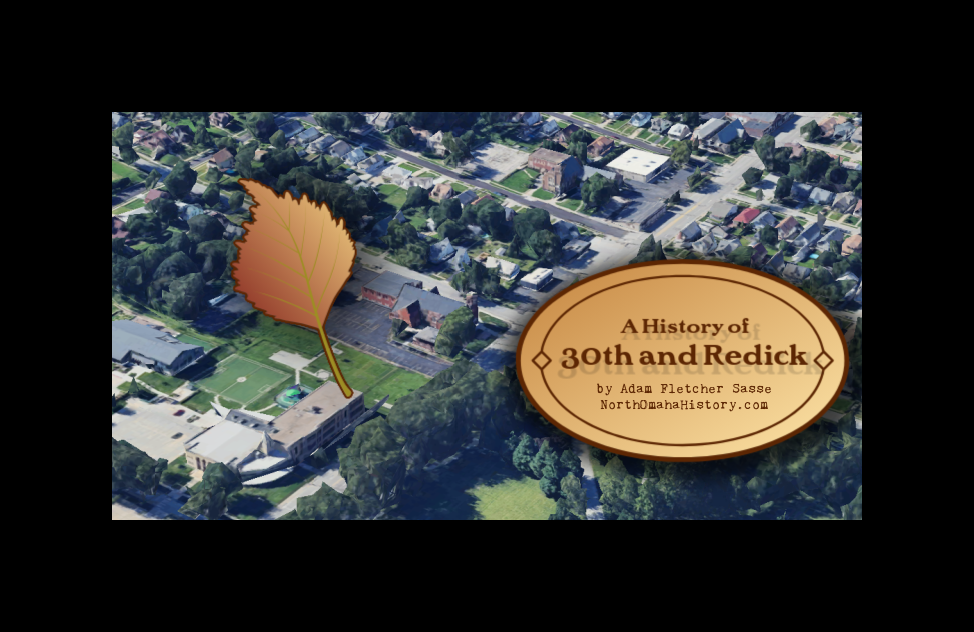
The area north of Miller Park began developing as suburban neighborhoods popping up along a streetcar line. It wasn’t until the 1910s that a real commercial hub was needed in the area. While there were successful intersections to the south and the Florence Main Street to the north, back then each neighborhood needed its own grocery stores and more because people didn’t travel far for their goods and services. Across a decade, churches, businesses, a fine park and more grew up here to meet the needs of this area. This is a history of the intersection at North 30th and Redick Avenue in North Omaha.
The Earliest Years

Long before there was a 30th and Redick, there were cornfields and farms covering the area surrounding the intersection. A single wealthy banker in Florence named Jim Parker (1824-1892) had amassed a fortune in the community, and with it he held more than 250 acres in the area. While his mansion sat on Vane Street west of N. 30th St., his farm spread below in the rolling hills going east that were dissected by a creek that was perfect for his cornfields. After Jim died, his son Fred started selling parcels of his land. Two of the Parker Estate parcels became a popular housing development that I explore below. But before that happened, one of them became a city park.
In my research, I found that “Redick Street” first shows up on a map made in 1886 (not Redick Avenue, but in the same place). It was most likely named for lawyer, politician, landowner, and judge John Redick (1826-1906), who was involved in many parts of pioneer Omaha and highly respected.
By 1892, Dr. George Miller (1830–1920) had already been buying up plots of land near Fort Omaha to sell to soldiers and officers working there. Unhappy with his slow sales, Dr. Miller bought a large swath of cornfields from the Parker Estate. Intent on making it a city park, he paid a park designer to lay out the site and started plowing roads and planting trees on his own. The land naturally undulated and had a creek flowing through the middle of it, and when he sold it to the City of Omaha he insisted the park bear his own name.
One of the first improvements related to the intersection was the construction of the Miller Park pavilion in 1908. This drew visitors to the park, where they enjoyed many of the amenities of the tree-lined roadways, walking paths, creek and more. An annual Ice Carnival and other events were held at the park from the 1920s through the 1950s.
In 1914, a streetcar line was laid along North 30th Street to Florence. This made the areas along the line look very attractive to real estate developers, and construction skyrocketed over the next 15 years. That was the real beginning of the intersection of 30th and Redick.
Miller Park, Minne Lusa & Florence Field

Built to serve the Minne Lusa, Florence Field, Belvedere and Miller Park neighborhoods, the intersection of North 30th and Redick quickly became essential for the surrounding region of North Omaha. Folks traveling north towards Florence on the streetcar needed to stop and get milk on the way home, others needed their cars fixed, and still others wanted to fill a prescription from their doctors. As all of these neighborhoods were built up and in-filled, one developer had a vision for a busy commercial intersection that would have all of those services and more.
The Miller Park neighborhood had few homes scattered throughout it in the 1880s. There was a large greenhouse on North 24th Street, and Florence Boulevard was graded for smooth wagon rides by then. Dr. Miller’s park was established in 1892 and his neighborhood continued to infill. In the first decade of the 1900s, the Belle Vista development in the Miller Park neighborhood, located between Hartman Avenue and Kansas Avenue from North 24th to North 27th Avenue, sold quickly and fine homes were built there. In 1904, the City of Omaha built the Chateau-style Miller Park pavilion, and the rest of the neighborhood began filling in after World War I.
Charles W. Martin started developing the Minne Lusa neighborhood in 1916. He laid out streets shooting east-west from a creek in the middle of the development along a boulevard with 600 lots for homes. That neighborhood sold so well that right after World War I in 1919, Martin bought more land to the north and platted another neighborhood called Florence Field. It had 1,000 lots and wrapped around Minne Lusa to the north and west including Martin Avenue and the Fontenelle Boulevard.

Martin was familiar with the older neighborhoods surrounding his developments, including the Miller Park neighborhood the south, Belvedere to the west and southwest, and Florence Boulevard to the east. There were some commercial developments to the south (30th and Fort along with 24th and Fort), but the new neighborhoods needed their own services. The intersection of N. 30th and Redick Avenue began developing soon after.
In 1923, the Omaha Police Department began a new program to install “pillbox stations” in neighborhoods around Omaha, with the first one located at 30th and Redick. The newspaper reported, “With this plan in operation any house in the city can be reached from one to five minutes time after the call is received at central station.”
By the mid-1920s the entire region including Minne Lusa, Miller Park, much of Florence Field and Belvedere, and the Prettiest Mile in Omaha (aka Florence Boulevard) was developed with fine working- and middle-class homes along tree-lined streets with electric lampposts, curbs and asphalt streets with smooth sidewalks throughout. Neighborhood schools were opened in Miller Park and Minne Lusa, churches developed surrounding the neighborhoods and everything took off.

This area was a leafy suburban wonderland. In this era, there was a movie theater, stores, churches, a major park, a private social club and many, many other amenities that were requirements for modern developments of that era. An exclusive enclave for white people only, many of the residents surrounding 30th and Redick moved north from the Near North Side and the Long School neighborhood into the area during the first wave of white flight after the lynching of Will Brown.
When they opened, some of the churches ended their European language services, while many of the residents clung to ethnic affiliations. Fraternal organizations and social clubs drew together businessmen from the neighborhoods around and the ties to the area became strong. One of the most popular institutions was the Prettiest Mile Club, later called the Birchwood Club and today with another name.
Historic Churches at the Intersection
One of the binding forces of the intersection of 30th and Redick were the churches. In just seven years between 1919 and 1926, five churches sprung up around 30th and Redick, with the massive buildings they constructed housing Trinity Lutheran, Miller Park Presbyterian, Parkside Baptist, St. John’s Episcopal and Blessed Sacrament Catholic churches. Following are overviews of each of those congregations.
Trinity Lutheran Church

Trinity Lutheran Church was established in 1915 as an outreach in the Saratoga neighborhood. However, moved by the rapid growth of the neighborhoods near Miller Park, the congregation set their sights on developing further at 30th and Redick. In 1921, they broke ground on a massive new church designed by architect Harvey C. Peterson (1898-1984) and completed it quickly. With a large sanctuary, the church could seat 250 congregants and included classrooms, a fellowship hall, a basement gymnasium and more. It continues today.
Parkside Baptist Church

Starting in October 1920, the Omaha Baptist Union held services in the city’s so-called “chapel car” at 30th and Newport. In 1923, popular Omaha architect John McDonald designed a new church and it was built that year. Parkside has served the neighborhoods around the area since, and was named in honor of its proximity to the Miller Park. The church has had worship services, Bible studies, choir and other church activities since its establishment, as well as sports teams, scouts and other community activities since it was founded. In 1961, a new sanctuary was dedicated after a decade of steady growth. Parkside closed and today the building is home to the Nazarene Karen Baptist Church. For more details read my article, “A History of Parkside Baptist Church.”
Miller Park Presbyterian Church

Built in 1923, the Miller Park Presbyterian Church closed in 2006. For more than 75 years, the church was home to a congregation of members from the surrounding area. Conversations about its closure began in 1997, and finally happened nine years later. After sitting empty for a few years, the original organ was removed from the building. In 2009, the World Fellowship Christian Center opened there, and in 2024 it is home to the Jehovah Shammah Church International Headquarters.
Episcopal Church of the Resurrection

A segregated Black Episcopal mission was started in Omaha in 1877, and in 1882 a official congregation was established. In 1891, it was named St. Phillip the Deacon Episcopal Church. Their longtime building was constructed in 1892, and the church stayed there until 1949 when the congregation opened a new church at 2532 Binney Street. Established in 1887 at North 26th and Franklin, St. John’s Episcopal Church moved to the Miller Park area at North 25th and Browne Avenue. In 1926, its new permanent structure opened at North 30th and Belvedere Boulevard. In 1986, St. Philip’s and St. John’s merged congregations to create an intentionally integrated church. Meeting in Saint John’s building, they formed the Episcopal Church of the Resurrection at North 30th and Belvedere Boulevard and continue today.
Blessed Sacrament Catholic Church

The Church of the Blessed Sacrament was opened in 1919 at 6304 North 30th Street, south of Redick, on the corner of Curtis Avenue. In 1952, they replaced their original structure with a new $280,000 building. John Latenser and Sons were the architects, and Jacob Maag (1881-1980), a Swiss-born and Italian-trained carver who lived in North Omaha, was responsible for some of the interior on the new church. The parish merged with Florence’s St. Phillip Neri in 2014, and that year the local archdiocese sold the church and school to the Lozier Foundation, and it was converted into Nelson Mandela Elementary School, a private school, which continues operating as of 2024. The original convent for the parish, located south of the school, still stands today and has been home to the Lutheran Service Corps since 1992.
Historic Businesses at the Intersection
Beginning with the development of the Minne Lusa neighborhood, businesses lined the northwest corner of North 30th from Redick Avenue to Newport Avenue. Gas stations, grocery stores, a drug store and a half-dozen other businesses went northward, broken only by a church facing Newport, then continuing in the strip where the Minne Lusa Theater is located. Several of these historic buildings still stand today.
Sinclair Gas Station

In 1923, the Sinclair Refining Company excitedly announced the opening of its second gas station in Omaha. Located on the northwest corner of 30th and Redick, on its opening day in April the station gave away souvenir Kewpie Dolls, a carnation “for each lady customer” and an Eveready Flashlight “free of charge to each customer purchasing a $10.00 coupon book.” Owned by Wilbur and then Ralph, this location was a gas station through the 1970s. Then in 1976 the station was replaced by Taco Grande, a small Mexican food chain restaurant. By 1983, it was closed and soon after a local restaurant called Romona’s Mexican moved into the space. After more than two decades at 30th and Redick, Ramona’s moved north on 30th Street into Florence. Today there is a real estate management and insurance business in the location at 30th and Redick.
White Rose Gas Station

Located on the southwest corner of 30th and Newport, there was a White Rose gas station opened on this corner in the late 1910s. After that building was burned down, a Family Dollar store opened on the same lot. By the 1950s, it was rebuilt and became a Phillips 66 station. It was called Clare and Bud’s 66 Station.
North Side Drugs

In 1916, the developer of Minne Lusa, Charles Martin, offered to develop the 5-storefront building located on the northwest corner of North 30th and Huntington Avenue. It wasn’t built until 1923. One of the first businesses to move in was North Side Drugs on the corner at 6602 North 30th Street. After that it became the Dall Drug Store. Leslie E. Dall operated his pharmacy at 30th and Huntington for more than 40 years, staying open from 1948 until at least 1987. Today this location is the location of the Four Aces Kwik Stop, a convenience store selling cigarettes, cigars, candy, chips, soda and more.
Safeway Grocery Store

In 1924, a Piggly Wiggly grocery store opened at 6604 North 30th. The store was “completely remodeled and modernized” in 1933 in the midst of the Great Depression. Safeway store opened in 1941. However, in just a few years the Safeway became a Save More Grocery Store. In 1945, the store became the Save More Hardware Store, and starting in 1947 it was called the Minne Lusa Hardware Store. A neighborhood icon, it was run by Bob Hawkins (1904-1978) and stayed open for more than 25 years. Four Aces Loan opened there in 1983, and has been operating in some form from the location since then. A pawn store, I went there to buy cassette tapes in the late 80s and early 90s, along with a bike, some speakers and other stuff.
7-11

The Manhattan Oil Company built a brick filling station on the southwest corner of 30th and Huntington in 1927, at 6524 North 30th Street. Originally Blohm’s Phillips 66 Station, Thompson’s Phillips 66 owned the station for decades. A modern 7-11 convenience store moved into the corner in the 1980s. When we were young teens, my friends Joe, Tracy and I stayed out past midnight and played the Street Fighter video game while we drank Slurpees here. The gas pumps at the store were removed in the 2000s, but the store stayed open there into the 2010s. Today there is a mobile phone sales store located on this spot.
Colfax Garage

Measuring 6,000 square feet, the Colfax Garage was built in 1917. Operating under that name until 1937, there was room for 37 cars and offices. From 1950 to 1969, a Hinky Dinky grocery store was located in this building. When I was a teenager in the 1980s and 90s, a small ice cream store was located in the building toward the back of the lot. Today, the site of this building is part of the parking lot for the neighboring Family Dollar store, which originally opened there in 1993. In 1996, a fire destroyed the store and killed an Omaha Fire Department captain who came to fight the fire. The company rebuilt, and today the Family Dollar continues operating at the intersection.
Other Stores
The other storefronts in this 5-store building included the Minne Lusa Shoe Store owned by Joe Salanitro (1890-1947), a cafe, and the Minne Lusa Card Store at 6610 North 30th Street. The Minne Lusa Barber Shop was also there, along with a Hinky Dinky grocery store and Margie’s Pet Shop. Dall’s Party and Card Shop was also in the strip.
Miller Park YMCA

A campaign to launch the Miller Park YMCA was started in 1946, and in 1956 a new facility was dedicated at 6330 North 30th Street, south of Redick in between Trinity Lutheran and Blessed Sacrament Catholic. The facility was lauded by the community for decades as an affordable, exciting place to belong. However, by the late 1980s it was largely viewed as outdated and increasingly irrelevant. In 1994 it was permanently closed when the Butler-Gast YMCA opened on Ames Avenue, three miles away. The building became a childcare center and after it was closed, it was demolished in 2015. Today the lot is part of the Mandela Elementary School property.
The Apex of the Intersection

The pinnacle of the intersection coincided with the neighborhoods it served. After World War II finished white veterans were encouraged to buy homes in the area, and in the decade after 1945, each of the neighborhoods around 30th and Redick completed their in-filling processes. Elementary schools in the area—including Miller Park, Minne Lusa, Belvedere, Florence, and the private Blessed Sacrament—were packed to the gills by 1955. In 1958, Omaha Public Schools opened the area’s first junior high a mile from the intersection. Omaha North High enjoyed strong community support from this area since its opening in the 1920s, and the private Notre Dame High School continued thriving in nearby Florence.

The original span of the Mormon Bridge opened in 1952, bringing a boon to commercial activity in North Omaha and affecting this neighborhood directly. Two years later in 1954, a new swimming pool was built in Miller Park, and a private pool was opened at the Miller Park YMCA in 1956. After the streetcars stopped running along North 30th in 1955 they were replaced by buses, and shoppers kept traversing through 30th and Redick on their way north new a new shopping area at 30th and Weber, as well as the busy intersection of 30th and Ames and west to the new Ames Plaza. North Omaha seemingly had everything needed to thrive.

However, the community was changing. The Omaha Civil Rights movement made major gains in the early 1960s, and it was around that time block-busting began about a mile south of 30th and Redick. With that cynical effort by real estate agents, African American residents started moving into the Saratoga and Miller Park neighborhoods. Black students began attending Miller Park School, and Black youth from the region south of the intersection tried attending the Miller Park Pool. At first rebuffed by white supremacists, by 1963 (and under police supervision) Black swimmers were allowed into the swimming pool. In 1964, the private High Point Pool was opened a mile away from 30th and Redick, and the exclusive Birchwood Club pool became a very popular place for upper middle class white families in the area. Racial segregation carried into the Hayden House, an upperclass restaurant at the Birchwood Club, and several other businesses and institutions throughout the area.
By the 1980s the Miller Park neighborhood was integrating quickly, and white flight had begun in earnest. In the 1990s the same thing happened in the Minne Lusa and Florence Field neighborhoods as well. The small saltbox homes in the latter neighborhood were out of favor with Omaha’s white middle class aspirations, and between that and simply not wanting to live by African American people, many white residents left the area.
30th and Redick Today

SInce the 1990s, the area around 30th and Redick has changed dramatically from its beginnings. Private investment in the businesses once lining 30th Street north of Redick has almost come to a standstill, with the Minne Lusa Theater and its neighboring storefronts long closed, and the Four Aces building locked up by that enterprise for decades. There are no gas stations left at the intersection and all of the restaurants have moved out. The Family Dollar brings in the most traffic, and almost all of the churches’ original congregations have closed and new ones are located there.
Today, there a few historic vestiges left at the intersection though. In 2013, the Minne Lusa Historic District was listed on the National Register of Historic Places for its remarkable collection of Craftsman-style homes, including more than 700 houses. The five church buildings surrounding the intersection are all a century old now, and they are in good condition. Mandela Elementary School is seen as a net benefit to the intersection, especially with the millions of dollars invested into it by private donors and philanthropists.
In 2019, a part of Miller Park was named in memory of Kerrie Orozco, a police officer who was killed in the line of duty nearby in 2015. Since then, the park has been continuously cared for by the City of Omaha with a new splash pad and renovations to the golf course. In 2022, the Lozier Foundation funded several improvements to the park including an amphitheater, walking trail, dog park and more.
Throughout the last decade, the Miller Park/Minne Lusa Neighborhood Association has provided an increasingly important community organizing space for residents to raise concerns and get responses from the City. For decades, the Florence Days Parade has started at this intersection and continues providing a point of community pride. The North Omaha Summer Arts Crawl has been happening for almost a decade now, and has frequently involved the churches and other facilities around the intersection.
Maybe in the future private investors and the City of Omaha will recognize the value of historic intersections like 30th and Redick, and work to recognize and preserve their well-being. The businesses, churches, park and other assets here foster community belonging like few places and deserve protection, too. Hopefully sharing this history is will help raise awareness. Will you share it with your friends and family?
Please tell me your memories and knowledge about the intersection of 30th and Redick in the comments section!
You Might Like…
MY ARTICLES ABOUT THE HISTORY OF STREETS IN NORTH OMAHA
STREETS: 16th Street | 24th Street | Cuming Street | Military Avenue | Saddle Creek Road | Florence Main Street
BOULEVARDS: Boulevards | Florence Boulevard | Fontenelle Boulevard
INTERSECTIONS: 42nd and Redman | 40th and Ames | 40th and Hamilton | 30th and Ames | 24th and Fort | 30th and Fort | 24th and Ames | 24th and Lake | 16th and Locust | 20th and Lake | 45th and Military | 24th and Pratt | 30th and Redick
STREETCARS: Streetcars | Streetcars in Benson | 26th and Lake Streetcar Barn | 19th and Nicholas Streetcar Barn | Omaha Horse Railway
BRIDGES: Locust Street Viaduct | Nicholas Street Viaduct | Mormon Bridge | Ames Avenue Bridge | Miller Park Bridges | East Omaha Bridge
OTHER: North Freeway | Sorenson Parkway | J.J. Pershing Drive | River Drive
MY ARTICLES ABOUT THE MILLER PARK NEIGHBORHOOD: Miller Park | Miller Park Duplexes | 30th and Fort | 24th and Fort | Fort Street Grocery Store | 5901 North 30th Street | Pearl Memorial United Methodist Church | Mr. C’s | Fort Street Special School for Incorrigible Boys | Fort Omaha School | Fort Omaha | Fort Omaha Balloon School |
Related: 24th Street | Florence Boulevard | 30th and Redick
Adam’s Note: This is the neighborhood where I grew up in the 1980s and 90s. Decades later, I’m still fascinated by it. Have info I should know? Email info@northomahahistory.com.
BONUS


Leave a Reply