
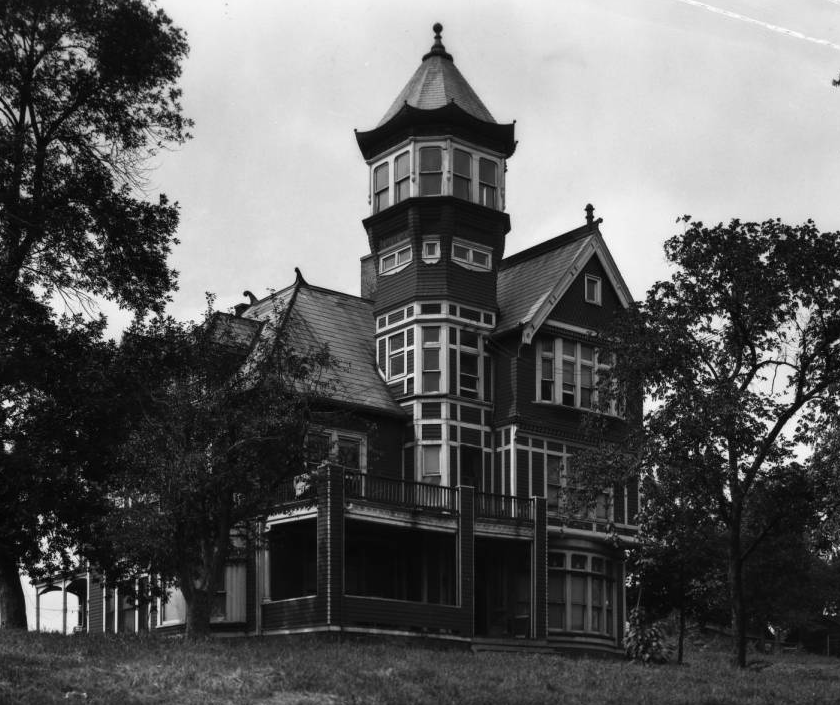
- Built: est. 1875
- Address: 958 North 27th Street
- Architecture: Stick Style
- Demolished: 1953
Many of early Omaha’s wealthy builders built their mansions and estates in North Omaha. One of them was attorney Dexter L. Thomas (1841-1919). His large house at N. 27th Avenue and Nicholas Street was a landmark for years, surely inspiring his contemporaries to use his home as the bar for their own and watching attentively as Omaha rose from the pioneer western frontier to become an urban oasis in the prairies of discontent. This is a history of the Thomas Mansion.
The Life of Mr. Dexter L. Thomas

In the 1860s, word was spreading across the Eastern United States that Omaha was a boom town. Within two decades of its founding in 1854, money and settlers poured in from New York, Ohio and Virginia. In 1870, a young businessman named Dexter L. Thomas arrived from Indiana determined to make his stake and build his fortune in the young Omaha City.
Thomas began his life in Indiana, and as a young man served during the Civil War from 1862 to 1865. He began in the US Army as a private and left as a captain. After going to Hiram College for three years, he taught high school in Indiana and worked for a county government in Iowa. Between 1869 and 1870, he went to the University of Michigan Law School, and when he graduated he moved to Omaha.
Before and while he was in law school, Thomas made a significant amount of money running a store in Michigan. After marrying Frances I. Jefferies, the couple moved to Omaha. Apparently, almost as soon as they arrived the Thomas Mansion was under construction. They had four children; Charles L., Hugh S., Clara Belle and Guy Dexter. Dexter’s son, Charles, became the news editor of the Omaha Bee.
Along with his work as an attorney, Thomas was an official of the Nebraska Savings Bank, which was open from 1887 through 1895, and he held a great deal of land around Omaha and beyond.
When Thomas died in 1919, he was buried at Forest Lawn.
Building a Dream Castle

In 1876, massive houses in Omaha were rare. First constructed that year, the house originally had eight rooms on two stories. In 1887, Thomas rebuilt the house and added a single story and a lot of space to make it three stories with a total of 20 rooms, as well as a tower that cost $4,000 to build. Constructed on one of the tallest hills in early Omaha, it was decorated in the latest Victorian-era furnishings and covered on the inside with highly polished hardwoods from around the world. The four-story tower had a glass-enclosed room at the top, with a 360′ view of the city, including downtown. An early newspaper reported it cost an estimated $30,000 to build, and that the surrounding area was “an exclusive residential section.”
By 1900, it was called the “Thomas Castle,” and was renowned for its extravagance, opulence and views. After Thomas moved out in 1901, the mansion became the Omaha Sanitarium.
A 1935 newspaper account said, “The house has three floors with magnificent woodwork, some oak, some birdseye maple, some rosewood. There are beautiful tiled fireplaces, too. On the third floor is a billard room with a mahogany ceiling… Sticking up on top of the house is a tower from which you can see 10 miles in every direction. To get there you ascend a circular staircase until you get dizzy.”
A House of Hope then a Hospital

In 1908, the extravagant mansion was sold to the former Methodist minister Rev. Charles W. Savidge. A notoriously busy pastor who started the Peoples’ Church, Rev. Savidge re-established the House of Hope at the Dexter Mansion. Thomas himself moved to 46th and Farnam Streets.
Writing to the Omaha Bee, Savidge wrote that,
It is a real fine house, finely furnished and well adapted for the purpose tor which we want to use it.
He bought the house for a reported $10,000. The newspaper said it had 20 rooms in 1911, when a plea was put out to the public for supplies for what was essentially a low-income senior retirement home. In 1916, the House of Hope moved their facility to Florence. After going on the auction block, the house became a private maternity hospital run by Swedes. In 1923, a jury in a court case estimated the house’s value at $5,000.
The Last Legs of an Old Mansion

The Thomas Mansion was bought for $3,000 by William Carter in 1927. Carter ran a boarding house there for several years, and then in the 1930s, ran it as a Prohibition-era night club. After years of speculation, there was a massive treasure hunt in the house in 1935. A professional gold hunter was hired by Carter to search the house, looking in every nook and cranny, crevice and closet to find any trace of Captain Thomas’ treasure. They didn’t find anything.
In 1943 the mansion was for sale again, this time advertised as “…arranged in 8 apartments with 3 baths, excellent new heating plant, stoker heat, price includes all furniture, ice box, a washing machine, etc. It is showing a high rental return.” In 1944, the Omaha World-Herald ran a featurette about the Thomas Castle, with a society woman proclaiming the home’s history with authority; she was off on a half-dozen facts though.
By the 1950s, the house was owned by Elmer Reeves, who ran it as an apartment house. In 1953, the house caught on fire and suffered more than $15,000 damage. The Reeves family was overwhelmed by the amount of generosity and kindness Omahans showed afterwards. Reeves decided the damage was too extensive, and had the house demolished.

Today, there’s no sign the Thomas Mansion ever existed.
You Might Also Like…
- A History of North Omaha’s Kellom Heights Neighborhood
- A History of the House of Hope
MY ARTICLES ON THE HISTORY OF ARCHITECTURE IN NORTH OMAHA
GENERAL: Architectural Gems | The Oldest House | The Oldest Places
PLACES: Mansions and Estates | Apartments | Churches | Public Housing | Houses | Commercial Buildings | Hotels | Victorian Houses
PEOPLE: ‘Cap’ Clarence Wigington | Everett S. Dodds | Jacob Maag | George F. Shepard | John F. Bloom
HISTORIC HOUSES: Mergen House | Hoyer House | North Omaha’s Sod House | James C. Mitchell House | Charles Storz House | George F. Shepard House | 2902 N. 25th St. | 6327 Florence Blvd. | 1618 Emmet St. | John E. Reagan House
PUBLIC HOUSING: Logan Fontenelle | Spencer Street | Hilltop | Pleasantview | Myott Park aka Wintergreen
NORMAL HOUSES: 3155 Meredith Ave. | 5815 Florence Blvd. | 2936 N. 24th St. | 6711 N. 31st Ave. | 3210 N. 21st St. | 4517 Browne St. | 5833 Florence Blvd. | 1922 Wirt St. | 3467 N. 42nd St. | 5504 Kansas Ave. | Lost Blue Windows House | House of Tomorrow | 2003 Pinkney Street
HISTORIC APARTMENTS: Historic Apartments | Ernie Chambers Court, aka Strehlow Terrace | The Sherman Apartments | Logan Fontenelle Housing Projects | Spencer Street Projects | Hilltop Projects | Pleasantview Projects | Memmen Apartments | The Sherman | The Climmie | University Apartments | Campion House
MANSIONS & ESTATES: Hillcrest Mansion | Burkenroad House aka Broadview Hotel aka Trimble Castle | McCreary Mansion | Parker Estate | J. J. Brown Mansion | Poppleton Estate | Rome Miller Mansion | Redick Mansion | Thomas Mansion | John E. Reagan House | Brandeis Country Home | Bailey Residence | Lantry – Thompson Mansion | McLain Mansion | Stroud Mansion | Anna Wilson’s Mansion | Zabriskie Mansion | The Governor’s Estate | Count Creighton House | John P. Bay House | Mercer Mansion | Hunt Mansion | Latenser Round House and the Bellweather Mansion
COMMERCIAL BUILDINGS: 4426 Florence Blvd. | 2410 Lake St. | 26th and Lake Streetcar Shop | 1324 N. 24th St. | 2936 N. 24th St. | 5901 N. 30th St. | 4402 Florence Blvd. | 4225 Florence Blvd. | 3702 N. 16th St. | House of Hope | Drive-In Restaurants
RELATED: Redlining | Neighborhoods | Streets | Streetcars | Churches | Schools



Leave a Reply