

There have been many notable structures in North Omaha throughout the decades. Many were built in the early 20th century as fine apartment buildings with beautiful woodwork and unique features. Some of the greatest losses of these structures were on North 16th Street, and this is the story of one of those. This is a history of the former Ivy Apartments aka The Fairfax in North Omaha.
Fine Living in North Omaha


These were structures along North 16th that would have been used by residents of The Ivy Apartments during its existence from 1910-1985.
Between 1890 and 1920, there were a lot of important buildings constructed on Sherman Avenue. A country road for a long time, North 16th Street was lined with large estates and fine homes from the 1860s through the 1890s. In 1898, the Trans-Mississippi and International Exposition was held on the street north of Locust Street. A grand Midway lined North 16th during the Expo, and when a streetcar was added to the street to serve the event a lot of people moved into the area and businesses opened up. The region of the city from downtown Omaha to the rural Sherman neighborhood boomed and everything changed.
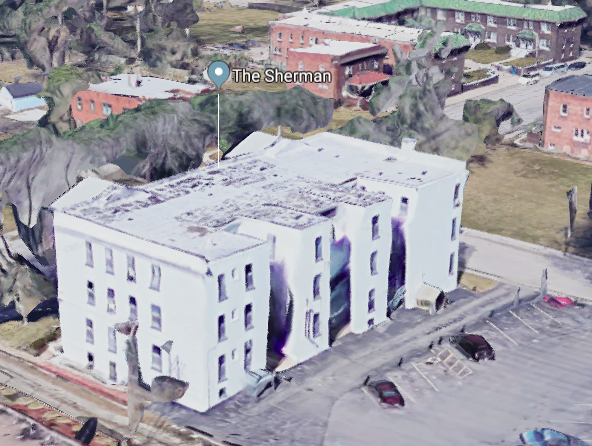
For 20 years after the turn of the century, North 16th Street infilled with homes, commercial structures, and apartment buildings. In that era, apartments on the strip were finely crafted structures that were meant to be as nice as any house and with all the amenities. Fine buildings that still stand in 2026 include the seven buildings at Ernie Chambers Court, which started construction the same year as The Ivy, The Sherman, as well as The Margaret and several others. There were also fine multi-family buildings in the area like the Climmie.
The original residents of The Ivy were middle- and upper-middle class white people, including middle managers from local businesses, political and social operators, and others who didn’t want to own a house but still wanted fine living. Along with the streetcar, their neighborhood was filled with grocery stores, restaurants and bars, boutiques for clothing and shoes, pharmacies, and up the street, movie theaters including The Corby and The Grand.
Built in Style

Built at stood at 2407 N. 16th Street, The Ivy was on the southeast corner of N. 16th and Sherwood Avenue. A four-story building, there were originally 10 units in the structure. There were several signature luxury features including sunrooms in distinctive three-story, glass-enclosed “bump-outs” on the corner of the building. There was decorative brickwork in the parapet and cornice along the roofline with “sawtooth” brick patterns above the third-story windows. The main doorway into the building featured an arched entryway with the stone or concrete surround and the two decorative spheres on top.
Filling up six months before it opened for occupancy in March 1910, The Ivy was originally advertised as having “3 and 4 rooms, finished in oak.” In addition to coming with heat and janitor service, an early ad said the building included “year around hot and cold water, gas range, shades, curtain rods. The wood work is oak, polished floors, tile bath rooms, built in buffet in dining room, walls are decorated” with a separate porch for each apartment, and included a store room and laundry room in the basement. There were “no inside rooms, plenty of light and air,” and the original monthly rent was $30.
The structure was an investment property from the jump, and according to newspaper reports swapped hands almost a half-dozen times in the first decade of its existence. This culminated in 1920, when an absentee owner in Sioux City failed to pay the water bill resulting in the distinguished renters losing water for several days at a time more than three times in one month.
Life along North 16th Street kept buzzing along. Kids living in the building went to Lake School just a few blocks away, and the nearest hospital was the Swedish Mission at N. 24th and Pratt. Shopping at 16th and Locust was popular, and many people went downtown for services too. There were college students in some families, including those attending Creighton or the nearby University of Omaha, as well as the Omaha Presbyterian Theological Seminary. They might have vacationed at the Omaha Rod and Gun Club on Carter Lake, or strolled around the Kountze Park not far away.
A Changing Neighborhood

However, starting in 1919 the neighborhood began changing, at first subtly, in a phenomenon called “white flight.” Real estate agents started steering wealthier white people to areas in what was then called “west Omaha” past 42nd Street, and Eastern European immigrants started filling blocks by The Ivy. Expanding their campaign to include the immediate neighborhood, in the 1920s they started fearmongering and blockbusting. In 1924, a new owner renamed the building as the Fairfax Apartments.
By the 1940s this campaign became explicitly racist and was storming the entirety of North Omaha south of Miami Street, including The Fairfax. African Americans were strategically moved into surrounding apartments in order to lower their values, then into the Fairfax Apartments. By then, the building was home to a lot of working class families including workers at the Storz Brewery, the Mother’s Best Flour mill, and the Tidy House plant, other industrial sites along 16th Street, and elsewhere in North Omaha.
By the late 1950s and early 1960s, businesses around the apartments were clearing out and storefronts were becoming abandoned. Houses were neglected by absentee landlords who refused to come to the neighborhood, and the City of Omaha began on an earnest campaign of benign neglect by letting street pavement crumble, burned out streetlights go unchanged, and neighborhood conditions deteriorate all the way around.
While I haven’t located direct evidence to prove it, I believe that it was during this time period that the Ivy / the Fairfax Apartments became available to African American renters.
When rioting afflicted North 16th from 1966 to 1969, it gave the City of Omaha and property owners along the way permission to wholly divest from the area. In 1975, the building was advertised for sale. They announced it had “newer gas heat,” 13 units, and was “one of the best buys in town.” Selling the community on claims of neighborhood rejuvenation and reclamation from absentee landlords, vacant houses, and other specters of oblivion, the City of Omaha targeted the Ivy for destruction as early as 1983. By that time the owner was calling it “The Ivy” again, but that didn’t stop the future from arriving. After a fire swept through the next year, the end was nigh, and in 1985 the building was condemned and demolished shortly afterwards.
Today, there are newer townhomes on the former site of the apartments. They have been there for almost 20 years now, and seem like a successful reuse of the land. Memories of the Ivy or the Fairfax Apartments are mostly gone now, and there are no signs or other physical symbols left of the building.
Maybe someday that will change.
You Might Like…
MY ARTICLES ON THE HISTORY OF ARCHITECTURE IN NORTH OMAHA
GENERAL: Architectural Gems | The Oldest House | The Oldest Places
PLACES: Mansions and Estates | Apartments | Churches | Public Housing | Houses | Commercial Buildings | Hotels | Victorian Houses
PEOPLE: ‘Cap’ Clarence Wigington | Everett S. Dodds | Jacob Maag | George F. Shepard | John F. Bloom
HISTORIC HOUSES: Mergen House | Hoyer House | North Omaha’s Sod House | James C. Mitchell House | Charles Storz House | George F. Shepard House | 2902 N. 25th St. | 6327 Florence Blvd. | 1618 Emmet St. | John E. Reagan House
PUBLIC HOUSING: Logan Fontenelle | Spencer Street | Hilltop | Pleasantview | Myott Park aka Wintergreen
NORMAL HOUSES: 3155 Meredith Ave. | 5815 Florence Blvd. | 2936 N. 24th St. | 6711 N. 31st Ave. | 3210 N. 21st St. | 4517 Browne St. | 5833 Florence Blvd. | 1922 Wirt St. | 3467 N. 42nd St. | 5504 Kansas Ave. | Lost Blue Windows House | House of Tomorrow | 2003 Pinkney Street
HISTORIC APARTMENTS: Historic Apartments | Ernie Chambers Court, aka Strehlow Terrace | The Sherman Apartments | Logan Fontenelle Housing Projects | Spencer Street Projects | Hilltop Projects | Pleasantview Projects | Memmen Apartments | The Sherman | The Climmie | University Apartments | Campion House | Ivy / Fairfax Apartments
MANSIONS & ESTATES: Hillcrest Mansion | Burkenroad House aka Broadview Hotel aka Trimble Castle | McCreary Mansion | Parker Estate | J. J. Brown Mansion | Poppleton Estate | Rome Miller Mansion | Redick Mansion | Thomas Mansion | John E. Reagan House | Brandeis Country Home | Bailey Residence | Lantry – Thompson Mansion | McLain Mansion | Stroud Mansion | Anna Wilson’s Mansion | Zabriskie Mansion | The Governor’s Estate | Count Creighton House | John P. Bay House | Mercer Mansion | Hunt Mansion | Latenser Round House and the Bellweather Mansion
COMMERCIAL BUILDINGS: 4426 Florence Blvd. | 2410 Lake St. | 26th and Lake Streetcar Shop | 1324 N. 24th St. | 2936 N. 24th St. | 5901 N. 30th St. | 4402 Florence Blvd. | 4225 Florence Blvd. | 3702 N. 16th St. | House of Hope | Drive-In Restaurants
PEOPLE: Clarence Wigington | John Latenser, Sr. | Joseph Guth | Jacob Maag | Everett S. Dodds |
RELATED: Redlining | Neighborhoods | Streets | Streetcars | Churches | Schools
Discover more from NorthOmahaHistory.com
Subscribe to get the latest posts sent to your email.

Great article on The Ivy building. By the time I moved in (1966-7), it was known as The Fairfax. I was a 23-year-old white kid–first-year grad student at Creighton. Rarely saw any other residents of the building. Never had any trouble. It was a good place to live.