
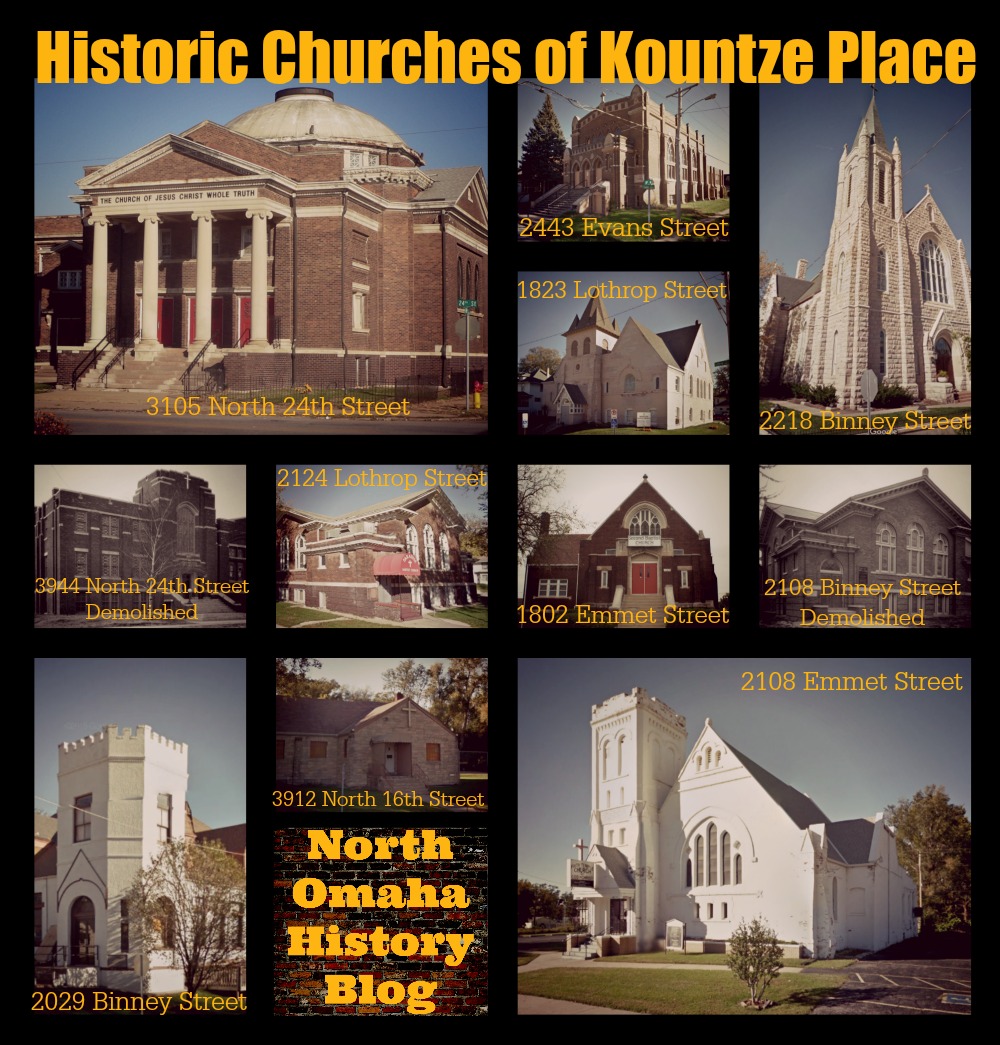
Most of the following churches still stand. Seemingly ignored by historic preservationists, the City of Omaha and Nebraska historians, they are testament to the changing nature of a specific neighborhood, a city’s economy, white supremacy and the role of religion. These are the historic churches of the Kountze Place neighborhood in North Omaha.
Going to Church in Fancyland

The churches of Kountze Place have existed since the 1880s when the subdivision was established. Built as Omaha’s first “streetcar suburb,” the neighborhood was developed with homes for high income and middle income families. Originally, there were no apartments and no working class people living in the neighborhood. African Americans were not allowed to live in the neighborhood.
Its from that position that between 1887 and 1903, the neighborhood’s developer Herman Kountze donated or sold cheap several lots for the oldest and most elaborate churches, because churches were a selling point for the early buyers. Kountze was involved in starting Trinity Methodist Episcopal Church, established in 1888; Immanuel Baptist Church, 1889; First United Presbyterian Church, 1890; First Universalist Church, 1894; and the last one before he died, Sacred Heart Catholic Church, 1903. Later, congregations built in the established neighborhood to secure a foothold with the wealthy residents. Those churches included North Presbyterian Church, 1910; North Side Christian Church, 1911; St. Paul Lutheran Church, 1913; Plymouth Congregational Church, 1914; and Church of the Brethren (Dunkard Society), 1915. Throughout the first 75 years of the neighborhood, there were union services, pulpit exchanges and several other neighborly activities that united the Christian laity who lived in the area.
Starting in the 1950s, the area became available to African American residents who were previously redlined from living there. This led to white flight, including for several of the congregations that simply moved away from Kountze Place. All of those congregations sold their buildings to Black churches, with several continuing in the neighborhood today. They include Calvin Memorial Presbyterian Church, 1954; Church of the Living God, 1955; Clair Memorial United Methodist Church, 1958; Corinth Baptist Church, 1958; St. Phillip the Deacon Episcopal Church, 1949; Faith Temple Church of God in Christ, 1961; Rising Star Baptist Church, 1954; Paradise Baptist Church, 1957; Primm Chapel African Methodist Episcopal Church, 1960; Second Baptist Church, 1981; St. John Missionary Baptist Church, 1974; and Greater St. Paul Church of God in Christ, 1956. In 1999, Mt. Vernon Baptist Church moved into the historic 1918 Grand Theater.
Other congregations have cycled through and the buildings are still active. Out of twelve historic church buildings in the neighborhood, one is currently empty, one is not a church and one was demolished after a fire.
The Churches of Kountze Place

Following are a dozen historic churches in Kountze Place. Only one is still open by the denomination that opened it, and that is Sacred Heart Catholic parish. The following aren’t in any particular order, but are numbered for convenient reference.
1. Calvin Memorial Presbyterian Church

Located at 3105 North 24th Street, this church was built in 1910 as North Presbyterian Church, a white-only congregation. Due to white flight, that congregation was racially integrated in the 1960s and the church was renamed Calvin Memorial Presbyterian Church. That congregation became an entirely Black church, and eventually merged with another congregation in another neighborhood. When they closed, the building became the Church of Jesus Christ Whole Truth. It moved in 2017, and as of 2023 it is empty. Read A History of Calvin Memorial Presbyterian Church.
2. Church of the Living God

Located at 2029 Binney Street, the Church of the Living God was built in 1888 as Trinity Methodist Episcopal Church, a white-only congregation. Due to white flight, Trinity moved to another neighborhood in the early 1950s, and the church building was sold to an African American congregation called Church of the Living God in 1955. It continues today, and as of 2023 it has been home to the second congregation longer than the first. Read A History of Trinity United Methodist Church.
3. Clair Memorial United Methodist Church

Located at 2443 Evans Street, this church was built in 1913 as St. Paul Lutheran Church, a white-only congregation. St. Paul sold it and moved to another neighborhood because of white flight. It became home to the Black congregation of Clair Memorial Methodist Church in 1958, which moved out in 1983. Home to the Good Tidings Evangelistic Church in the 1980s, as of 2023 the building is owned by Black and Pink, Inc., a prison abolitionist organization focused on LGBTQIA++ people. Read A History of St. Paul Lutheran Church.
4. Corinth Baptist Church

Located at 3499 North 24th Street, this church was built in 1889 as a white-only congregation called Immanuel Baptist Church, which moved to another neighborhood because of white flight in 1958. Corinth Baptist Church moved in soon after, but the building was demolished by fire in 1966. Corinth moved to other locations afterwards. Read A History of Immanuel Baptist Church.
5. Faith Mission Church

Located at 2532 Binney Street, this church was built in 1949 by St. Phillip the Deacon Episcopal Church, a historically Black congregation established in 1888. In 1986 that congregation merged with another to form an integrated congregation called the Church of the Resurrection, which continues in another neighborhood today. Corinth Baptist Church moved here next and closed when its founder died in 1995. Soon after, Faith Mission Church moved in and continues there as of 2023.
6. Faith Temple Church of God in Christ

Located at 2108 Emmet Street, this church was built in 1907 as a white-only congregation called the First United Presbyterian Church. That church closed permanently because of financial troubles in 1928, and soon after the building hosted another church. In 1961, the Black congregation of Faith Temple COGIC moved in, and as of 2023 it continues. Read A History of First United Presbyterian Church.
7. Rising Star Baptist Church

Located at 1823 Lothrop Street, this church was built in 1900 as the white-only First Universalist Church, then became the white-only Hartford Memorial United Evangelical Brethren Church. That congregation moved to another neighborhood because of white flight, renamed itself and later merged with another denomination. The original building became home to the Black congregation of Rising Star Baptist in 1957. It continues there as of 2023. Read A History of Rising Star Baptist Church.
8. Paradise Baptist Church

Located at 2124 Lothrop Street, this church was built as the whites-only North Side Christian Church in 1911. Because of white flight, it merged with a church in another neighborhood and the building was sold to the Black congregation of Paradise Baptist Church in 1957. It continues as of 2023.
9. Sacred Heart Catholic Church

Located at 2206 Binney Street, originally a white-only congregation, Sacred Heart Church was moved to the neighborhood in 1897 and was rebuilt in 1903. It continues as an integrated congregation as of 2023. Read A History of Sacred Heart Catholic Church.
10. St. John Missionary Baptist Church

Located at 3906 North 16th Street, St. John Missionary Baptist Church was built in 1917 as a private home. In 1950, the Salvation Army remodeled it into a chapel. St. John Missionary was established in 1962 and took over the building in 1974, and continues as of 2023.
11. Second Baptist Church

Located at 1802 Emmet, Second Baptist Church was built as the white-only Plymouth Congregational Church in 1914 after being founded in 1884. Plymouth was an original Kountze Place church. Racist white flight sent that church from the neighborhood and it was sold to to become the African American congregation of Primm Chapel AME Church in 1960, which closed in 1981. Second Baptist moved in. Second Baptist Church continues today. Read “A History of North Omaha’s Second Baptist Church.”
12. Greater St. Paul Church of God in Christ

Located at 2123 Miami Street, Greater St. Paul Church of God in Christ was built in 1915 by the white-only Church of the Brethren (Dunkard Society). After white flight began striking, the original congregation moved out and the Black congregation of Grove Memorial Methodist Episcopal Church moved into the building in 1927. That congregation was renamed Clair Memorial Methodist Episcopal Church and moved out in 1956. The Black congregation of Greater St. Paul COGIC moved in in 1962, have expanded the building significantly and continue as of 2023. Read “A History of the Greater St. Paul Church of God in Christ.”
Other Religious Organizations in Kountze Place
There were several other religion-affiliated organizations in Kountze Place.
13. Omaha Presbyterian Theological Seminary

Located at 3033 North 21st Street in 1902, the white-only Omaha Presbyterian Theological Seminary closed permanently because of financial concerns in 1943. It served as the Grace Bible College for less than a year, and then was converted to apartments. The building was demolished in 1979.
14. Salvation Army Booth Memorial Hospital

Opened in 1896 at 3704 North 24th Street, the Salvation Army Hospital moved away in 1920, then back to 2404 Pratt Street in 1938. It closed permanently in 1966 and was demolished in 1968. Read A History of the Salvation Army Booth Memorial Hospital.
15. Swedish Mission Hospital

Located at 3706 North 24th Street, the Swedish Mission Hospital was operated by the Swedish Evangelical Covenant Church and opened in 1908, changed its name in 1924, and closed permanently in 1938 because of financial concerns. Read A History of the Swedish Mission Hospital.
16. Omaha Presbyterian Hospital

Located at 1626 Wirt Street, the Omaha Presbyterian Hospital opened in 1890 and moved to a larger location south of downtown in 1893.
17. Wise Memorial Hospital

Located at 3208 N 16th Street, the Wise Memorial Hospital was opened by the Jewish community in North Omaha in 1901 and moved to a larger location in a different area in 1902.
Preserving the Religious History of Kountze Place
Kountze Place might be one of the most important clusters of historic religious buildings in Nebraska. Varying from being severely neglected to being outstandingly preserved, these churches and their historic congregations offer important perspectives about the role of religion in establishing Kountze Place, maintaining community identities and bonds, and the re-establishment of a neighborhood after the terror of white flight and the benign neglect of the Omaha City government.
Perhaps one day these churches will be recognized for their contributions by listing them as the Kountze Place Historic Churches on the National Register of Historic Places. Until then, it would be a tremendous thing for ALL Omahans to familiarize, patronize and support these congregations today.
Self-Guided Tour of Kountze Place Historic Churches
Note: There are more listings here than in the article because I broke them out a bit. Also, I’ve included the historic names as well as the current ones when applicable.
- North Presbyterian Church / Calvin Memorial Presbyterian Church / Church of Jesus Christ Whole Truth, 3105 North 24th Street (1910—Present)
- Trinity Methodist Episcopal Church / Church of the Living God, 2031 Binney Street (1888—Present)
- St. Paul Lutheran Church / Clair Memorial United Methodist Church / Good Tidings Evangelistic Church, 2443 Evans Street (1913—Present)
- Immanuel Baptist Church / Corinth Baptist Church, 3499 North 24th Street (1889—1966)
- St. Phillip the Deacon Episcopal Church / Faith Mission Church, 2532 Binney Street (1949—Present)
- First United Presbyterian Church / Faith Temple Church of God in Christ, 2108 Emmet Street (1890—Present)
- irst Universalist Church / Hartford Memorial United Brethren Church / Rising Star Baptist Church, 1823 Lothrop Street (1894—Present)
- North Side Christian Church / Paradise Baptist Church, 2124 Lothrop Street (1911—Present)
- Sacred Heart Catholic Church, 2206 Binney Street (1903—Present)
- Salvation Army North / St. John Missionary Baptist Church, 3912 North 16th Street (1917—Present)
- Plymouth Congregational Church / Primm Chapel African Methodist Episcopal Church / Second Baptist Church, 1802 Emmet Street (1914—Present)
- Church of the Brethren (Dunkard Society) / Clair Memorial United Methodist Church / Greater St. Paul Church of God in Christ, 2123 Miami Street (1915—Present)
- Omaha Presbyterian Theological Seminary, 3033 North 21st Street (1902—Present)
- Salvation Army Home for Unwed Mothers, 3704 North 24th Street (1920—1938)
- Swedish Mission Hospital / Covenant Hospital / Salvation Army Booth Memorial Hospital, 3706 North 24th Street (1908—1966)
- Omaha Presbyterian Hospital, 1622 Wirt Street (1889—1893)
- Wise Memorial Hospital, 3208 N 16th Street (1901—1902)
- Christ Child Center North / Catholic Charities, 2118 Emmet Street (1958-Present)
- Mt. Vernon Baptist Church (originally Grand Theater), 2920 North 16th Street (1918-Present)
- Heart Ministry Center, 2222 Binney Street (2005-Present)
You Might Like…
MY ARTICLES ABOUT THE HISTORY OF KOUNTZE PLACE
General: Kountze Place | Kountze Park | North 16th Street | North 24th Street | Florence Boulevard | Wirt Street | Emmet Street | Binney Street | 16th and Locust Historic District
Houses: Charles Storz House | Anna Wilson’s Mansion | McCreary Mansion | McLain Mansion | Redick Mansion | John E. Reagan House | George F. Shepard House | Burdick House | 3210 North 21st Street | 1922 Wirt Street | University Apartments
Churches: First UPC/Faith Temple COGIC | St. Paul Lutheran | Hartford Memorial UBC/Rising Star Baptist | Immanuel Baptist | Calvin Memorial Presbyterian | Trinity Methodist Episcopal | Mount Vernon Missionary Baptist | Greater St. Paul COGIC | Plymouth Congregational/Primm Chapel AME/Second Baptist | Paradise Baptist
Education: Omaha University | Presbyterian Theological Seminary | Lothrop Elementary School | Horace Mann Junior High | Omaha Presbyterian Theological Seminary
Hospitals: Salvation Army Hospital | Swedish Hospital | Kountze Place Hospital
Events: Trans-Mississippi and International Exposition | Greater America Exposition | Riots
Businesses: Hash House | 3006 Building | Grand Theater | 2936 North 24th Street | Corby Theater
Other: Kountze Place Golf Club
Listen to the North Omaha History Podcast show #4 about the history of the Kountze Place neighborhood »
MY ARTICLES ABOUT HISTORIC CHURCHES IN NORTH OMAHA
GENERAL: Directory | Black Churches | Florence Churches
METHODIST: 17th Street | Pearl Memorial UMC | St. John’s AME | Bethel AME | Cleaves Temple | Ames Avenue | Trinity | Walnut Hill | 18th Street |
BAPTIST: Mount Moriah | Zion | Immanuel | Second | Rising Star | Paradise | Parkside
CATHOLIC: Holy Family | St. Benedict the Moor | St. John’s | Holy Angels | Sacred Heart | St. Cecilia | St. Therese
PRESBYTERIAN: Calvin Memorial | Hillside | First United | Covenant | St. Paul
EPISCOPALIAN: St. Phillips |
COGIC: New Bethel | Faith | Greater St. Paul
LUTHERAN: Hope | St. Paul | Mount Olive
OTHERS: Mt. Calvary |
RELATED: St. Clare’s Monastery | Omaha Presbyterian Theological Seminary | North Omaha Catholic Schools | Black Churches | Florence Churches | Kountze Place Churches
MY ARTICLES ABOUT HISTORIC BLACK CHURCHES IN NORTH OMAHA
Main Article: Historic Black Churches in North Omaha
Churches: St. John’s AME | Mount Moriah Baptist | Hope Lutheran | Bethel AME | New Bethel COGIC | Zion Baptist Church | Rising Star Baptist | Faith Temple COGIC | Mt. Calvary Community | St. Benedict the Moor Catholic | North 24th Street Worship Center | Greater St. Paul COGIC | Second Baptist | Paradise
Former Churches: Calvin Memorial Presbyterian Church | Hillside Presbyterian Church | St. Philip the Deacon Episcopal Church | North Presbyterian | Church of the Brethren | Plymouth Congregational | North Side Christian

BONUS



Leave a Reply