
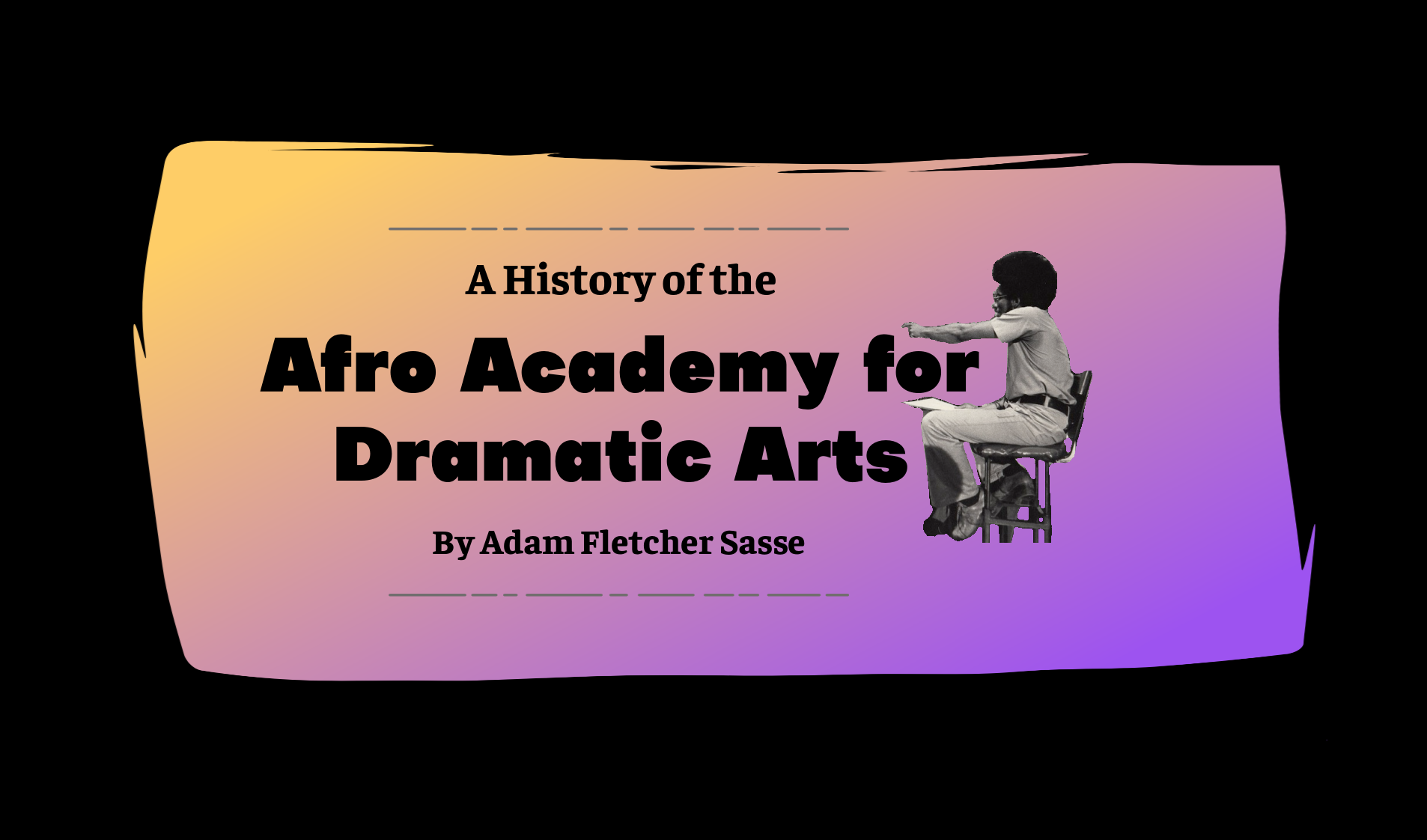
Black culture in Omaha has many curves, twists and bends, including a beautiful arc towards the theater. Actors, plays, musicals, directors, playwrights and more have emerged from the city, leaving a local and national impact felt everyday. This is the history of Nebraska’s first black theatre, the Afro Academy for Dramatic Arts.
Why in Omaha?

As early as the 1870s, Black people in Omaha were gathering to share the Arts. During the Harlem Renaissance in Omaha, African Americans saw the emergence of a distinct Black theater community in the city, and with the leadership of Flora Pinkston and others, it flourished throughout the era. The first African American film company ever was established in Omaha then, and the Arts community stayed strong in North Omaha through the 1950s.
However, with increasing unemployment in the early 1960s and white flight at its apex, Omaha’s Black creatives were languishing. Over the next decade, a group of young leaders emerged determined to revitalize it, including Darryl Eure and Harry Eure. Focused on fostering authentic Black identity and excellence in Black culture, with the support of their mother Eure, the brothers established the Afro Academy of Dramatic Arts in North Omaha.
According to an article by students with an Omaha Public Schools project, Harry Eure said,
“[We]… wanted to make a space where African Americans could create and perform stories that transcended the racial barriers of the time. It was also a place where African Americans could find entertainment that related to them, because at the time there were no movies or TV shows that could speak to African Americans on a personal level.”
From that background, the Afro Academy for Dramatic Arts was started.
The Beginning

Dorothy Watson Eure was born in 1927 and raised in North Omaha. While going to Tech High, she started a student activist group called Tomorrow’s World, one of the earliest examples I’ve found of youth-led activism in Omaha’s Civil Rights movement, which started in the 1870s. Later an activist with the DePorres Club and 4CL (Citizens Coordinating Committee for Civil Liberties), her social change work impacted her kids a great deal.
When he was in the military during WWII, Albert A. Eure, Sr. left New York and took recreation leave in North Omaha. Marrying local Dorothy Watson, the couple had four sons and raised their family in North Omaha. Albert was the son of a Harlem Cotton Club dancer, and along with her activism Dorothy was an aspiring actress whose father was a minister, and the couple met at North Omaha’s iconic Dreamland Ballroom. From that cloth, the family’s fabric of performance and dedication to the Arts was cut.

The Eure brothers were alumni of Show Wagon, a 50-year program sponsored by the City of Omaha Parks Department and the Omaha World-Herald. Using a portable stage across the city, the program “drew hundreds of participants and thousands of audience members” all summer long to shows in the parks. Featuring performers age 1 to 18, participants competed in annual competitions with prizes and more. As kids, Darryl and Harry acted, sang and tap danced on the Show Wagon. Longtime competitors, they won prizes four years out of five between 1961 and 1966. They mimed in 1966, winning this one with a performance of “Little Blue Riding Hood.”
Rev. Darryl C. Eure was born in 1950 in North Omaha. A student activist at Central High in the 1960s, he was involved in Civil Rights and anti-war protests when he was young. Born a year after his brother, Harry S. Eure was the first to perform for the public when he was in a production of A Raisin in the Sun at the Omaha Community Playhouse. It was 1961, and young Harry was just 11 years old.
In 1964, Harry and Darryl performed at the Kellom Youth Council talent show, directed by Beverly Blackburn. They performed a miming routine in the show. The brothers stayed active through the years including their high school careers. Harry performed at an Omaha Urban League Guild gathering in 1965. They were in other performances throughout the community, too.
Starting their performance careers as kids, a 1966 article in the Omaha Star said their first director was Beverly Blackburn, a longtime community educator and youth advocate in North Omaha. Their first education was with her at the Kellom Community Center. The newspaper said “They have performed on television and before civic, religious and social groups.” The paper also said Harry, who was 17, wanted to be a doctor or minister, and Darryl, 15, wanted to be an actor.
Given the downturn in the economy of the Near North Side neighborhood in the early 1960s, it was apparent to the Eure family that action had to be taken to build community pride. African Americans had been targeted by systematic divestment by the City of Omaha designed to stop the continued growth of Omaha’s Black population. Growing up near 24th and Lake, the Eure brothers witnessed the North Omaha riots starting in 1966. During those years, the brothers graduated from Central and left for college. In 1968, Darryl and Harry, along with their younger brother Tyrone, protested an appearance by George Wallace, a racist presidential candidate, when they were caught in the police brutality surrounding the event. The brothers became even more committed to making a positive change in the community.
Launching the Afro Academy of Dramatic Arts

It was 1968 when Darryl, Harry, and their mother Dorothy established the Afro Academy of Dramatic Arts. Dwight Beck and Howard Duncan were also credited as co-founders by the newspaper. A junior at UNO when it opened, Harry Eure told the Omaha World-Herald the theater would produce works that “will attack issues dividing Negroes and whites.” Darryl had just graduated from Central, Dwight was a sophmore at Creighton, and Howard was a former UNO student.
When it opened, Harry told the paper, “We’ll address ourselves to Omaha… We won’t do anything unless it can be related to Omaha.” In a vacant building on the southwest corner of 24th and Ames in the Saratoga neighborhood, in 1969 the academy converted a former storefront by installing 100 seats for its first production. At the same time, another Black-focused theater opened across the street at 2404 Ames, but only lasted a single season. Next door was a store called the Psychedelic Sounds Record Shop, and the corner was heralded for its creativity in the Omaha Star.
The first plays rehearsed were “Praise the Lord but Pass the Ammunition” by Yusef Iman; Arm Yourself or Harm Yourself” by LeRoi Jones, and; “Cracker Prayer” by Paul Lawrence Dunbar.
“Anyone who possesses a creative talent other than acting, such as creative writing, art techniques, stage design, musical abilities, Black-dance of expression and any other creative talent that will exemplify Black solidarity, understanding and creative expression, also come to the scheduled auditions this week.”
—Omaha Star, September 3, 1970
Their first production was delayed. However, by the start of their second season in September 1970, the academy had incorporated and reopened. Apparently they had fiscal problems that kept them from launching their first production again though. However, in November 1971 the World-Herald loudly broadcasted, “Play opening to end long struggle” and gladly pronounced the academy recieved a grant from the Nebraska Arts Foundation and support from United Methodist Community Services to pay rent.
In an announcement through the Star, the theater said “Anyone who possesses a creative talent other than acting, such as creative writing, art techniques, stage design, musical abilities, Black-dance of expression and any other creative talent that will exemplify Black solidarity, understanding and creative expression, also come to the scheduled auditions this week.”

They had to hold fundraisers to support the organization though. In November 1971, before their first production launched, the academy held a variety show at the Carter Lake Club Ballroom. There were a number of dance acts and musical performances including groups like The Affections and The Family Portrait.
Soon using space at the Wesley House Community Center, the group put on productions almost immediately. According to an outstanding feature on the Eure family by Leo Adam Biga for NOISE, “One of its first plays was an original by Darryl that equated Strong’s killing to Emmett Till’s murder.”

Focused on Black actors, writers, directors and other theatre performers, the Academy was committed to Black excellence, with consciousness and pride at the core of every activity.
Every theater program had the same statement on it: “All characters in this play are real and may relate to any real person, place or thing. Please understand the profound meaning that is sought by the use of profanity or bad-mouth. If you see something offensive in any or all of the characters portrayed on stage, i.e., their characterized attitudes, we challenge you — by your thoughts and actions — to change it and its true-to-life interpretations.” The reason for this statement was in the content of productions that were made.
Thriving In Spite…

In 1972, the theater produced “Day of Absence,” a social satire by Douglas Turner Ward. Over the years, other productions included works by Lorraine Hansbury, Douglas Turner Ward, Amiri Baraka (aka LeRoi Jones) and August Wilson. The brothers also created original works, and Dorothy created a children’s theater program. Some of the plays they performed were “Ceremonies in Dark Old Men,” “The Adventures of Rose Red,” and “A Raisin in the Sun.”
Early in 1972, they also premiered a poetry production featuring works by several African American poets, as well as plays by Ward and Ben Caldwell. Later that year, the academy started presenting productions in spaces around North Omaha, including Calvin Memorial Presbyterian Church and the Harriet Tubman Center on North 28th and Miami Streets. A newspaper review of “A Raisin in the Sun” that fall was generous, but described the space with a backhanded compliment: “The academy makes its tiny stage work to good advantage in this production. The cramped space is perfect for the dingy tenemanet setting of the action.”

In November 1972, the academy moving to the former Our Savior Lutheran Church, the present-day St. Matthew Missionary Baptist Church, at 1001 North 30th Street (30th and Izard), and continued into the early 1980s. Speaking openly about the white flight that led to the church being abandoned, a Lutheran minister said the congregation moved to 105th and Fort Streets but wanted the building “to be used in some way by the community.”
Biga’s report said many of Omaha’s premier Black artists taught at the academy over the years, including Preston Love Sr., Claudette Valentine and Oran Belgrade. Some of Omaha’s most important performers, including actor John Beasley and Adrienne Higgins, went through the academy on their ways to fame.

The academy moved to a former Lutheran church at 30th and Izard in 1973. Speaking openly about the white flight that led to the church being abandoned, a Lutheran minister said the congregation moved to 105th and Fort Streets but wanted the building “to be used in some way by the community.” Later that year, they produced a performance in honor of Malcolm X at the Woodson Center in South Omaha and collaborated to deliver programming at YMCA summer camps. That year, the World-Herald lumped the academy together with a group of other local performance houses, calling it “the midst of a live theater boom.” (Adam’s note: My own alma mater, the Magic Theater, was included along with the Westroads, Firehouse and Talk of the Town Dinner Theaters, the Bellevue Little Theater, and others.) They also sponsored a bus trip to Detroit to see a production of a play there.
When Beverly Blackburn Jones died in 1973, the academy hosted a Christmas variety show in her honor. It was headlined by Preston Love, Sr. and included singing groups, comedy, dancers, poetry, karate, and more. The Organization of Africans in Nebraska sponsored a dance and fashion show at the event, too.

In a first of its kind, in 1974 the academy hosted an exhibit called Art Without Walls featuring locally-made experimental art. They collaborated with many local organizations including UNO to host local Black History Week activities that year, too. Shortly after announcing this, the Omaha Star ran an article exploring the academy’s need for more space. Celebrating new activities by the academy, including African handcrafts, commercial printing, art classes and a visual gallery space, they sought a new building. There were also reports of collaborations with KOWH to promote Black culture on the radio, as well. Hosting a youth performance choir from Kansas City, presenting at an “ethnic expo” and summer camp, and presenting a few productions rounded out that season. They didn’t leave their building though.
Towards the End

In 1975, the organization landed a $10,000 grant from the Nebraska Arts Council for “Support of the Afro Academy of Dramatic Arts multidiscipline progress in drama, dance, music, literary creative writing, visual arts and oral and written history.” Cosponsoring an Omaha Playhouse Studio Theater production called “Lay My Burden Down,” an all-black musical with actors, singers, dancers and musicians choreographed by guest Quincy Edwards, a New York dancer. Charlotte Eure taught Junior Theater at the academy throughout the year, and there was a film festival planned.
That same year, the academy proposed a mural at 24th and Lake that would have included Rev. Dr. Martin Luther King, Jr., James Brown, Stevie Wonder, and Muhammed Ali, as well as Angela Davis. Funded with fiscal support from the Omaha-Douglas County Bicentennial Commission, they initially approved the design. However, a former mayor spoke out against the inclusion of Davis in the media, leading to the cancelation of the funding. The World-Herald published an op-ed against the decision the next week. A writer named J. Anthony Watkins called out the commission’s “thinly veiled racist political considerations” and “petty, simplistic and politically racist orientations.” He ended his letter powerfully, declaring “Certainly, alert persons in Omaha’s [B]lack community will not countenance this form of racist paternalism on the part of local white leadership, nor will they long celebrate hypocrisy and deceit.”
On July 4, 1975, the academy hosted a 5-mile jog-a-thon around Carter Lake, offering cash prizes and trophies to the top three runners. Inmates in the Nebraska State Prison were sponsored in an art show, too, Late in the season, a play by Charlotte Eure was premiered and noted poet Don L. Lee lectured and workshopped there, too.
Through these years, the brothers Harry and Darryl continued as co-directors of the academy. Along with them, their mother Dorothy produced shows and more.
An Unclosing
In January 1976, an announcement was printed that said the academy had closed. Harry was quoted saying the theater was closing “because of a lack of funds and a lack of support from the community… The theater had become too much of a financial hardship on me and on others who have been supporting the theater.” Poor ticket sales and cuts in federal and state grants damaged the group, too. A month later Harry and Darryl announced a reorganization. “If Black theater is to survive in Omaha, it’s the responsibility of the community to make it work… We need you.”
The newspaper referred to the academy as “closed” in 1977, and called it “the former Afro Academy of Dramatic Arts” in 1978. In 1983 though, it was referred to in an arts organization directory for the city, and in 1984 the academy received a grant from the Nebraska Arts Council.
Tyrone taught a theater class for kids at Pearl Memorial United Methodist Church in 1977, and Darryl has led a successful church since then. He has also appeared in historical reenactments as MLK and Malcolm X, among others.
Over the years, Harry and Tyrone have continued the Afro Academy’s mission. Harry is still active and active in North Omaha, struggling for Civil Rights and sharing the community’s history. He has testified to the Omaha City Council, and is regularly affiliated with the academy in the media and elsewhere. His history advocacy has continued over the decades, too. In 2003, he was a member of an advocacy group called the Committee for the Preservation of Historic North Omaha Sites, and today he continues promoting the community’s history.
Despite its successes and impacts in Omaha, today in 2025 there are no historical markers or other memorials to the Afro Academy of Dramatic Arts. Maybe in the future that will change.
You Might Like…
- A History of Music in North Omaha
- The Harlem Renaissance in North Omaha
- A History of Theatres and Movie Theaters in North Omaha
MY ARTICLES ABOUT BLACK HISTORY IN OMAHA
MAIN TOPICS: Before 1850 | Black Heritage Sites | Black Churches | Black Hotels | Segregated Hospitals | Segregated Schools | Black Businesses | Black Politics | Black Newspapers | Black Firefighters | Black Policeman | Black Women | Black Legislators | Black Firsts | Social Clubs | Military Service Members | Sports
EVENTS: Stone Soul Picnic | Native Omahans Day | Congress of Black and White Americans | Harlem Renaissance in North Omaha
RELATED: Enslavement in Nebraska | Underground Railroad in Nebraska | Racist Laws Before 1900 | Race and Racism | Civil Rights Movement | Police Brutality | Redlining
TIMELINES: Racism | Black Politics | Civil Rights | The Last 25 Years
RESOURCES: Book: #OmahaBlackHistory: African American People, Places and Events from the History of Omaha, Nebraska | Bibliography: Omaha Black History Bibliography | Video: “OmahaBlackHistory 1804 to 1930” | Podcast: “Celebrating Black History in Omaha”
Elsewhere Online
- Afro Academy for Dramatic Arts on Facebook
- “Black Legacy Families, Installment III: The Eures Making Arts and Activism the Family Business” by Leo Adam Biga in 2021.
- “African American Dramatic Arts” by Making Invisible Histories Visible for Omaha Public Schools in 2012.
- “Oral History Interview with Darryl Eure (April 23, 1982),” by Alonzo Smith for the Nebraska State Historical Society.
- “Oral History Interview with Dorothy Eure (April 23, 1982),” by Alonzo Smith for the Nebraska State Historical Society.
- “The Black Arts Movement in Omaha” from Engines of the Black Power Movement: Essays on the Influence of Civil Rights Actions, Arts, and Islam by James L. Conyers, Jr. (2006)
BONUS

This is a 2012 interview about Black theater in Omaha including the Afro Academy for Dramatic Arts by students from an OPS project.

Leave a Reply