
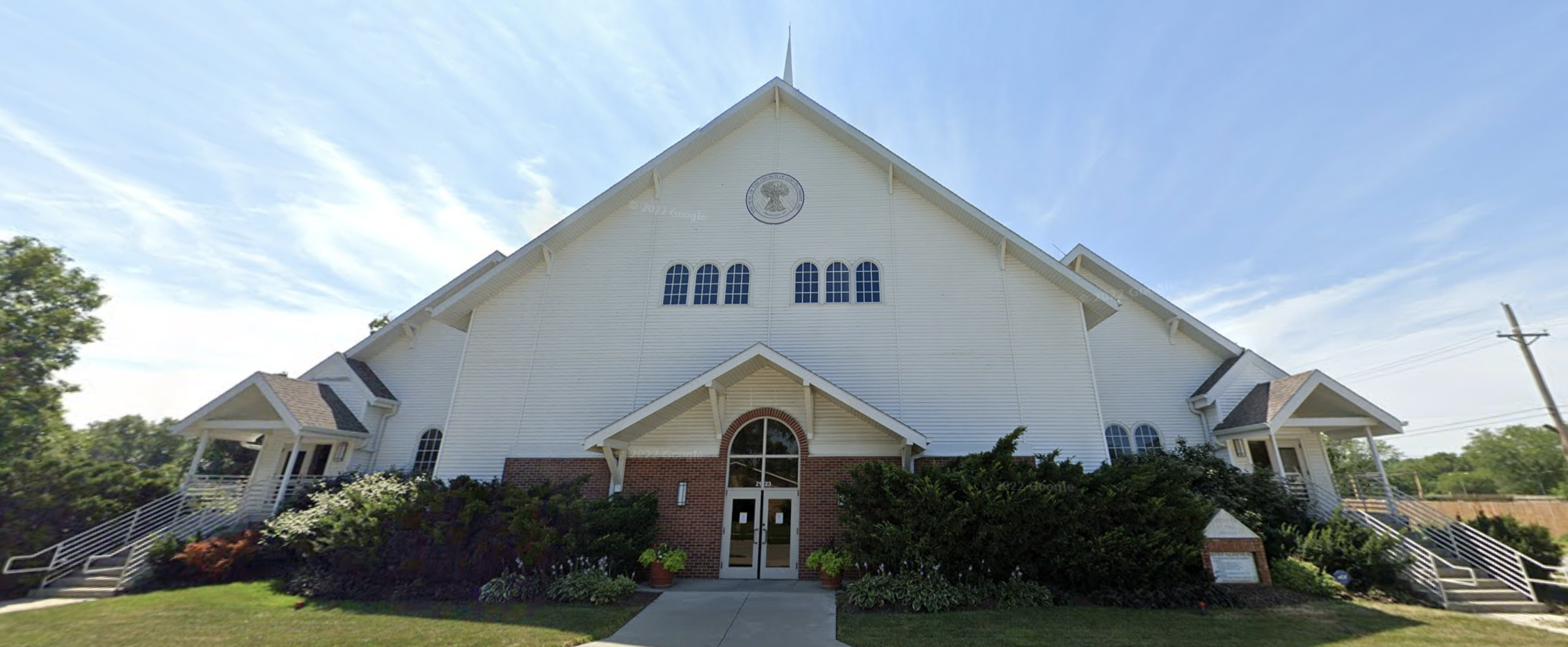
The Kountze Place neighborhood of North Omaha has been packed with beautiful churches since it was established in the 1880s. Today, a dozen serve as historic landmarks in the community, and this article includes details about one of them. This is a history of Greater Saint Paul Church of God in Christ in North Omaha.
Earliest Years at 22nd & Miami
Before it was a church, the corner lot at North 22nd and Miami Streets was a house lot. Starting in the 1880s, the lot at 2123 Miami Street had a 9-room house and a large barn. By the turn of the century in 1900, it was for rent regularly. By 1909, Rev. J. Flook was living there, and that’s what likely led to the site becoming used by a church. The minister was selling the house in 1911, promoting it as “an elegant 8-room house and corner lot” with shade and “paying fruit trees,” along with that barn, a “refined neighborhood,” and “plenty of room for additional house on property; elegant home or investment.” Rev. Flook was the minister of Hillside Presbyterian Church near North 30th and Wirt Streets until he retired around 1910.
Built in 1915 to be the First Church of the Brethren (Dunkard Society), the original church address on the southeast corner of North 22nd and Miami Streets is 2321 Miami Street. The Church of the Brethren is a 300-year old denomination related to the Mennonites and Quakers. Built for $10,000, it was considered a major investment in a growing neighborhood that would affect the denomination’s growth across the entire city of Omaha.

After a major conflict with the church in 1926, the Omaha Church of the Brethren moved its congregation to Benson and built a new church at North 51st and Lake Streets. The Omaha church merged with a Council Bluffs congregation in 1966 and there hasn’t been a Church of the Brethren in the city since.
Becoming Clair Chapel

In 1927, Grove Memorial Methodist Episcopal Church moved into the building and was renamed Clair Memorial Methodist Episcopal Church in honor of Bishop Matthew Wesley Clair, Sr. (1865-1943), who became one of the first African-American bishops in the Methodist Episcopal Church in 1920. Opened with a laying of the cornerstone by the Prince Hall Masons and a huge performance by Professor Waddle’s Band, the event was noted in several newspapers. Referred to as Clair Chapel in the media, the congregation was originally opened in 1913 as a segregated church for African Americans. After operating at North 22nd and Seward Street for 14 years, Rev. T. V. Orville moved the congregation north to the former Brethren building, which was smaller than its original church. Struck hard by the Great Depression, Clair struggled to stay afloat but managed. In the 1940s the church’s minister, Rev. G.D. Hancock started the Omaha Interdenominational Union Services at the Civic Auditorium. The congregation started growing in the 1940s, and in 1958, Rev. E.T. Streeter led the congregation in moving to a different building at North 25th and Evans Street. Clair Memorial United Methodist Church continues today on Ames Avenue.
Starting with tent meetings outside in 1960, in 1961 the Union Baptist Church was incorporated at the address. It closed soon after though.
For a few months in 1961, the Northside YWCA operated in the building. They held meetings and events there until their new facility at North 28th and Miami Street was opened.
St. Paul Moves In
A congregation called St. Paul Church of God in Christ moved into the building in 1962. Their denomination, called Church of God in Christ or COGIC, was formed in 1897, and is the largest Pentecostal denomination in the U.S. It is a predominantly African American church.
With the usual church services, choir, Bible study and Sunday school, the church took its place in the community quickly. Throughout the decades, they remained steadfast in the face of changes and have successfully continued in spite of challenges.
In 1975, the church hosted a week of revivals led by Bishop M.J. Bradford, head of the Nebraska COGIC.
In the 1990s, the congregation changed their formal name from St. Paul COGIC to the Greater St. Paul COGIC. In 1999, they spent $1.2 million renovating their church building. That same year the church held a series of nightly services as part of a weeklong celebration for a visit by Bishop Charles Blake the leader of the largest COGIC in the U.S.
The church has stayed active and involved in the life of the North Omaha community. In the 1990s, the church held events for the O.I.C. Neighborhood Association, which served the neighborhood from North 16th to North 27th Streets, from Lake to Binney Streets. There was a get-acquainted picnic and more. The congregation has held other charitable activities for the community, including coat give-aways and more. When an African American man was killed by an Omaha police officer in 2000, the church served as a meeting place for more than 60 community leaders who decided to respond.

Greater St. Paul Today
The church continues on Miami Street as of 2024, in addition to operating the Greater St. Paul Worship Center at 5116 Terrace Drive. Regular church activities including sermons, Sunday School, Bible study, choir and other events are held there, along with funerals and weddings.
The 115-year-old building at 2123 Miami Street has not been designated as an official Omaha Landmark and is not listed on the National Register of Historic Places. There is no historic plaque outside the building or acknowledgment in the increasingly popular historic tours of North Omaha’s Black community.
However, its importance as a place of worship and site for community building should not be diminished by this lack of vision. Instead, it should be a clarion call for all those committed to North Omaha to stand up for places that matter to the community, to the people and to the legacy of the community. Recognize this building now!
Do you have memories of this church? Please share them in the comments! Do you have photos or historical info? Email them to info@northomahahistory.com.
You Might Like…
MY ARTICLES ABOUT HISTORIC BLACK CHURCHES IN NORTH OMAHA
Main Article: Historic Black Churches in North Omaha
Churches: St. John’s AME | Mount Moriah Baptist | Hope Lutheran | Bethel AME | New Bethel COGIC | Zion Baptist Church | Rising Star Baptist | Faith Temple COGIC | Mt. Calvary Community | St. Benedict the Moor Catholic | North 24th Street Worship Center | Greater St. Paul COGIC | Second Baptist | Paradise
Former Churches: Calvin Memorial Presbyterian Church | Hillside Presbyterian Church | St. Philip the Deacon Episcopal Church | North Presbyterian | Church of the Brethren | Plymouth Congregational | North Side Christian
MY ARTICLES ABOUT THE HISTORY OF KOUNTZE PLACE
General: Kountze Place | Kountze Park | North 16th Street | North 24th Street | Florence Boulevard | Wirt Street | Emmet Street | Binney Street | 16th and Locust Historic District
Houses: Charles Storz House | Anna Wilson’s Mansion | McCreary Mansion | McLain Mansion | Redick Mansion | John E. Reagan House | George F. Shepard House | Burdick House | 3210 North 21st Street | 1922 Wirt Street | University Apartments
Churches: First UPC/Faith Temple COGIC | St. Paul Lutheran | Hartford Memorial UBC/Rising Star Baptist | Immanuel Baptist | Calvin Memorial Presbyterian | Trinity Methodist Episcopal | Mount Vernon Missionary Baptist | Greater St. Paul COGIC | Plymouth Congregational/Primm Chapel AME/Second Baptist | Paradise Baptist
Education: Omaha University | Presbyterian Theological Seminary | Lothrop Elementary School | Horace Mann Junior High | Omaha Presbyterian Theological Seminary
Hospitals: Salvation Army Hospital | Swedish Hospital | Kountze Place Hospital
Events: Trans-Mississippi and International Exposition | Greater America Exposition | Riots
Businesses: Hash House | 3006 Building | Grand Theater | 2936 North 24th Street | Corby Theater
Other: Kountze Place Golf Club
Listen to the North Omaha History Podcast show #4 about the history of the Kountze Place neighborhood »
Elsewhere Online
BONUS


Leave a Reply