
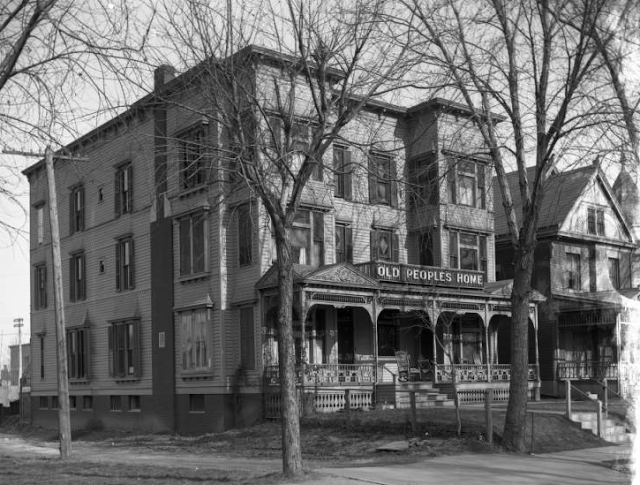
Many of Kountze Place’s finest homes are gone now, demolished by indifferent landowners and city planners who are blind to the value of the neighborhood. One of these homes stood at 2214 Wirt Street, and it was clearly one of the biggest homes in the area. This is a short history of the address.
Building on Building Buildings


This is James and Mary McLain of Omaha, Nebraska.
The mansion at 2214 Wirt Street belonged to James “J.J.” McLain (1828-1912), a businessman and aspiring politician in Omaha for more than 50 years, and his wife, Elizabeth McLain (1833-1916). The McLains were married in Ohio in 1855, and became some of the first pioneers in Omaha in 1857.
Building on the building of buildings throughout the young city, J. J. ran a painting and roofing company for a long time, and kept regular ads for his company’s services in the newspaper for decades. By 1885 though, McLain had become wealthy from selling lightning rods to homeowners throughout the Midwest.
The McLain’s massive home was built in 1887 in the Kountze Place district before it was platted for development. At the time, the house sat on an early block Augustus Kountze himself laid out, including making sidewalks and curbs and planting trees. Wirt Street connected to the Florence Road, Saunders Street and Sherman Street – but not much more! The surrounding blocks weren’t laid out yet, and even Binney Street wouldn’t have been laid out for a decade. This was truly a pioneer-era mansion, far out in the countryside north of Omaha and south of the town of Saratoga.
The McLain Mansion was designed in the Italianate Revival style that was popular in post-pioneer Omaha. Built in the 1870s, it was a single family mansion with three stories and a full basement. It had 24 rooms, a large front porch and a tightly gardened yard. It sat on Wirt Street, which thanks to the McLains and other early residents, became a highly desirable strip of mansions with tall towers, fine fixtures and immaculate social standing.
J. J. and Mary McLain (c.1838-1916) became charter members of First Methodist Church as soon as they arrived in Omaha City. They became charter members of the Trinity Methodist Church at 2017 Binney, just a few blocks from their home, when it opened in the 1890s. The couple was busy around town, too. Mr. McLain was a founding member of the Methodist Episcopal Hospital and Deaconess’ Home Association, and when a group of Methodist society women across the city joined together to establish a charity, Mrs. McLain became a founding member with them.
Serving Women or Kids or Old People?

The Women’s Christian Aid Association was founded to help Omaha’s Home for the Ill and Indigent in 1883. In 1887, they bought a house at 2718 Burt Street to focus on sick women and children, and moved to 2718 Burt Street Later. In 1902, they were given the old McLain Mansion at 2214 Wirt Street, and the massive building was named the Old Peoples Home. Mrs. McLain was responsible for ensuring they got it, and she and her husband moved just a few blocks away. At that point, their stated mission was to serve “Persons 65 years old, or over, residents of Omaha, Nebraska” who were “admitted by paying an entrance fee of three hundred dollars.”

When she died in 1911, notorious madame Anna Wilson left her mansion to become the next Old Peoples Home. However, the charity rejected the idea of moving their residents into her large house that was located less than a mile away. Instead, they took possession of the house and then sold it, staying at 2214 Wirt Street all the while.
However, the end of the McLain Mansion’s role in the life of the Old Peoples Home came soon enough.
A New Senior Home

In 1917, the George and Sarah Joslyn donated money to build a new home at 3325 Fontenelle Boulevard, which was designed by John and Alan McDonald in the Colonial Revival style. That facility was called the Fontenelle Boulevard Home. The name was changed to the Leo Vaughan Manor later, and in 1987 it was listed on the National Register of Historic Places. Today, this facility is used as senior living apartments.
Demolishing A Pioneer Mansion

Next, the building at 2214 Wirt Street was called the Woodbine Apartments. Featuring 12 units of 2 bedrooms apiece, in the 1920s they were considered high end apartments. In the 1930s, they were advertised as modern, newly decorated apartments that were close to the 24th Street streetcar line and were offered at reasonable rates.
By the early 1960s, redlining boundaries were extending into the neighborhood and apartments in the building were being advertised “for colored renters.” White flight was sweeping North Omaha, and white people moved out of the neighborhood fast. This caused housing values to plummet, and made the City of Omaha anxious to run their bulldozers in the name of “slum clearance.” Targeting the historic mansions and fine homes they thought were decaying throughout North Omaha, they began plowing down the McLain Mansion’s neighbors. It wouldn’t be long before this one-time posh address would meet its fate.
In early 1969, the building was advertised as having three and four bedroom apartments. Its historical provenance wasn’t mentioned, and as far as my research has shown, its place among Omaha’s history wasn’t acknowledged.
At 1:22pm on October 9, 1969, a fire was reported at the 2214 Wirt Street. The Omaha World-Herald said it was a “vacant, condemned apartment dwelling,” and made no further report. The building doesn’t show in any other reports afterwards, so its easy to assume it was demolished immediately afterward, probably before 1969 was over.
The lot has sat empty next to the former Calvin Presbyterian Church since then, for more almost 50 years.
MY ARTICLES ABOUT THE HISTORY OF KOUNTZE PLACE
General: Kountze Place | Kountze Park | North 16th Street | North 24th Street | Florence Boulevard | Wirt Street | Emmet Street | Binney Street | 16th and Locust Historic District
Houses: Charles Storz House | Anna Wilson’s Mansion | McCreary Mansion | McLain Mansion | Redick Mansion | John E. Reagan House | George F. Shepard House | Burdick House | 3210 North 21st Street | 1922 Wirt Street | University Apartments
Churches: First UPC/Faith Temple COGIC | St. Paul Lutheran | Hartford Memorial UBC/Rising Star Baptist | Immanuel Baptist | Calvin Memorial Presbyterian | Trinity Methodist Episcopal | Mount Vernon Missionary Baptist | Greater St. Paul COGIC | Plymouth Congregational/Primm Chapel AME/Second Baptist | Paradise Baptist
Education: Omaha University | Presbyterian Theological Seminary | Lothrop Elementary School | Horace Mann Junior High | Omaha Presbyterian Theological Seminary
Hospitals: Salvation Army Hospital | Swedish Hospital | Kountze Place Hospital
Events: Trans-Mississippi and International Exposition | Greater America Exposition | Riots
Businesses: Hash House | 3006 Building | Grand Theater | 2936 North 24th Street | Corby Theater
Other: Kountze Place Golf Club
Listen to the North Omaha History Podcast show #4 about the history of the Kountze Place neighborhood »
You Might Like…
- A History of Kountze Place
- A History of North Omaha’s Wirt Street
- A History of Anna Wilson’s Mansion in North Omaha
Elsewhere Online
- “Old People’s Home” National Register of Historic Places Registration Form, US Department of the Interior National Park Service





Leave a Reply