
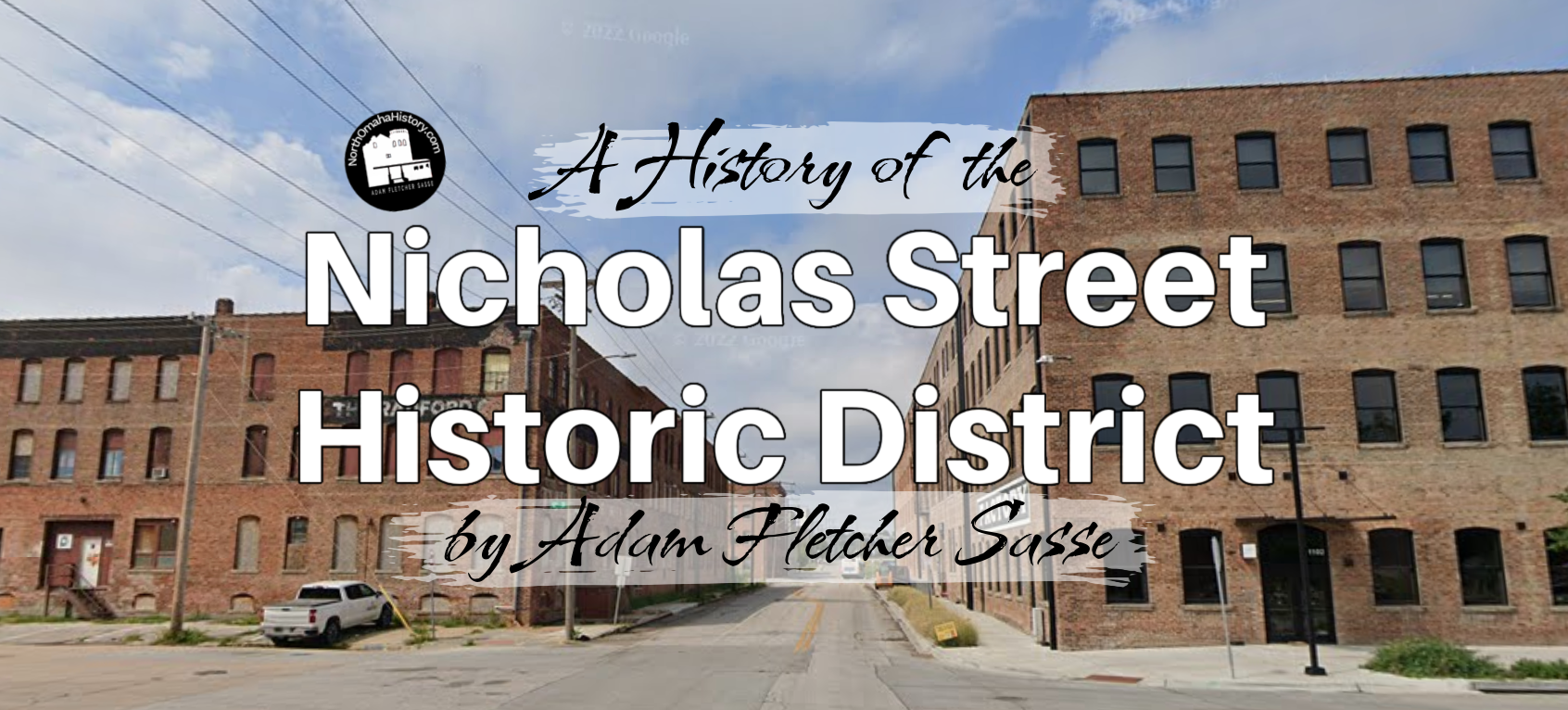
As Omaha was settled it immediately grew to north of downtown. Residences filled the region from Dodge Street to Lake Street, with houses, apartments, tenaments and mansions clogging the area with thousands of families. Some of the area took on a different flavor though, forming into industrial hubs. This is a history of one of those areas that today is referred to as the Nicholas Street Historic District.
The Earliest Years

Rolling into Omaha off ferry over the Missouri River, from 1850 through the 1870s, travelers would’ve headed up California Street and Cuming Street to catch the Military Road westward to the Platte River. It wasn’t until the 1880s that the area a few blocks north of those routes developed. One of the first named streets in the city, Nicholas Street was likely named for the pioneer-era Nicholas Hotel.

In the pioneer years of Omaha, the Jefferson Square neighborhood developed south of Nicholas Street to Capitol Avenue, including several distinct ethnic areas, many churches, a lot of businesses and railroads, and more. When it emerged in the 1880s, the industrial area that was about to form just north of Jefferson Square was separated from the homes of this neighborhood by just one street.
Nicholas Street was on the very northern edge of Omaha when the city was platted in 1854, and it stayed that way until 1883.
Railroads and the Nicholas Street Historic District

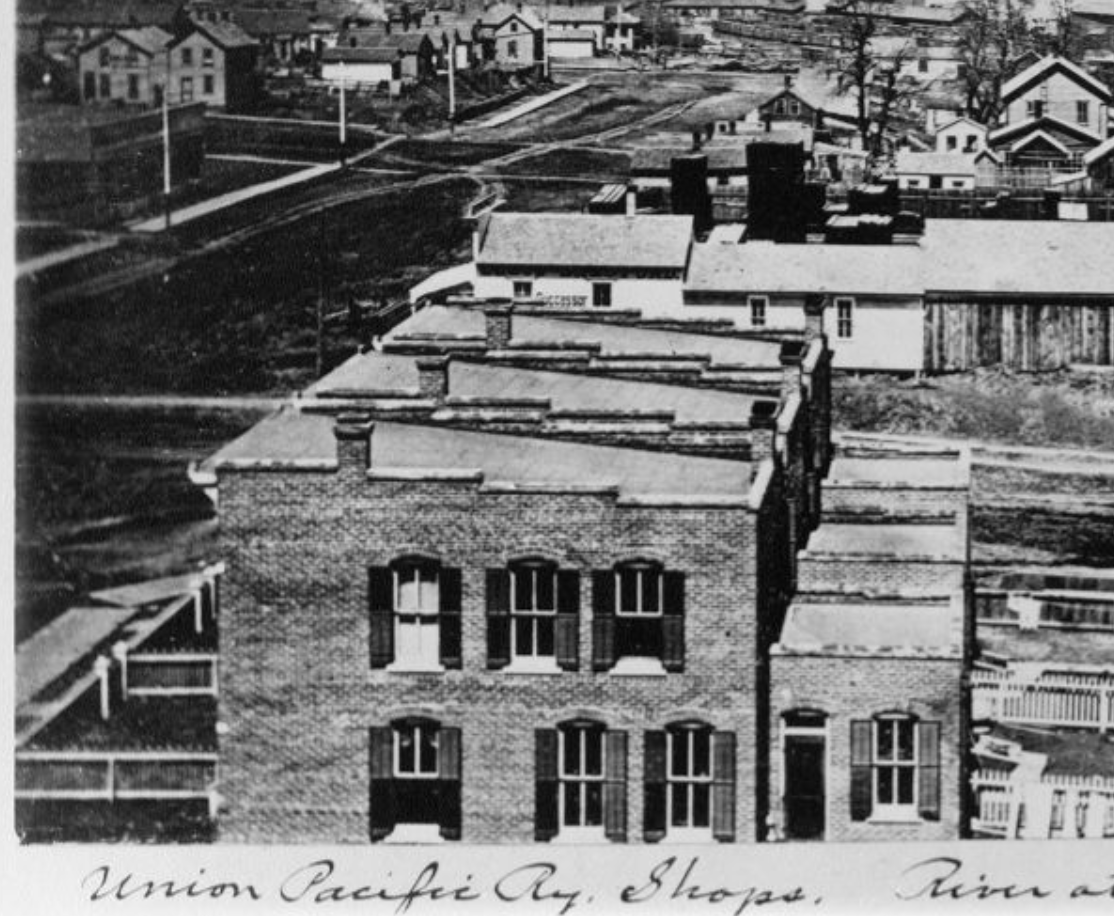
Railroads were essential to the growth and development of the area that became the Nicholas Street Historic District. Starting in the 1870s, railroad tracks were laid near, through and around the area that would become the Nicholas Street Historic District. The Missouri Pacific laid the most trackage, but the Union Pacific shops were nearby and there was the Webster Street Station was built nearby by the Chicago, St. Paul, Minneapolis and Omaha Railway in 1885. The Missouri Pacific extended spurs into the area, and transportation set up the real estate for success. The North Yard was run by the Missouri Pacific too, with several other lines using the seven railroad tracks that dissected Nicholas Street at North 11th Street, extending north to Locust Street. The Nicholas Street Freight Depot was built at North 15th and Nicholas in 1885, giving all the manufacturers in the district a national transportation route for shipping their goods.

Because of all that infrastructure, it wasn’t always easy getting to work there! After decades of complaints from the City of Omaha and the thousands of people who trod the path starting in the 1880s, in 1913 construction of the Nicholas Street viaduct began in 1914 to carry foot traffic, streetcars and wagons over the railroad tracks from North 13th to North 16th Streets. At 1,800 feet long, the viaduct was a massive structure that benefited businesses in the Nicholas Street Historic District greatly.
All of those rail lines made the area roughly bounded by North 11th Street on the east, 14th Street to the west, and centered around Nicholas Street attractive to real estate developers and the businesses they wanted to recruit to build there.
Buildings in the District

All kinds of buildings were constructed by local, regional and national companies operating warehouses, manufacturing, food processing and other industries. There were also public works buildings in the district. Three mattress companies, at least two sash and door companies, and three millwork companies were located in this area of North Omaha. Starting around 1900, many were in business longer than almost any of their rivals in their specialties, making the present-day Nicholas Street Historic District unique in Omaha for its long-time usage for these specific industries. It was also unique because of the hand-crafted nature of the goods here, with mechanization making jobs more efficient without eliminating human labor in the process.
Today, the area has several of these former structures, with 14 of the 17 buildings included in the district’s nine blocks listed on the National Register of Historic Places. Following is information about these buildings.
Orchard & Wilhelm Warehouse #1

The oldest building in the district is the Orchard & Wilhelm warehouse at 1113-1117 Nicholas Street, and was built in 1893. The popular furniture company used it until 1921. The Omaha School Supply Company used the building from 1921 into the 1960s, along with other businesses including a church furniture company, a farm machine dealership and others. It was in fair condition for decades after businesses moved out, but after being covered in stucco many of its windows were damaged while it sat empty. However, today it stands as a unique building in the district. There is one building at this address.
Orchard & Wilhelm Warehouse #2
Located at 1302-1306 Izard Street, this building was built as a warehouse in 1918. That year, Wilhelm & Orchard started using it as storage for their furnitue and carpet business. By 1934 they were gone and a business called Industrial Laboratories used it was a warehouse. Starting in 1936, the building was home to the On-Time Transfer Company, a moving business, until the late 1960s. L.G. Doup took over the space then and used it through the 1980s. In the late 1990s, the Hot Shops Art Center started using it for art glass studios, a metal foundry, ceramics studios, an an iron forge, and continue today. There is one building at this address.
L.G. Doup Company

Located at 1301-1311 Nicholas Street, the L.G. Doup Company was a furniture maker that built a factory in 1906 with an addition a decade later. A four-story building, there are windows across the front of the front with a storefront on the fourth floor and a large door. Focusing on mattress-making only in the 1920s, Doup stayed in business until 1980. After that it was a Serta mattress factory until the 1990s, and stood empty for a decade afterward. In the late 1990s, the Hot Shops Art Center moved into the space and today there are “90 resident artists in 50 studios” in the complex. There are two buildings included at this address.
Adams and Kelly Company

Established in Omaha in 1892, the Adams & Kelly Millwork Company made windows, doors and woodwork for the insides of houses and other buildings. In 1902, they moved into a small building in the middle of this block at 1208 Nicholas Street. Eventually their factory was made of three buildings, including two built in 1906 and one in 1910 after their original factory was demolished. The buildings, located at 1202-1224 Nicholas Street, are interconnected, have four stories, and have a lot of windows facing Nicholas Street. The company operated here for almost 70 years until 1961, along with offices and a warehouse at 1529-33 Sherman Avenue. In 2019, it was renovated for $25 million and converted the factory into office space as part of the Millwork Commons development. Today its used for commercial and office use. There are three buildings included at this address.
Disbrow & Company Buildings

For 96 years, Disbrow and Company made fine woodwork in several buildings in the district. The remaining structures include two three-story buildings, a mule barn, and corrugated steel building. The first factory was built in 1886 at 1201 Nicholas Street. Maynard B. Copeland (1855-1953) came to Omaha to open and manage the Omaha branch of Disbrow and Company, a custom millwork business from Iowa. Copeland was the protege of the company’s founder. After building a large factory at North 12th and Nicholas Streets in 1886, Copeland had a large home built in the fine Kountze Place neighborhood of North Omaha. The company had more than one building in the area, with another built in 1890 and another in 1912, with extensive renovations in 1921. Copeland became president of the business in 1912, and continued operating the business until he died in 1953. The company was sold in 1982 and the factory remained in operation until 1982. After Disbrow left Omaha, the buildings sat empty for decades. Today the buildings are included on the National Register of Historic Places as part of the Nicholas Street Historic District. There are four buildings included at this address.
Hay Exchange Building
In 1920, the Hay Exchange Building was built at 1015 North 14th Street. Angled on the west corner because of a railroad jutting across the property, the building has two stories and was filled with offices for the Nebraska Hay Company and the Grand Omaha Grain Exchange. After that closed, in 1924 a business called Industrial Laboratories, Inc. moved in. In 1935, a two-story addition was built to fill in an alley. A separate two-story building was constructed in 1958 and wrapped around both the original building and the small addition from 1935. A three-story addition was built, and another addition was added onto that. The 1958 building is the newest structure included in the district on the listing for the National Register of Historic Places. There are four buildings included at this address.
City of Omaha Street Department Office

There are two public works buildings in the northeast corner of the Nicholas Street Historic District, including the City of Omaha Street Department offices and a warehouse at 1114 and 1124 Nicholas Street. They both still stand in good shape. There are two buildings included at this address.
J.D. Adams Company
Home of a factory for road machinery made by the J.D. Adams Company, the building at 1308-1312 Izard Street is a single-story rectangle with the building at 1302-1306 Izard Street attached to it. In the 1960s, the On-Time Transfer Company moved into the building, and after that the Doup Copmany bought the buildings. Today this building is part of the Hot Shots Art Center. There are two buildings included at this address.
Transforming the District

The Nicholas Street Historic District grew and thrived as a manufacturing center for more than 50 years. During its initial development from the 1880s through the first decade of the 20th century, the area from Nicholas Street on North 16th Street to Locust Street became a popular residential and commercial district. Packed with businesses, fine apartments and upscale homes, this area was near the Little Stokholm neighborhood along Florence Boulevard and the Near North Side, which was a racially, ethnically and economically integrated neighborhood. Squatter’s Row was nearby too though, and there was tension between the older houses in the area where all the factories were located.
After the Great Depression, the area saw little change, and shrunk soon after. There are still businesses to this day, but the area had little space for expansion, and the appeal of the area was low. Much of the area in the district was acquired by the City of Omaha, which sat on the buildings for several years without razing them or otherwise continuing the demolition they were notorious for in other areas near downtown. Ironically, the very tracks that caused the area to develop originally may have saved them too, since being surrounded on three sides by rail tracks made the area hard to access and limited the number of people and businesses in the district.

Starting in the late 1990s, the City of Omaha turned up the pressure valve on the region south of the district called North Downtown Omaha. Massive investments in the cleanup of the riverfront including the demolition of the Union Pacific Shops, the removal of the massive rail trackage through the area, the removal of the Nicholas Street viaduct and the realignment of Cuming Street with Abbott Drive, as well as the construction of a new event center and baseball stadium with more harkened to the radical future ahead. In 2008, the Nicholas Street Historic District was listed on the National Register of Historic Places. In the years since, there has been a great deal of development in and near the district, including the redevelopment of commercial and residential structures within the district and more.
Demolition Strikes!

Across the life of this district, there have been many buildings constructed and demolished; what is left today represents a fraction of what’s been there before. Some of the most significant buildings that have been demolished were struck between 1920 and 1990, long before any historic preservation efforts began. For instance, the John T. Dillon Building was located at North 11th and Nicholas, with several now-demolished buildings located west of it that belonged to Adams & Kelly, Doup, and the Nebraska Hay Company. The Omaha Boiler Works had a plant on North 12th and Izard, and the Omaha Fuel Company was located west of it. There was also a factory of the Aermotor Company on Izard past North 13th, as well as the J.F. Tawnley & Son plant.
However, those weren’t the only structures that have been wrecked. After it was listed on the National Register of Historic Places in 2008, between 2011 and 2013 there were several buildings demolished in the Nicholas Street Historic District. These were historic structures recognized by the federal government for their contributions to the local, state and national economy—which didn’t save them.

Some of the demolished structures in the district include the Wayne Auto Truck and Trailer, which operated at 1322 Nicholas from 1945 to 1968. They had a large building on Nicholas that was used for painting cars until 1968, when it burned down. The business closed afterwards and several car shops came and went over the next few decades in the two remaining buildings, including a Quonset hut and a small brick garage building. Those two stood until 2013 and were demolished after they were included on the National Register of Historic Places.
There were two buildings built by Consumer’s Coal & Supply Company at 1112 Nicholas Street from 1925 until 2013. In 1940, the company was taken over for five years by the Federal Works Agency. After WWII, there were several businesses located there that stayed in business through the 1960s. The Deep Rock Oil Company building was at 1126 North 11th Street. It was a four-story building that was opened as a warehouse in 1921. In the 1930s, a Works Progress Administration project said the building was part of Omaha’s oil distribution center, with “six major oil refineries and warehouses stretching from Clark to Nicholas” Streets. After merging with another company in the 1950s, Deep Rock left the building in 1965. Used for making insecticides through the 1970s, it was abandoned and sat empty for decades. There was also a large, single story Behlen Building at 1222 Izard until around 2013. A unique structure when it was demolished, it was a large steel manufacturing building used for decades.
The City of Omaha Street Cleaning Department built a facility at 1124 Nicholas Street, across the street from their offices, in 1924. Using pavers originally meant for streets, the building has a unique exterior in the district. The windows on the building were filled in with ugly brick and there was poorly colored repointing on some of the brick, but otherwise the building was in good shape. In 1920, the City of Omaha Street Maintenance Department built a two-story office building and a warehouse next to it at the same time. It was demolished around 2013.

Between 1995 and 2000, the Nicholas Street viaduct was also completely wrecked and soon after, the city completely rebuilt Abbott Drive, creating a dead end for Nicholas Street. Once exclusively covered by brick streets, today the historic district is paved over except for one block of North 13th Street.
Today the district is an island of historic property in the middle of a broad swath of the North Downtown area that has been massively redeveloped in the last 25 years.
The District Today

With the listing of the Nicholas Street Historic District on the National Register of Historic Places in 2009, new life continued was breathed into the area. Renovations and demolitions, new pavement and massive marketing campaigns have marked the rebirth of the district.
Two buildings in the district are part of a newly-minted 44-acre area in North Omaha marketed as the “Millwork Commons.” The Millwork Commons also includes other buildings not in the district including the repurposed Mastercraft Building and several brand new structures. Their website says the area “is a hub for tech, art, design, and community growth.” Alley Poyner Macchietto Architecture was responsible for creating the master plan and designing Millwork Commons. Featuring “the renovation of historically significant structures, the construction of new mixed-use buildings, and the development of multi-modal transportation infrastructure (pedestrians, bikes, buses and cars),” the project has won local and state awards.
Today, almost all of the 14 buildings in the district have been rehabilitated and house new apartments, offices, workspaces and more. There is a park, new construction and plans for further development in the area surrounding the district.
The future of the Nicholas Street Historic District is secured. Between its listing on the National Register of Historic Places and the tremendous infusion of money into renovating the historic structures as well as in-filling old spaces and securing transportation, this neighborhood will remain a North Omaha history haven for for a long time to come.
Special thanks to Jennifer Honebrink of Alley Poyner Macchietto Architecture for completing the 2008 application for the Nicholas Street Historic District listing on the National Register of Historic Places. Much of the information included here is from that document.
You Might Like…
MY ARTICLES ABOUT THE HISTORY OF NORTH DOWNTOWN OMAHA
PEOPLE: African Americans | Chinese | Hungarians | Italians | Jews | Scandinavians
PLACES: Cass Street School | North Omaha School | Holy Family Parish | Near North Side | Jefferson Square Park | St. John’s AME Church | 18th Street Methodist Church
NEIGHBORHOODS: Jefferson Square Neighborhood | Nicholas Street Historic District | Winspear Triangle | Near Northside |
BUSINESSES: Badger Body | Tip Top | ASARCO | Union Pacific
OTHER: North Omaha Bottoms | Winspear Triangle | Cuming Street | Nicholas Street Viaduct
MY ARTICLES ABOUT HISTORIC NEIGHBORHOODS IN NORTH OMAHA
National Register of Historic Places Historic Districts in North Omaha: 24th and Lake Historic District | Benson Downtown Historic District | Country Club Historic District | Dundee/Happy Hollow Historic District | Fairacres Historic District | Fort Omaha Historic District | Minne Lusa Historic District | Nicholas Street Historic District
Historic Neighborhoods in North Omaha: Bedford Place | Belvedere Point | Bemis Park | Benson | Briggs | Bungalow City | Carter Lake, Iowa | Central Park | Clifton Hill | Collier Place | Creighton University | Crown Point | DeBolt | Druid Hill | East Omaha | Fairfax | Florence | Florence Field | Fort Omaha | Fontenelle View | Gifford Park | Gold Coast (Cathedral) | High Point | Jefferson Square | Kellom Heights | Kountze Place | Lakewood Gardens | Little Russia | Long School | Malcolm X Memorial | Miller Park | Miller Park Duplex Historic District | Monmouth Park | Montclair | Near North Side | North Downtown Omaha | Omaha View | Orchard Hill | Plum Nelly | Prairie Park | Prettiest Mile in Omaha | Prospect Place | Raven Oaks | Redman | Saratoga | Sherman | Squatter’s Row | Sulphur Springs | Ponca Hills | Wakonda | Walnut Hill | Winspear Triangle | Wyman Heights
Lost Towns in North Omaha: Benson | Briggs | Cutler’s Park | DeBolt | East Omaha | Florence | Saratoga | Sulphur Springs | Winter Quarters
Elsewhere Online
- Nicholas Street Historic District on Wikipedia
- Hot Shops Art Studio
- Nicholas Street Historic District, Omaha Heritage Preservation
- Millwork Commons official website
- Millwork Commons on the Alley Poyner Macchietto Architecture website
BONUS


Leave a Reply to Adam F.C. FletcherCancel reply