
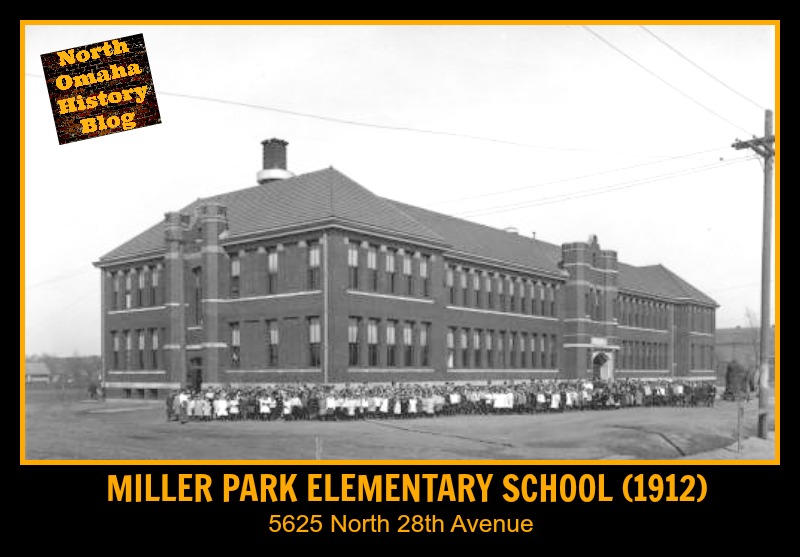

As Omaha’s suburbs grew, they needed schools to meet the needs of young residents. Many of these buildings have been engulfed by the city, and today one of them hides by a park, a community college, and a LOT of other historical places! This is a history of Miller Park Elementary School.
Staring in the 1880s, the Miller Park neighborhood began developing a little bit. There were small farmhouses and farms in the area between Saratoga Avenue and Kansas Avenue, from North 30th Street east to North 24th Street.
After the neighborhood kept in-filling during and after World War One, the school outgrew its facilities, which then included several wood frame buildings. To meet the neighborhood’s growing needs, a grand factory-style building was constructed at 5625 North 28th Avenue in 1912.
Building a Legacy

The namesake of the school, as well as the surrounding neighborhood and bordering park, was Omaha pioneer Dr. George Miller (1830-1920). Dr. Miller was the main owner of the new neighborhood’s land, and sold the properties quickly before he died in 1920.
When Fort Omaha became home to a balloon school, Miller Park School’s population grew fast, booming from 150 students to 300 within years. Suburban housing started filling in the blocks of the neighborhood and things had to change. The neighborhood would need stores, a restaurant, eventually, gas stations, and soon, a school. Located on the periphery of the neighborhood, the Fort Omaha School had been closed for years and the new residents needed a schoolhouse.
The First School Building

Located halfway between Fort Street and the Miller Park in the middle of a cornfield, the original building was a four-room wooden schoolhouse that claimed one of the first three school libraries in Omaha when it opened. Originally with only kindergarten through fourth grade, when it opened the original school had five teachers and 151 students. Within months the building was bursting with students, and a second building was built for grades five through eight.
When it opened in 1910, most of the original Miller Park School students came from families attached to the US Army at Fort Omaha, and to people moving up the hill from East Omaha where flooding was becoming worst. Along with the surrounding cornfields, other neighbors to the school included the Fort, and a sizable operation called Littlefield’s Dairy.
There were two wooden buildings still on the site of the new school when it opened in 1912. Only one was left a few years later after the second building was moved near North 30th and Browne Streets to become the Fort Street Special School for Incorrigible Boys in 1914. Three years later it was moved to become a temporary home to the new Minne Lusa School in 1917.

The first building stayed on it’s original site until 1970, when it was removed.
The Second Miller Park School
Within a year of the original opening, the Miller Park Improvement Club wanted a new building for the school, and in March 1912 the Omaha School District contracted popular Omaha school architect John Latenser (1858-1936) to design the building with a budget of $70,000. When it originally opened, there were more than 800 students in kindergarten through eighth grade. According to the World-Herald, a “Mother’s Circle” started in 1912 was credited with going on to “to help form Omaha’s first PTA in 1925.”
From 1910 to 1941, the first four principals of Miller Park were Lula H. Hunt, Etta Smith, Alice D. Orr and Mary N. Austin. A decade after the new building opened in 1912, the school was a resounding success, and by the late 1930s several organizations studied the school’s programs, including the National Education Association and several independent education researchers.
In 1958, seventh and eighth grades were moved to McMillan Junior High School and Miller Park School returned to serving just grades kindergarten through fourth grade.
Teachers at the school recreated a pioneer school room at the school in 1980, using original desks and other supplied from the original 1910 school building.
My Time at Miller Park School

When I attended Miller Park School in the 1980s, there was a racially integrating student body and packed classrooms. In 1984, a replica of a one-room schoolhouse at Miller Park was featured by the National Trust for Historic Preservation. It was setup as a “pioneer classroom” with period desks, a pot-bellied stove and other features.
My favorite teachers from all of my school career were at Miller Park in third grade with Miss Abramson and my fourth grade teacher, Mr. Jeff Koneck. My love for history is directly attributed to Mr. Koneck, who took my class to Fort Omaha to perform in the River City Roundup events there. As an awkward Canadian immigrant kid picked on because of my accent and poor country kid clothes, I finally found a place to belong, and today I spend a lot of time on this NorthOmahaHistory.com project because of that belonging, and ultimately Mr. Koneck, who I’m proud to call a friend today. While I attended the school, its long traditions of having a Cub Scout pack and Girl Scout troop, along with an active PTA and annual school fairs were all intact.
Modern Times at Miller Park

While many things have changed, Miller Park continues to be a positive and influential part of the Miller Park community. In 2002, the building got a major addition and renovation featuring new administrative space, a new gymnasium, cafeteria and classrooms. Today, the attendance area for Miller Park Elementary School goes from Redick Avenue on the north to Sorenson Parkway on the south, from Florence Boulevard on the east to North 30th Avenue on the west, as well as the Fort Omaha campus. The school population wavers around 400.
As of 2024, the school is 90% students of color and 85% low-income. There is an equivalent of 26 full-time teachers and 1 full-time school counselor at the school.
You Might Like…
- A History of the Miller Park Neighborhood
- A History of North Omaha’s Miller Park
- A History of the Miller Park Duplex Historic District
- Biography of Dr. George L. Miller
MY ARTICLES ABOUT THE HISTORY OF SCHOOLS IN NORTH OMAHA
GENERAL: Segregated Schools | Higher Education
PUBLIC GRADE SCHOOLS: Beechwood | Belvedere | Cass | Central Park | Dodge Street | Druid Hill | Florence | Fort Omaha School | Howard Kennedy | Kellom | Lake | Long | Miller Park | Minne Lusa | Monmouth Park | North Omaha (Izard) | Omaha View | Pershing | Ponca | Saratoga | Sherman | Walnut Hill | Webster
PUBLIC MIDDLE SCHOOLS: McMillan | Technical
PUBLIC HIGH SCHOOLS: North | Technical | Florence
CATHOLIC SCHOOLS: Creighton | Dominican | Holy Angels | Holy Family | Sacred Heart | St. Benedict | St. John | St. Therese
LUTHERAN SCHOOLS: Hope | St. Paul
HIGHER EDUCATION: Omaha University | Creighton University | Presbyterian Theological Seminary | Joslyn Hall | Jacobs Hall | Fort Omaha
EDUCATORS: Eugene Skinner | Lucinda Williams nee Lucy Gamble | Edmae Swain
COMMUNITY EDUCATORS: George McPherson | Florentine Pinkston | “Professor” PJ Waddle | Christine Althouse | Bertha Calloway | Beverly Blackburn
COMMUNITY EDUCATION ORGANIZERS: Edwin Overall | Lerlean N. Johnson | Nellie Mae Webb | Ernie Chambers | BANTU
MORE: Fort Street Special School for Incorrigible Boys | Nebraska School for the Deaf and Dumb
Listen to the North Omaha History Podcast on “The History of Schools in North Omaha” »
BONUS



Leave a Reply