
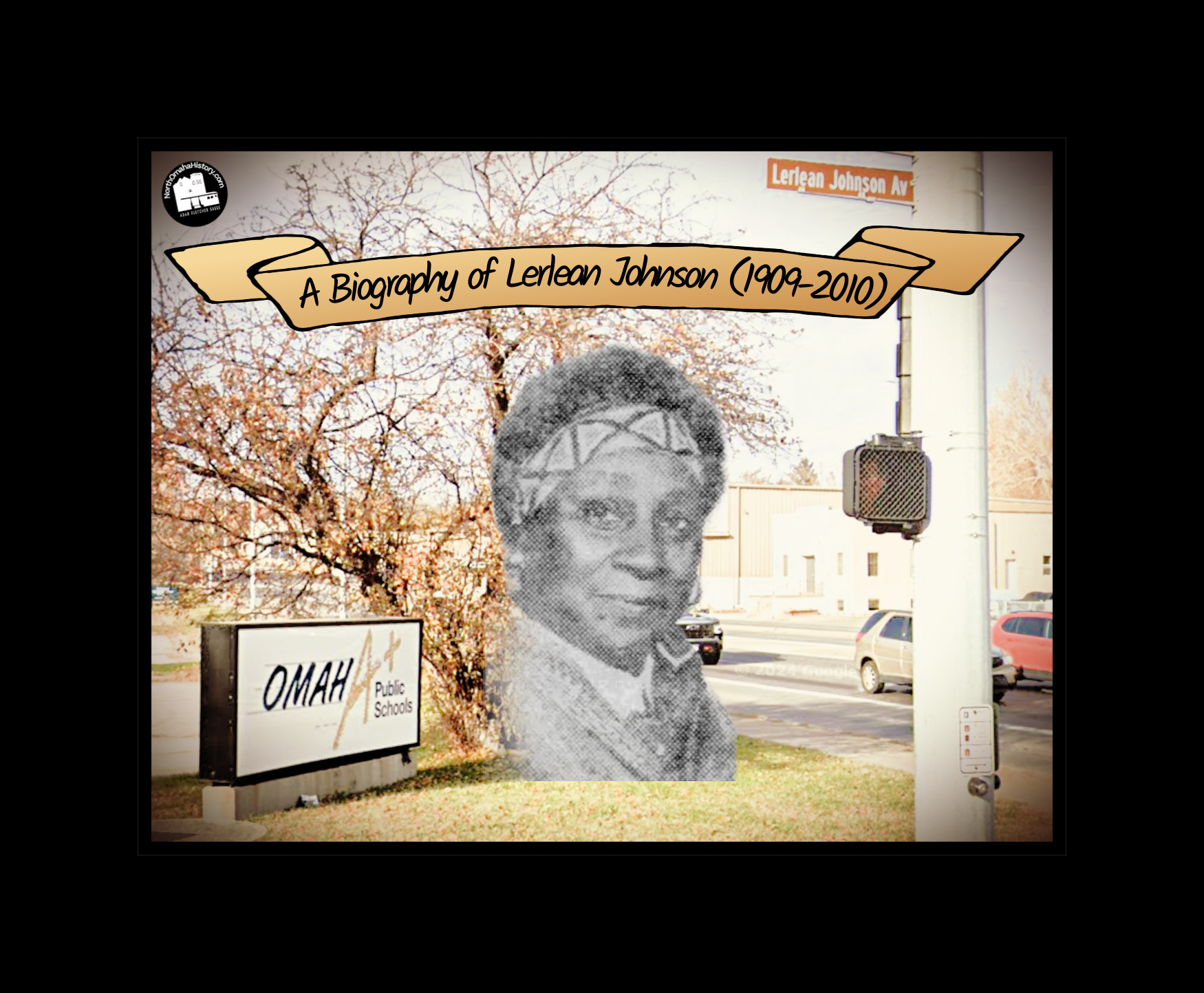
After the riots of the 1960s, the force of change in Omaha focused on social justice and Black equality moved a lot of things. One of those forces was a group of African American mothers who were determined for their kids to go to the best schools in the city. This is a biography of a lifelong activist whose impact is still being felt, Mrs. Lerlean N. Johnson (1932-2010).
Raising a Strong Family
Lerlean N. Johnson was born in East St. Louis, Illinois, in 1932. According to a 1982 oral history interview, Lerlean said the city was filled with racial tension and poverty during the Great Depression. Johnson remembered that her family would run out of food and her family would eat lard and sugar to make their hunger stop. They would also have to forage for wood to burn because they ran out of coal. Because of these hardships and more, Johnson was placed in foster care when she was 13 years old. After World War II, she married Jessie L. Johnson (1928-2022) and moved to work in wartime jobs at the Navy munitions plant in Hastings. Their young family moved to North Omaha in 1956.
The couple eventually had 14 children, including Carl Clemmons (1952-2004), A’Jamal Byndon, Kamau N’Namdi, Angela Jackson, Verna Johnson, Kevin Johnson, Lerlean Johnson, Irene Harris, Jesse Johnson Jr., Charlotte Johnson, Sarah Johnson, Rosalie Johnson, Lyndon Johnson, and Louis Johnson (1974-2011).
Later working Johnson in a South Omaha meat packing plant, she became a local union representative.
In addition to raising a strong family and working hard, Mrs. Johnson took the entire community’s interests to heart through action.
Building a Strong Community

An active volunteer and community educator, Mrs. Johnson was deeply involved in the community throughout the rest of her life. Advocating for Black empowerment through educational, legal, economic, and other levers, her activities ranged from nonprofit board membership to teaching in new empowerment programs, and much more. She was an high-profile activist in Omaha for decades, and provided volunteer leadership for a wide array of organizations including the Omaha Urban League, the Legal Aid of Omaha, Greater Omaha Community Action, the Charles Drew Health Center and other organizations.
It began in the early 1960s when she joined Mothers for Adequate Welfare, a group associated with Greater Omaha Community Action (GOCA). The activists were trying to stop Black welfare clients from being treated rudely by white caseworkers, having checks held back for no clear reason, and people becoming barred from low-income housing. They also worked with the Nebraska State Welfare Department. In that capacity, Mrs. Johnson regularly testified in the state legislature as an advocate for poor people.
In 1970, Mrs. Johnson joined the North Neighborhood Action Board for the Greater Omaha Community Action, Inc., or GOCA. Serving as the corresponding secretary, she became aware of the various services or lack thereof for low-income people in the city. GOCA was the local agency for a federal anti-poverty initiative. In that role, she held GOCA to account including insisting parents be involved in hiring a new Head Start director in 1971. She continued to serve on the Board of Directors for more than a decade.
She protested against rate increases for the bus in 1970, along with retaining a route from North Omaha to the industrial areas of southwest Omaha. Writing frequent letters to the editor at the Omaha World-Herald, Mrs. Johnson advocated for Black excellence and against white supremacy.
She was also the chairperson of a group called LAW, or the Lone Arrangers Welfare Rights Organization. LAW created summer activities for 47 Omaha families in 1972. She also testified against the North Freeway during organized protests in the early 1970s.
Mrs. Johnson’s advocacy for educational equality for African American students began in the 1960s. In the early 1970s, she became active in advocating to the Omaha School Board. Mrs. Johnson first arrived on the media’s radar for schools in 1971, when she protested against the firing of Eddie Chambers by OPS. Cited as the mother of 12 children, the paper quoted her saying, “There is no justice in this school system… If it doesn’t change, I will tell my children to go elsewhere.”
She later testified with Ernie Chambers about situations facing Black students, and in 1972 she requested to the school board that, “several Black teachers be assigned this fall to Florence School which… now has none.” All of this advocacy for schools led to Mrs. Johnson’s biggest foray, which changed Omaha forever.
Transforming Schools

A group of African American mothers became synonymous with activism to force Omaha Public Schools to make education for Black students equal to education for white students. Mrs. Johnson joined with Zenolia Hilliard, Lillie Gunter, Irene Gunter, Charlotte Stropshire, Nellie Webb, and Dorothy Eure (1927-1993) to continuously campaign to force the school district to stop segregating schools.

In 1972, the U.S. Justice Department informed the Omaha School District that they were investigating the district’s policies and practices because “some Black parents” complained. That year, seven Black parents joined with the department to sue OPS. In 1974, a district court judge ruled in favor of the school district. However, on appeal the next year the 8th U.S. Curcuit Court overturned the lower court ruling and found Omaha had intentionally segregated students. They ordered the district to integrate.
Mrs. Johnson’s own hopes were not fulfilled though. In an interview she said her own children and other Black children were still treated badly in predominantly white schools, with parents called frequently for minor infractions and insensitive responses to the concerns of Black parents by school leaders.
A Lifelong Commitment
For another 30+ years, Mrs. Johnson continued to determinedly challenge and change the white supremacy and classism that seemed ever-present throughout Omaha.
At the same time she was fighting OPS, Mrs. Johnson felt that a similar pattern of systematic racism held true for welfare programs too. She openly said that most of the people in charge of those programs were not truly advocating on behalf of the poor and fought battles against welfare discrimination, for prison reform, against utility shut-offs, and much more. She also stayed on the district’s case by speaking out in public forums and, in 1988, running for the district school board.
She charged the Douglas County Welfare Department with racial discrimination in 1974, leading to the State of Nebraska investigating the county. Ms. Johnson’s complaints were filed with the U.S. Department of Health, Education and Welfare, and were directed to the state level. According to a state official, “As far as we could figure out, both offices are integrated in staff and applicants… We could find no basis for a charge of discrimination.” Mrs. Johnson had filed a complaint with the county board by reporting that Black people were “denied benefits and are harassed” at the 24th and Lake office. The department later said Mr. Jesse Johnson, her husband, had an application under review at the time.
She testified in the Nebraska Legislature against utility shutoffs against non-paying customers in Omaha in 1977. That same year, Mrs. Johnson was cited by the newspaper as saying “…she thinks Black youngsters are better off as a result of integration.”

By the time she ran for school board in 1988, Mrs. Johnson had been a community activist for more than 20 years. Her advocacy called for equality and justice for Omaha’s Black community in schools, the economy, politics and more. As a constant leader, in 1988 she led a campaign for the Omaha School Board to raise issues of racial inequities throughout the education system, including the curriculum, teaching and behavior policies.
In 1979, Mrs. Johnson served as the president of the Omaha Clients’ Council, a resident advocacy group that appeared before the Omaha Public Power District Board of Directors. She testified saying, “You should have more sympathy for low-income people. You are hurting us.”
She called on OPS to stop the practice of depriving students of their lunches as a disciplinary measure in 1980. A school board member took her side and forced a policy change in the district. The next year in 1981, she testified against locating more Omaha Housing Authority housing units south of Ames Avenue, where nearly all of the public housing in Omaha was located.
As late as 1982, Mrs. Johnson was cited in the paper as telling the Douglas County Commissioners “Due to Reagonomics, more people are getting laid off. They have large utility bills eating away at their measly incomes.” Later that year she testified to the Douglas County Board saying their so-called “medical care plan for indigent people” should be thrown out. “You should burn it up and start from scratch,” she said.
She came out against the closure of Tech High by OPS in 1983. She also joined a lawsuit that year to force the Nebraska Department of Roads not to expand the North Freeway in 1983. The lawsuit ultimately failed, but the impact of the project continued to become more obvious.
She was awarded an Urban League Community Spirit Award in 1984.
In 1985, she protested the lack of support for the OPS integration plan by the district superintendent. Exerting her leadership, she told the newspaper she “would not hesitate to press for another superintendent if they did not see discrimination diminishing.”
“Black kids are still being discriminated against… If we have to try another superintendent, I’m ready to get on that bandwagon. I’m ready to start trying to get rid of you if these kids are being treated fairly. This will be done by your involving some of us Black parents and low-income people on committees. I’m serious as a heart attack.” — Lerlean Johnson as quoted in the Omaha World-Herald on August 14, 1985.
Continually calling the school board to account, in 1986 she demanded the board president appoint a Black or other nonwhite person to an empty board seat. “We have enough white people on the board,” she said. Through the 1980s, she fought attempts by OPS to rescind their integration plan. “I’m sure that the authorities in this city will go back if they can get away with it. But there’s nothing that says we won’t take them back to court if they try.”
In 1988 when she was a board member of the NAACP, Mrs. Johnson ran for a seat on the OPS school board. She was called “one of the Black parents involved in OMaha’s busing integration case,” and was quoted saying “I want to work against prejudice and racism in the school system. We also need to work on not suspending children for minor things.”
She ran against an opponent who agreed with her that racial discrimination existed in Omaha’s schools, but said “low student achievement, drugs and alcohol and a lack of parent involvement” were the problems that needed dealt with.” The Omaha World-Herald came out against her and she lost the position.

On the 15th anniversary of the Supreme Court case in 1991, the media took notice and interviewed her. “After we got busing going, we found out there were other snares. Although it was a lot better than it was, we found there was a whole lot more that needed to be done. We don’t have everything we hoped for yet,” she said. Rating the district a C- for its efforts, she said “It felt good to have Caucasian children get better acquainted with Black children. When they get to be adults, they don’t know who they’ll be under. It might be one of our children.”
Mrs. Johnson stayed active in many different campaigns, but was only occasionally cited by the media for her involvement. In 1992, she was cited for the first time in the State’s prison reform conversation. the World-Herald quoted her “criticizing” the makeup of the Nebraska Governor’s Task Force on Prison Alternatives. She said “the task force needs the perspective of [ex-inmates, low-income people and minority groups] to understand the insensitivity and wastefulness of the current prison system.” The next year they named her as an anti-poverty advocate when she came out against welfare reforms in the state.
In 1994, she was given an award for her community advocacy by GOCA.
“I knew that once Black kids got out there with the white kids, the district wasn’t going to play games with their education… It wasn’t going to be the same old inadequate schools in the ghetto.” — Lerlean N. Johnson as quoted in the Omaha World-Herald on 2/21/99.
Mrs. Johnson ramped up the battle against OPS segregation again in 1995. Concerned that board members were turning against integration, she sought to work together with other two original defendents in the Supreme Court trial, Charlotte Shropshire (1931-1998) and Nellie Webb, to praise integration busing and OPS working to improve race relations. White supremacists in the state had called to end the plan after the court supervision ended. However, because of Mrs. Johnson and others’ advocacy it stayed in place, if only for five more years.
In 1999, the Omaha Public Schools board began work to rescind the integration plan. Mrs. Johnson spoke at meetings about the proposal, chiding school board members for excluding the original plantiffs from the plans, saying, “And then you’re going to push it down our throats,” apparently while shaking her fists. Editorializing in favor of returning to school segregation, the Omaha World-Herald soon refutted Mrs. Johnson’s claims that Black students would be put “right back where they started” and that their education would be neglected. Strongly and consistently against school integration since the 1970s, as late as 1999 the newspaper continued essentially advocating for white supremacy — at the expense of Mrs. Johnson’s words and experiences. That year she remembered the Ku Klux Klan visiting her during the Supreme Court trial. Without being specific, the newspaper said, “…she never feared sending her children to school across town once busing started. Getting a good education outweighed any racism her children encountered in or out of school.” According to the newspaper though, two of her fellow plaintiffs from the original suit had grown weary of integration by this point though and supported plans to eliminate desegregation school busing in Omaha.
Throughout the past 25 years, Mrs. Johnson’s son A’Jamal Byndon has largely continued promoting the moral and ethical perspectives his mother made plain has he’s led an organization called the Movement in Omaha for Racial Equity, or MORE. His work parallels much of his mother’s anti-racist, pro-transformational perspective.
Remembering Lerlean Today

In 2009, the City of Omaha renamed part of 30th Street between Cuming and Burt Street in honor of Mrs. Johnson, along with Dorothy Eure, a fellow plaintiff in the 1974 lawsuit. The location was choosen because it borders the OPS headquartes in the former Tech High School building. Honoring their fight to desegreate OPS, A’Jamal spoke to the newspaper and said, “She’s done a lot over the years… That busing thing was not easy for her. They got a lot of flak for that, but she didn’t take any prisoners.” As of 2025, a brown sign still hangs at 30th and Cuming marking the commemoration.

When she died the next year, a newspaper feature on her life said, “Lerlean Johnson loved her children unconditionally, advocated for the poor and fought injustice. Her family knows she did the first two. All of Omaha knows she accomplished the last.”
Ms. Johnson was 78 years old when she died in October 2010. Her funeral was held at Zion Baptist Church, and she was buried in Forest Lawn.
Through her lifetime of activism, Mrs. Johnson left an impact still felt in Omaha than 15 years years after her death.
Thanks to A’Jamal Byndon and the Movement in Omaha for Racial Equity (MORE) for existing!
You Might Like…
MY ARTICLES ABOUT THE HISTORY OF SCHOOLS IN NORTH OMAHA
GENERAL: Segregated Schools | Higher Education
PUBLIC GRADE SCHOOLS: Beechwood | Belvedere | Cass | Central Park | Dodge Street | Druid Hill | Florence | Fort Omaha School | Howard Kennedy | Kellom | Lake | Long | Miller Park | Minne Lusa | Monmouth Park | North Omaha (Izard) | Omaha View | Pershing | Ponca | Saratoga | Sherman | Walnut Hill | Webster
PUBLIC MIDDLE SCHOOLS: McMillan | Technical
PUBLIC HIGH SCHOOLS: North | Technical | Florence
CATHOLIC SCHOOLS: Creighton | Dominican | Holy Angels | Holy Family | Sacred Heart | St. Benedict | St. John | St. Therese
LUTHERAN SCHOOLS: Hope | St. Paul
HIGHER EDUCATION: Omaha University | Creighton University | Presbyterian Theological Seminary | Joslyn Hall | Jacobs Hall | Fort Omaha
EDUCATORS: Eugene Skinner | Lucinda Williams nee Lucy Gamble | Edmae Swain
COMMUNITY EDUCATORS: George McPherson | Florentine Pinkston | “Professor” PJ Waddle | Christine Althouse | Bertha Calloway | Beverly Blackburn
COMMUNITY EDUCATION ORGANIZERS: Edwin Overall | Lerlean N. Johnson | Nellie Mae Webb | Ernie Chambers | BANTU
MORE: Fort Street Special School for Incorrigible Boys | Nebraska School for the Deaf and Dumb
Listen to the North Omaha History Podcast on “The History of Schools in North Omaha” »
Elsewhere Online
- Movement in Omaha for Racial Equity (MORE)official website
- “Interview with Lerlean Johnson, August 25, 1982” by Alonzo Smith for the Nebraska Black Oral History Project.
- “Dorothy Eure & Lerlean Johnson – African American Education” by the Making Invisible Histories Visible Project for Omaha Public Schools in 2015.

Leave a Reply