
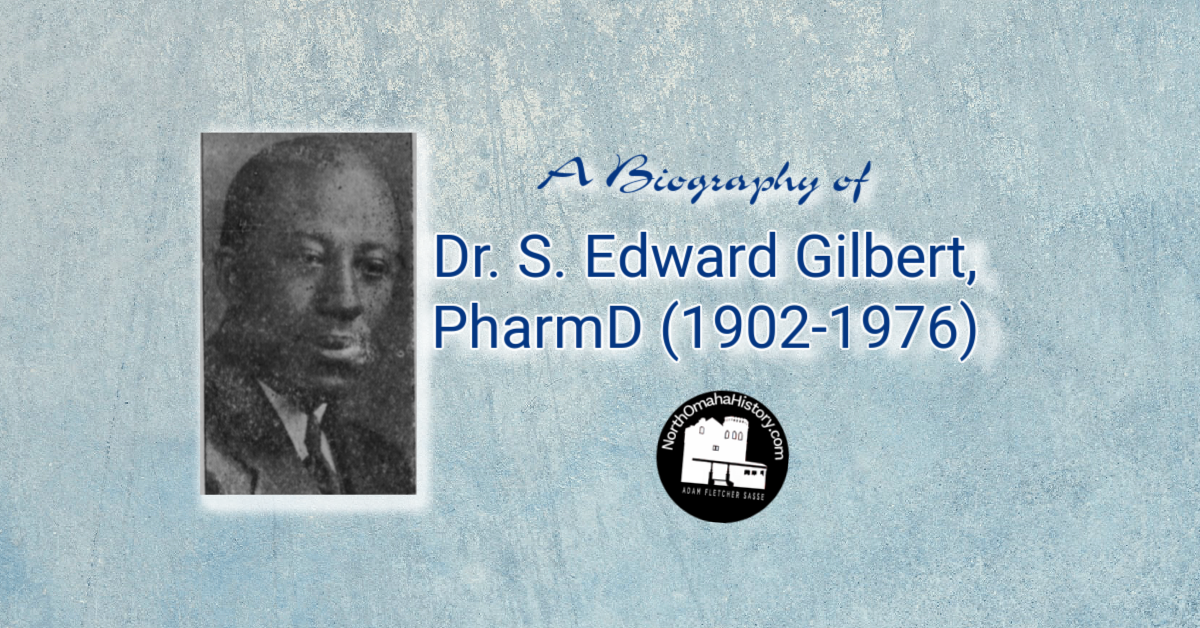
Sometimes a person’s legacy gets wiped out after they’re gone. In North Omaha, we’ve lost many leaders’ actions and impacts to erasure, censoring and silence. This is a biography of newspaper editor, businessman and community leader S. Edward Gilbert.
Early Life

Shirley Edward Gilbert (November 27, 1902-April 16, 1976) was born in Culleoka, Tennessee. His mother’s name was Hattie Brice (1885-1977) and he had a sister named Clennie.
Graduating primary school in Culleoka, young S. Edward earned a Bachelor’s degree in teacher education from the now-defunct Turner College, a private HBCU (Historically Black Colleges and Universities). Turner was located almost an hour away from the town where he grew up, and must have closed just after he graduated, because it has been defunct since the late 1920s.
After graduating from Turner, Gilbert moved to Washington, D.C. where he graduated from Howard University with a pharmacy degree in 1928. Later, he also earned a doctorate in pharmacology and studied journalism. While at Howard, he was a member of Phi Beta Sigma, an African American college fraternal organization founded a little more than a decade earlier.
After graduating from Howard, Gilbert became a science professor at Campbell College, another private HBCU, in Jackson, Mississippi, and a professor of chemistry at Saint Paul’s Polytechnic Institute, a private HBCU in Lawrenceville, Virginia.
Heading to Middle America
S. Edward Gilbert met Midred D. Brown (1905-1989) in the early 1930s in Sioux City, where her father was a minister. The couple connected around their love of Black journalism and launched a newspaper called the Silent Messenger together. It ran for two years.
The couple moved to Chicago and Des Moines. In 1933, Mr. Gilbert was the leader of a segregated YMCA in Des Moines. Later in life, his ex-wife Mildred recalled having a hard time renting a storefront in those cities for her husband to operate a drug store. Because of that, Gilbert took a job as a historian for the Works Progress Administration and authored The History of the Negro in Sioux City from 1855 to 1900, the first publication of its kind. In 1934, he found a space to rent in Sioux City and and started a drug store there.
While in Sioux City, Gilbert was credited with organizing several organizations including the Booker T. Washington Community Center, a segregated Boy Scout troop, the Interracial Commission, the Negro Men’s Booster Club, and the Negro Youth Council. While there he was also a member of the Black Elks, the Prince Hall Masons, and the AME Church. A member of the National Pharmaceutical Association, he also established and edited a newspaper called the Silent Messenger.
Coming to Omaha

In 1936, the Omaha Guide hired Gilbert to run the newspaper’s growing circulation department. Almost immediately, he began writing a children’s column under the pen name “Uncle Gil,” earning a good reputation throughout the community.
Gilbert was recognized as a leader in Omaha’s Black community almost immediately after arriving, immediately joining the volunteer leadership of an attempt to restart the Omaha Colored Commercial Club and serving as the president of the National Negro Congress Council of Omaha in 1937. The Congress was established a year earlier at Howard. Painting a vivid portrait of white supremacist terrorism facing African Americans in the previous year, in his position Gilbert called for justice and empowerment for the city’s Black community. Later that year, he was selected as the chairman of the Sub-Session on the Problems of Foreign Born Negroes at the Negro Congress Congress Annual Conference in Philadelphia.
“Victories are not won by wishing but by fighting. And the desire for individual freedom and security in America will be gauged by the effectiveness with which Negroes support this fight.”
—S. Edward Gilbert, 1937 National Negro Congress Council of Omaha Conference
After a disagreement with editors over the direction of the Omaha Guide, Mildred and her husband left the Omaha Guide to proudly establish “Omaha’s only Negro-owned newspaper” in 1938. Their newspaper was called the Omaha Star, and it continues today as Nebraska’s only African American newspaper. Gilbert was originally the general manager and Mildred was the financial manager. Founded as a champion of social justice, from its start the banner motto for the paper was, “For the service of the people that no good cause shall lack a champion, and that evil shall not thrive unopposed.”
In 1939, Gilbert became a leader in the newly-formed Omaha Negro Chamber of Commerce . Dr. D.M. Peebles was the first president, with S. Edward Gilbert as the president-elect. Active into the 1960s, the Chamber launched major State of the Community events to inform the entire state of the activities of Nebraska’s African American population.
Gilbert wasn’t without controversy. In 1940, he and his wife were walking in downtown Omaha when they were physically attacked by a man. After he hit S. Edward and throwing Mildred, the couple escaped into the Omaha City Hall and pressed charges against the man. He alleged they owed him money, despite a judge having found otherwise in an earlier court trial.
On February 12, 1943, Gilbert was invited to speak about the life of George Washington Carver at the Nebraska State Legislature. Later that year he and Mildred were divorced. Afterward, Gilbert maintained his stature in the community for another decade, going back to his original profession as a pharmacist. He continued leading a variety of civil rights campaigns and stayed involved in the community. In 1946, he was elected the national director of “Bigger and Better Business” at the Phi Beta Sigma annual convention.
Life After Omaha

Dr. Gilbert was in his 40s when he left Omaha and moved to St. Louis in late 1946. Marrying again there, his second wife was Virginia M. Gilbert. Their kids included Rosalyn and Shirl E. Jr..
In January 1947, a newspaper article credited him with being involved in saving a number of lives after a train wreck happened. The Panama Limited was heading south from Chicago to New Orleans when “six coaches of the southbound train” derailed near Ruddock, Louisiana. Helping two white doctors along with another Black pharmacist, Dr. Gilbert was credited with helping people with serious injuries despite having wounds himself. There were around 100 wounded passengers.
Dr. Gilbert lost his larynx to throat cancer in 1949. That year, he participated in a cutting edge technological advancement when he was given an artificial voice box. The subject of a medical journal article from that era, he was noted as an “enthusiastic public speaker and lecturer in Missouri before he had the laryngectomy…” The same article reported that “After some time of adjustment to the artificial voice box, Gilbert went back to public speaking.”
After working for a St. Louis drug company for two years, Dr. Gilbert became a pharmacist at a segregated hospital. Starting in the 1950s, he ran his own business called Pyramid Professional Pharmacy for eight years. After closing it, he worked in several other pharmacies in St. Louis. Civic engagement stayed central to Dr. Gilbert’s life.
By the 1950s, he was referred to regularly in the media around issues related to civil rights and more. His career advanced, too, and he served as an attending member of the National Pharmaceutical Association annual convention. Gilbert served as the chairman of the St. Louis Council for Political Education in 1960. Through that group he led the launch of an anti-segregation campaign calling for affirmative action in public accommodations across the city. Later in his career, Dr. Gilbert worked for several nonprofits including the Human Development Corporation, H.E.L.P. and others. In 1962, Dr. Gilbert ran to be a state representative in the Missouri State Legislature, but came in fifth out of seven candidates.
When he died, his ex-wife wrote of many other activities he participated in, and several awards he was given to acknowledge his service to the community and Black people specifically.
He died in 1976. By May of that year he had wrestled with an aggressive cancer for a month, and he passed away early the next one. Outlived by his mother and his sister, who both lived in Los Angeles, Gilbert was well-loved. In his will, Dr. Gilbert explicitly asked for his body to be donated to science, and it went to the St. Louis University School of Anatomy. Memorializing her ex-husband, in 1976 Mildred Brown wrote in the Omaha Star, “He was a man for all seasons, loved, respected and admired by people throughout St. Louis and across the nation.”
“He was a man for all seasons, loved, respected and admired by people throughout St. Louis and across the nation.”
—Mildred Brown, Omaha Star, May 6, 1976
As of 2024, there is little acknowledgment of Mr. Gilbert’s contributions in Omaha. His legacy in co-founding the Omaha Star is overshadowed by his then-wife’s longevity and legacy, and the groups he led are all gone now. No streets, buildings or other memorial monuments carry his name and apparently, none of his family are in Omaha today.
Perhaps someday Omaha will remember this businessman, newspaper editor and community leader as well as Mildred did.
You Might Like…
- A History of the Omaha Star
- A Biography of Mildred Brown by Jody Lovallo
- A History of African American Newspapers in Omaha
- A History of 24th Street in North Omaha
MY ARTICLES ON AFRICAN AMERICAN NEWSPAPERS IN OMAHA
Newspapers: The Enterprise | Omaha Star | Omaha Guide | The Omaha Whip |
People: Ferdinand Barnett | Cyrus D. Bell | Rev. Dr. John Albert Williams | Comfort Baker | George Wells Parker | C. C. Galloway | Mildred Brown | Dr. S.E. Gilbert
MY ARTICLES ABOUT THE HISTORY OF N. 24TH ST.
NATIONAL REGISTER OF HISTORIC PLACES: 24th and Lake Historic District | Calvin Memorial Presbyterian Church | Carnation Ballroom | Jewell Building | Minne Lusa Historic District | The Omaha Star
NEIGHBORHOODS: Near North Side | Long School | Kellom Heights | Logan Fontenelle Housing Projects | Kountze Place | Saratoga | Miller Park | Minne Lusa
BUSINESSES: 1324 North 24th Street | 24th Street Dairy Queen | 2936 North 24th Street | Jewell Building and Dreamland Ballroom | 3006 Building | Forbes Bakery, Ak-Sar-Ben Bakery, and Royal Bakery | Blue Lion Center | Omaha Star | Hash House | Live Wire Cafe | Metoyer’s BBQ | Fair Deal Cafe | Carter’s Cafe | Carnation Ballroom | Alhambra Theater | Ritz Theater | Suburban Theater | Skeet’s BBQ | Safeway | Bali-Hi Lounge | 9 Center Five-and-Dime | Jensen Building
CHURCHES: Calvin Memorial Presbyterian Church | Pearl Memorial United Methodist Church | Immanuel Baptist Church | Mt Moriah Baptist Church | Bethel AME Church | North 24th Street Worship Center
HOUSES: McCreary Mansion | Gruenig Mansion | Redick Mansion
INTERSECTIONS: 24th and Lake | 24th and Pratt | 24th and Ames | 24th and Fort | Recent History of 24th and Lake | Tour of 24th and Lake
EVENTS: 1898 Trans-Mississippi and International Exposition | 1899 Greater America Exposition | 1913 Easter Sunday Tornado | 1919 Lynching and Riot | 1960s Riots
HOSPITALS: Mercy Hospital | Swedish Covenant | Salvation Army
OTHER: Omaha Driving Park | JFK Rec Center | Omaha University | Creighton University | Bryant Center | Jacobs Hall | Joslyn Hall | Harlem Renaissance
RELATED: A Street of Dreams | Redlining | Black History in Omaha | North Omaha’s Jewish Community | Binney Street | Wirt Street


Leave a Reply