
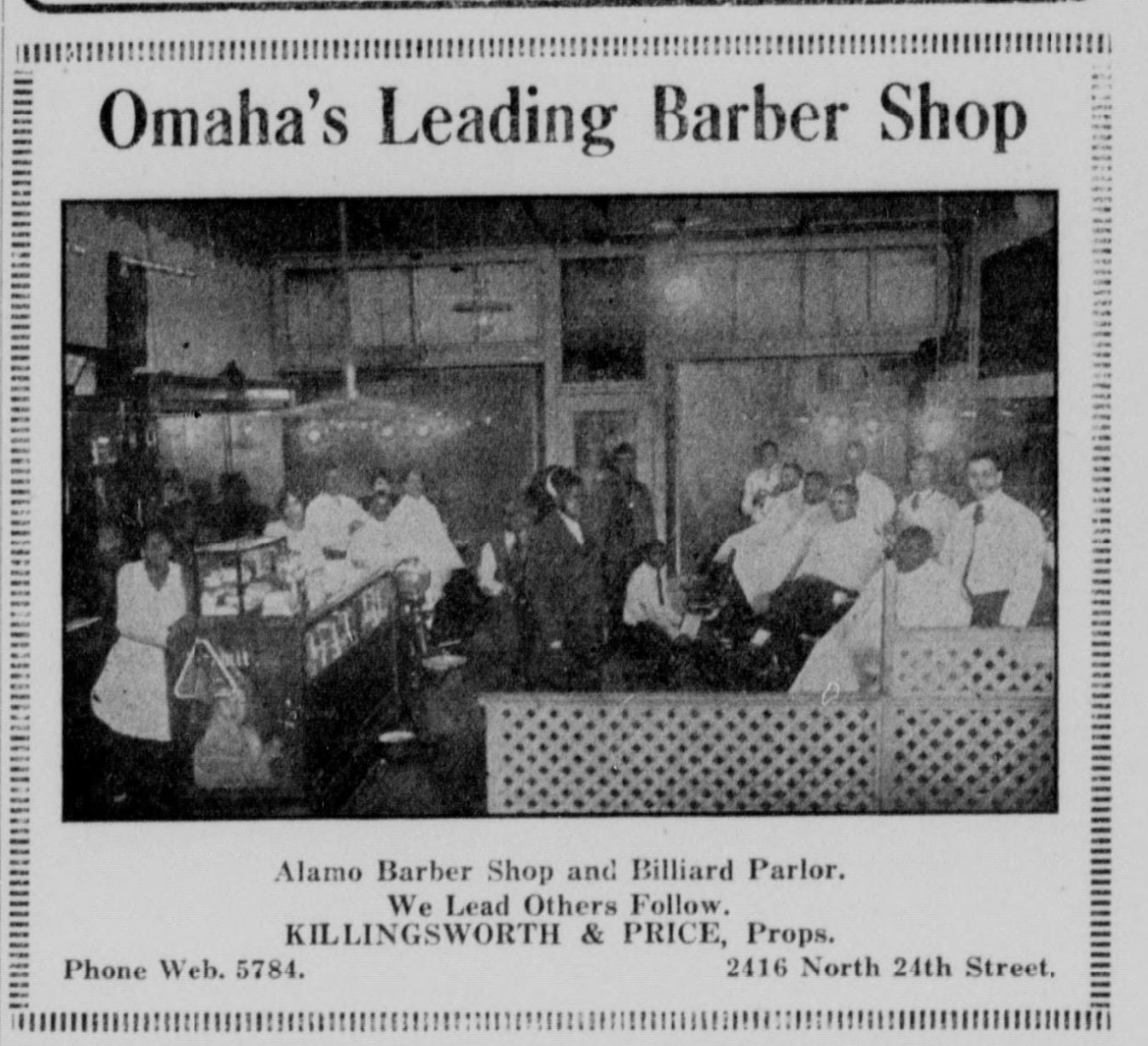
In the history of North Omaha, there have literally been more than 1,000 businesses owned by African Americans since 1856 when the city was established. However, some lasted longer than others. This is a history of one of the oldest Black-owned businesses in Omaha called the Alamo Barber Shop.

Located at 2416 North 24th Street at the intersection of 24th and Lake, the business was a storefront in today’s Union for Contemporary Arts. It was actually built after the Easter Sunday Tornado of 1913, and the storefront was home to a laundry service before the First World War.
After returning from World War I, African American veterans were hungry to work and improve the community. Some stood out for others because of their work ethic, the community contributions or their leadership. E.W. Killingsworth and R.C. Price, the two men behind the Alamo Barbershop had both, in spades.
Claiming to have “stepped into the lead and given to the public things unheard of in Colored shops in the city,” Killingsworth and Price were proud, determined businessmen. Their barbershop included a reading room and restrooms, a shower bath, and a number system to take care of the high volume of customers. “We advertise and don’t knock” was the motto for years, and the barbers were determined to “further the barber business and bring to the people their very needs, more than all the shops put together have ever done.”
In addition to their services, Killingsworth and Price offered a pocket billiard parlo along with “a full line of choice cigars, tobaccos, cigarettes, candies and chewing gum.”
Edward William Killingsworth (1890-1956) and Reuben C.A. Price (1894-1956) started their business in 1917. The media referred to the business as “the oldest barber partnership in the state, and known from coast to coast.”

Price was a barber and community leader in North Omaha for his entire career. In World War I, he served as a private in the US Army Alabama 9th Regiment Cavalry. After the war, Price went into business with fellow WWI veteran Edward W. Killingsworth and shared a shop at until 1955, when he retired after 38 years of business.
Price was a former leader in the Knights of Pythias; a member of the Negro Associated Press; a member of the Prince Hall Masons; and a longtime churchgoer.
A longtime president of the Omaha NAACP, he was credited with several successes fighting for Civil Rights in Omaha, including the end of Jim Crow signage in Omaha restaurants and addressing pro-segregation protests in the neighborhood near Fort Omaha.
Price was first married to Mintie until she passed in 1936; his second wife, Vera, was extremely involved in the North Omaha community. His funeral was at St. John’s AME Church and he was buried in Prospect Hill Cemetery.

Ed W. Killingsworth was a businessman in North Omaha, Nebraska, who co-owned the Killingsworth & Price Barber Shop. Along with being a leader in the African American community, he was a commander of the American Legion Roosevelt Post No. 30. In World War, I he served as a Battalion Sergeant Major in the US Army.
A veteran of World War I like his business partner, Killingsworth was a commander of the American Legion Post #30. He was also a Prince Hall Mason, a member of St. Phillip’s Episcopal Church and a member of the Mid-City Businessman’s Association. In honor of his service to the community, Killingsworth was named an Admiral of the Navy of the State of Nebraska. After graduating from high school in Paris, Texas, he attended barber college there, too, as well as in Chicago. He got a bachelor’s degree from Drake University before joining the US Army.
His funeral was at Zion Baptist Church with an Episcopalian minister officiating. Killingsworth was buried in his family’s cemetery in Paris, Texas.
Retirement and Memory


This is Ed Killingsworth and Reuben Price, both pictured in 1954 in separate newspaper articles.
After running their business for 36 years, Killingsworth and Price closed the Alamo Barbershop in 1953. Price ran for the Omaha Board of Education in 1954, but didn’t win. They died in the same year, 1956, with Reuben going in March and Ed going in October.
The building at 24th and Lake has lived a long, eventful life, and today is recognized as an iconic African American structure through its listing on the National Register of Historic Places. The Alamo Barbershop was mentioned in the application. Unfortunately, nothing is done today to acknowledge its longest tenants, Killingsworth and Price. These two men contributed so much to the community, and their legacies live on today more than a century later.
You Might Like…
MY ARTICLES ABOUT THE HISTORY OF N. 24TH ST.
NATIONAL REGISTER OF HISTORIC PLACES: 24th and Lake Historic District | Calvin Memorial Presbyterian Church | Carnation Ballroom | Jewell Building | Minne Lusa Historic District | The Omaha Star
NEIGHBORHOODS: Near North Side | Long School | Kellom Heights | Logan Fontenelle Housing Projects | Kountze Place | Saratoga | Miller Park | Minne Lusa
BUSINESSES: 1324 North 24th Street | 24th Street Dairy Queen | 2936 North 24th Street | Jewell Building and Dreamland Ballroom | 3006 Building | Forbes Bakery, Ak-Sar-Ben Bakery, and Royal Bakery | Blue Lion Center | Omaha Star | Hash House | Live Wire Cafe | Metoyer’s BBQ | Fair Deal Cafe | Carter’s Cafe | Carnation Ballroom | Alhambra Theater | Ritz Theater | Suburban Theater | Skeet’s BBQ | Safeway | Bali-Hi Lounge | 9 Center Five-and-Dime | Jensen Building
CHURCHES: Calvin Memorial Presbyterian Church | Pearl Memorial United Methodist Church | Immanuel Baptist Church | Mt Moriah Baptist Church | Bethel AME Church | North 24th Street Worship Center
HOUSES: McCreary Mansion | Gruenig Mansion | Redick Mansion
INTERSECTIONS: 24th and Lake | 24th and Pratt | 24th and Ames | 24th and Fort | Recent History of 24th and Lake | Tour of 24th and Lake
EVENTS: 1898 Trans-Mississippi and International Exposition | 1899 Greater America Exposition | 1913 Easter Sunday Tornado | 1919 Lynching and Riot | 1960s Riots
HOSPITALS: Mercy Hospital | Swedish Covenant | Salvation Army
OTHER: Omaha Driving Park | JFK Rec Center | Omaha University | Creighton University | Bryant Center | Jacobs Hall | Joslyn Hall | Harlem Renaissance
RELATED: A Street of Dreams | Redlining | Black History in Omaha | North Omaha’s Jewish Community | Binney Street | Wirt Street


Leave a Reply to Brenda WatkinsCancel reply