
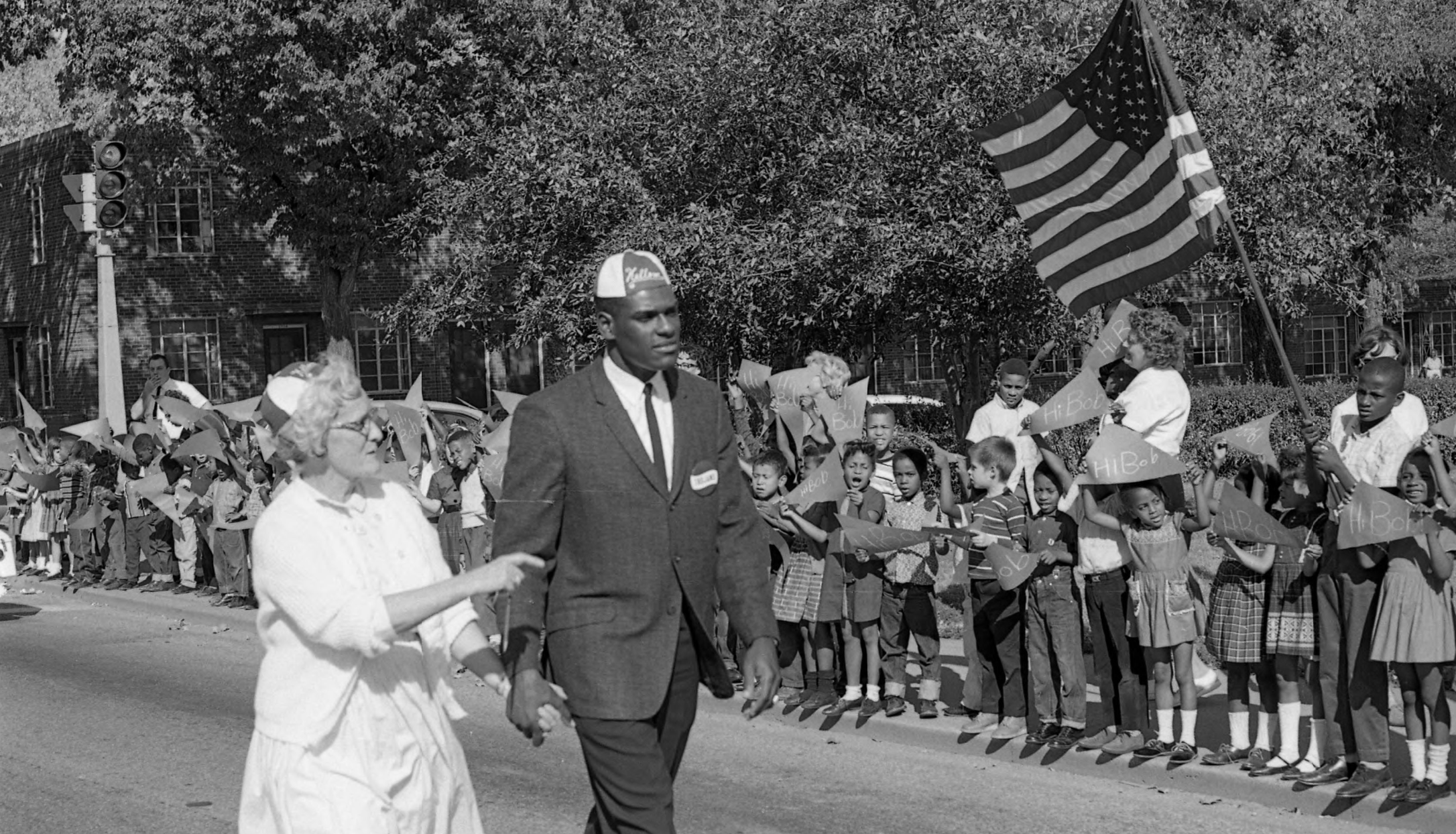
The legends, the trailblazers, and many of the people who put Omaha on the map in the world of sports have been African Americans. This is a testament to the sheer talent and relentless spirit that has poured out of the city, breaking barriers and setting new standards. This is a history of Black athletes, Black teams, and segregated sports in Omaha.
Swinging for Fences

The history of Black baseball in Omaha is woven with defiance, talent, and pride. As far back as 1893, Dorcas Lewis (1874-1939) made history, breaking the color barrier as a successful first baseman for the Omaha Originals. His talent was undeniable, with media at the time declaring him “among the best first basemen the town has ever had.” Just two years later, in 1895, Vasco Graham (1875-1913), a standout from Omaha High School, became the first Black professional athlete from Omaha when he signed with a barnstorming team in Michigan. Graham’s dedication continued as he later organized the all-Black semi-pro Omaha Giants in 1910.
By 1911, this independent Negro League team, the Omaha Giants, was formally established, playing across Omaha and the Midwest until 1915. The early 1920s saw further development with the Omaha Federals starting in 1921, and emerging as the first Black semi-professional baseball club in the city. They competed against other Black teams nationwide for at least three seasons. Between 1922 and 1936, the Omaha Colored Baseball League flourished as a Black-only amateur league, featuring at least six teams primarily playing in North Omaha. They included the Cudahy Rex baseball team among others. While a planned professional Negro National League team called the Omaha Black Bisons never fully materialized in 1925, Omaha’s connection to professional Black baseball grew.
After World War II, in 1947, the Omaha Rockets launched as the city’s first fully professional Black baseball team, playing for three seasons. The Rockets, an independent professional Black baseball team, played a crucial role in the post-war era. The integration of baseball began to open doors, and in 1955, Tom Alston (1926-1993) became the first African American player on the Omaha Cardinals semi-professional baseball team, a significant step forward locally. Just a few years later, in 1959, Bob Gibson (1935-2020), a Tech High School graduate and multi-sport star, became the second Black major league baseball player from Omaha when he signed with the St. Louis Cardinals, where he would go on to an illustrious career.
The Omaha Eagles, an All-America League club, also played from 1957 until 1965, challenging various competitors, including Negro League teams like the Kansas City Monarchs. Omaha continued to send its talent to the big leagues, with Frank White (b.1950) signing with the Kansas City Royals in 1973 and Willie Wilson (b.1955) joining the Royals in 1976, both playing in Omaha during their careers. More recently, Lorenzo Cain (b.1986) continued this legacy, signing with the Milwaukee Brewers in 2010.
Driving and Dominating the Court

Omaha’s basketball history is equally rich with pioneering Black athletes. Bob Boozer (1937-2012), a Tech High graduate who set league scoring records and led Kansas State to two NCAA Final Fours, became the first Black major league basketball player from Omaha in 1960 when he signed with the Cincinnati Royals. He went on to play for several professional teams until 1971. In 1968, Ron Boone, another Tech High graduate from their state championship team, joined the professional ranks in the ABA with the Dallas Chaparrals. Nate Archibald (b.1948), though not originally from Omaha, became a professional NBA player in 1970 with the Cincinnati Royals, notably playing for the Kansas City–Omaha Kings and Boston Celtics during his 14-year career, earning a spot in the Naismith Memorial Basketball Hall of Fame in 1991.
On the women’s side, the city also saw early professional representation. Rosie Walker, a star player for the Nebraska Wranglers of the Women’s Professional Basketball League (WBL), was a key figure when the team was active in Omaha in 1981. As an African American player, Rosie Walker can be recognized as the first professional women’s basketball player in Omaha, leading the Wranglers to a league title and earning MVP honors. Later, in 1993, Maurtice Ivy, a celebrated 1984 Central High School graduate and two-time state champion, began her professional basketball career with the Women’s Basketball Association (WBA), earning MVP honors in 1994 with the Nebraska Express. Her impressive collegiate career at the University of Nebraska included being named 1988 Big Eight Player of the Year and a two-time Kodak All-American, cementing her legacy with multiple Hall of Fame inductions.
Gridiron Greats Changed the Game

Omaha’s football heroes carved their own path to greatness. Beyond James F. Hall, II’s early high school achievements, Preston Love, Jr. (b.1942) graduated from Tech High in 1960 as a standout, earning all-state honors in football and basketball and a state championship in high hurdles. After lettering with the Nebraska Cornhuskers, he was drafted by the Detroit Lions and played professionally for the Lincoln Comets in 1965.
The NFL welcomed Omaha’s first professional football player in 1965 when Gale Sayers (1943-2020) was drafted by the Chicago Bears. Sayers graduated from Central High in 1961 as a star in football and track.
In 1968, Marlon Briscoe (1945-2022) made history as a professional football player in the AFL, signing with the Denver Broncos. This Omaha South star became the first African American to play quarterback in the NFL, a true pioneer, and his impact is commemorated with a street sign and a statue in Omaha.
Johnny Rodgers (b.1951), a Tech High graduate voted high school athlete of the year in 1969, went on to win the Heisman Trophy in 1972 with the Nebraska Cornhuskers before playing in the Canadian Football League and NFL, with a street sign on Burt Street honoring his legacy.
The coaching ranks also saw Omaha talent rise, with Ron Prince (b.1969), born and raised in North Omaha, becoming an American football coach in the NFL and for a college team in the 1990s.
The tradition of professional running backs from Omaha continued with Ahman Green (b.1977), who played twelve seasons in the NFL after turning professional in 1998 with the Seattle Seahawks. In 1986, Larry Station became a professional football player in the NFL, signing with the Pittsburgh Steelers. Calvin Jones joined the NFL in 1994, signing with the Los Angeles Raiders. In 2007, Kenton Keith (b. 1980), another North Omaha native, was signed as an NFL running back with the Indianapolis Colts.
Fight Night in North O

Omaha’s fighters have also left their mark. Joey Parks began his professional boxing career as a lightweight contender in 1957, once holding the number nine ranking worldwide. In 1975, Lamont Kirkland, a Black professional boxer from Omaha, began a remarkable run, winning a record-breaking six Golden Gloves titles and a national championship in 1980, culminating in a USBA super middleweight title fight in 1987. The world of Mixed Martial Arts saw Houston Alexander turn professional in 2001, fighting in the Ultimate Fighting Championship (UFC).
In the wrestling arena, Ed “Bearcat” Wright (1931-1982) began his professional wrestling career in 1957, a career that spanned into the 1970s and earned him a posthumous induction into the WWE Hall of Fame. Breaking barriers in coaching, Don Benning became the first Black professional college wrestling coach in Omaha in 1963 when he was hired by Omaha University.
The most recent and perhaps most astounding “first” in Omaha’s boxing history belongs to Terence “Bud” Crawford (b.1987). After a successful amateur career, his professional journey began in 2008. By 2023, Crawford achieved an unprecedented feat, becoming the first Black professional boxer in Omaha and in the world to simultaneously hold all four major world titles in boxing (WBA, WBC, IBF, and WBO) in two different weight classes (junior welterweight and welterweight). This monumental achievement solidified his status as one of the sport’s pound-for-pound best.
Other Sports

Omaha’s Black community accomplishments in athletics extends to the ice, with Keith Jones making history in 1992 as the first Black professional hockey player from Omaha to sign with an NHL team, the Washington Capitals. In 1997, the first Black PGA professional was hired in Omaha. The impact of Black athletes also extended to sports leadership. Omaha’s own Steve Hogan (1953-2008) became the first Black PGA professional in Nebraska in 1997. He founded Hogan’s Junior Golf Heroes in 1990, a program that used golf as a “hook” to teach life skills to hundreds of youth annually, earning him the PGA Junior Golf Leader of the Year in 2003. His enduring legacy is honored by the renaming of Miller Park Golf Course to Steve Hogan Golf Course in 2009.
Legacy and the Future

This timeline is just a glimpse into the incredible athletic history of Omaha’s Black community. These individuals and teams, through their talent, dedication, and perseverance, not only achieved personal greatness but also paved the way for future generations, inspiring countless others to pursue their dreams in the world of sports. Today, there are a few memorials to individual athletes from Omaha Black history, but no single monument to their great achievements. Maybe someday in the future that will be fixed!
Questions, comments or thoughts? Please share them!
You Might Like…
MY ARTICLES RELATED TO SPORTS IN NORTH OMAHA
Main: Black Sports in Omaha
People: Dorcas Thornton | Will Calhoun | Vasco Graham
Teams: Omaha Rockets | Omaha Eagles
Organizations: Red Dot Athletic Club | Near North YMCA | Gene Eppley Boys Club | Midwest Athletic Club | Omaha Colored Baseball League
Places: Kountze Place Golf Club | YMCA Athletic Park | Fontenelle Park | Omaha Driving Park | Lakeside Raceway | Omaha Speedway
MY ARTICLES ABOUT BLACK HISTORY IN OMAHA
MAIN TOPICS: Before 1850 | Black Heritage Sites | Black Churches | Black Hotels | Segregated Hospitals | Segregated Schools | Black Businesses | Black Politics | Black Newspapers | Black Firefighters | Black Policeman | Black Women | Black Legislators | Black Firsts | Social Clubs | Military Service Members | Sports
EVENTS: Stone Soul Picnic | Native Omahans Day | Congress of Black and White Americans | Harlem Renaissance in North Omaha
RELATED: Enslavement in Nebraska | Underground Railroad in Nebraska | Racist Laws Before 1900 | Race and Racism | Civil Rights Movement | Police Brutality | Redlining
TIMELINES: Racism | Black Politics | Civil Rights | The Last 25 Years
RESOURCES: Book: #OmahaBlackHistory: African American People, Places and Events from the History of Omaha, Nebraska | Bibliography: Omaha Black History Bibliography | Video: “OmahaBlackHistory 1804 to 1930” | Podcast: “Celebrating Black History in Omaha”



Leave a Reply