
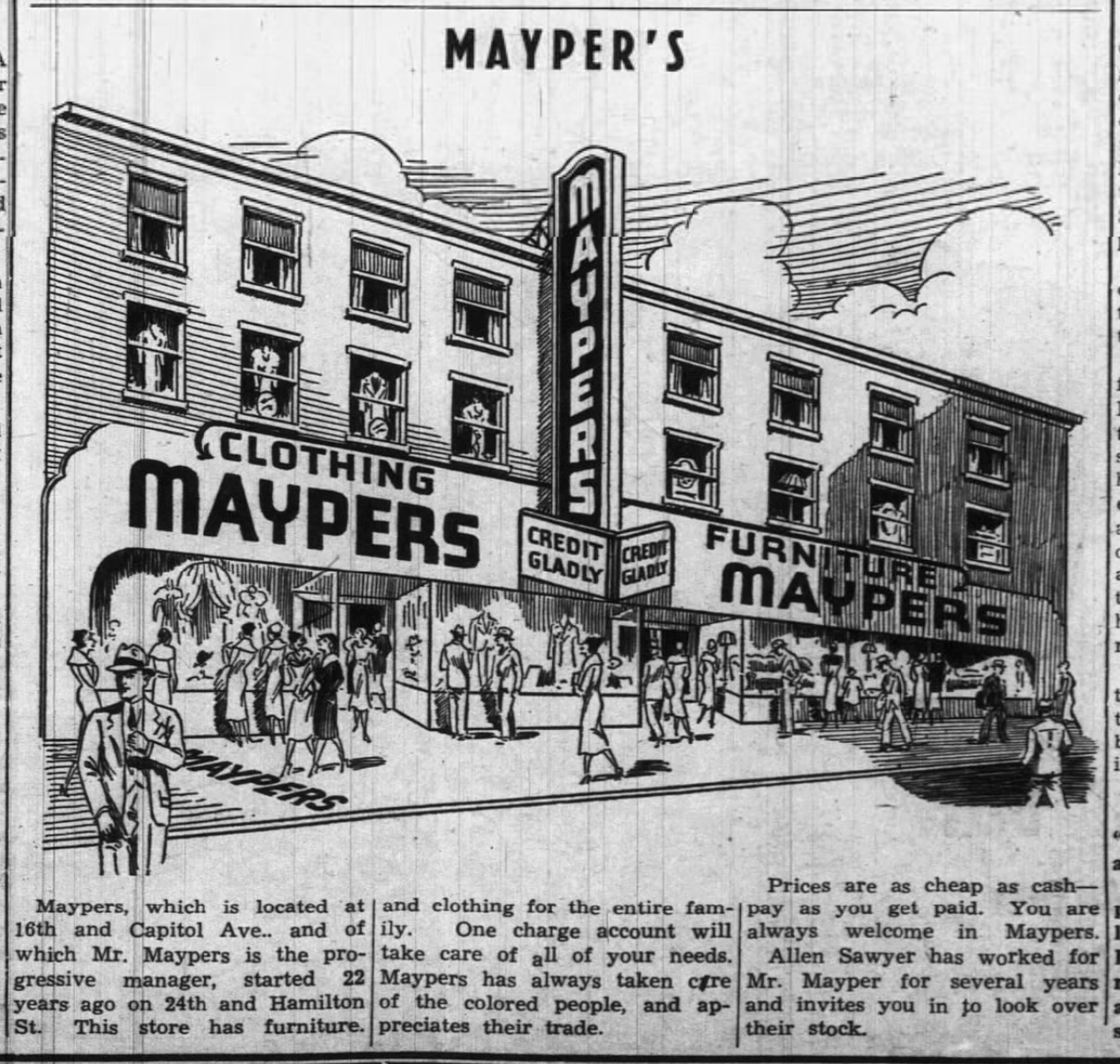
The the area north of Dodge Street and south of Cuming was lined with large stores, especially along North 16th Street. A commercial dynamo, the area was like a shopping mall but all along the street instead of inside. One of the largest was “the biggest store on one floor.” This is a history of Mayper’s Store in Omaha.
Meet Milton Mayper

Despite the fact that his obituary was just one short paragraph, Milton Mayper (1898-1993) was a successful businessman who had influenced Omaha for generations when he died at 95 years old.. As one of Omaha’s most enduring innovators in its retail sector he left a large footprint into which many others have walked.
Mayper’s first wife Bertha (1902-1936) died in 1936 after a longtime “critical illness.” Leaving Milton with two children Stanley “Stan” (1921-2003) and Adele (1919-2005), Mrs. Mayper was a busy socialite whose support for her husband was noted in the newspapers. She was buried at Pleasant Hill Cemetery in North Omaha, which was later renamed Temple Israel Cemetery.
In the late 1930s, Milton was remarried to Lucille Cohn (1900-1982). It was a social event when Adele married Joseph Hornstein of Omaha in 1938, and when Stan married Sally Astor of Leavenworth, Kansas, in 1943, it was important, too. Stan eventually took over the business.
Launching a Business

A Jewish immigrant from Rumšiškės, Lithuania, Mayper came to Omaha around 1917, and soon after started his first business in the Near North Side by North 24th and Decatur Street. Called the Reliable Mercantile Company, it was located in a two-story building at 1809 North 24th Street, Mayper’s store openly courted Black customers in an era when businesses were becoming more racially segregated, and welcomed Jews and the mixed European and American neighbors around it, too.
A 1920 article from The Monitor said the Reliable Mercantile Company “enjoys a large patronage from colored people.” Located at 1809 N. 24th St. for more than a decade, its customers were North Omaha’s Jewish community, as well as Black and white neighbors. At his store, Mayper offered cash or credit to customers. He appealed directly to Jewish customers, suggesting in more than one ad that “It will pay the Jewish people to get acquainted with the Reliable Mercantile Company.” Advertising exclusively in The Monitor, he also won many Black customers. An early article about him said, “He enjoys a large patronage from colored people, which he appreciates. Mr. Mayper’s courtesy, affability and fair dealing with all his customers accounts for his success. Mr. Mayper has a rapidly growing business. He sets a good example for others.”
Offering clothes, furniture, and other household goods, Mayper’s offered seasonal specials on winter coats and summer dresses, and a lot more. Mayper was a success, and in 1923, Reliable Mercantile moved to a bigger storefront located at 1406 North 24th Street on the northwest corner of 24th and Hamilton. That location only lasted five years though.
Moving Downtown

In 1928, the Mayper’s Store opened in the Leflang Building at 206 North 16th Street. The Leflang Building was constructed at North 16th and Capitol Avenue around 1874 on land that was originally owned by the Council Bluffs and Nebraska Ferry Company, Mayor Jesse Lowe, A.J. Poppelton, and others. According to Omaha historian Micah Evans, the building was originally constructed as Omaha’s Freemason’s Hal in 1876. After the Masons opened their new building at 19th and Douglas in 1917, they sold Freemason’s Hall to Emil Leflang (1850-1929) in 1919 for $198,000. Along with the Masons, some of the earlier occupants of the building included Rees Printing Company, Forsyth Pharmacy, Jonsen’s Jewelry Store, and Mrs. Moody’s Crockery Store.
Located in the Jefferson Square neighborhood, Mayper invested in this upscale location to increase business by serving the city from a more central location. He focused stock on clothing and household goods, and grew the business a lot over the next several years. The Great Depression took its toll though, and Mayper’s suffered. However, they overcame this challenge and kept going. Located across the street from the Loyal Hotel, Mayper’s was considered one of the important downtown stores that drove Omaha’s retail marketplace. Other neighbors included the old Omaha Post Office.
The store suffered a setback in 1933 when a fire swept through the facility. It was just a few years earlier when they had a water main break and ruin $10,000 in stock. However, with this damage to the Leflang Building, the store was forced to sell everything quickly to recoup costs. It didn’t go out of business though, and soon after kept going.

Just before the U.S. entered World War II, Mayper’s finished remodeled his store at 16th and Capitol in 1941. Expanding to include several buildings, Mayper’s included half the block facing North 16th Street.
Fire Changed Everything

In November 1947, Mayper’s Store was devastated by a massive fire that “almost completely gutted” the entire building overnight. The massive structure of the LeFlang Building was demolished, with several buildings located on the floors of the building and damage to Mayper’s “ran into hundreds of thousands of dollars.” They did manage to recover jewelry and records from the store though, and immediately after promised to reopen. Three people were saved from the four-story structure, which included businesses and residences. The massive blaze was new Fire Commissioner Glenn Cunningham’s first emergency, and he attended the fire without proper gear. Cunningham Lake was later named in his honor.

Aside from Mayper’s, several other businesses were damaged too including Midwest Intertypers, a printing plant with five journeymen, the Spotlight Liquor Store, Ortman Bakery, Film Exhibitors Printing Company, a commercial photographer, a beauticians supply company, and a restaurant called the Dean Lunch Room.
In late December 1947, a sealed copper box was found in the cornerstone of the Leflang Building that had the date of October 21, 1876 on it, as well as the name of George H. Thummel, the lodge’s grand master. Scheduled to be opened in January, the box was an exciting find because there were no records on construction of the building. The time capsule found in the cornerstone wasn’t opened until June 1948. Then, a ceremony was held during a three-day meeting and the collection was revealed: Several copies of 72-year-old newspapers including the Omaha Bee, the Omaha Herald, and the Omaha Republican. There were also lodge papers, lists of government officials, coins, and Masonic items. There was also an advertisement for the Omaha Book Company within. The Omaha World-Herald labelled the find “a dud.”
The final cost of the fire was placed at $500,000, and there was never an official cause stated.

An original 1937 plan advocated for the federal government to bulldoze the old Omaha Post Office to replace it with a combined post office and federal building on the site. After that did not happen then, in the 1940s a city planning process concluded that Capitol Avenue could be closed from North 16th Street to the Joslyn Museum, and that the federal site could be expanded to include the entire area from North 16th to North 17th, from Dodge to Davenport. Earlier in 1947, the federal government proposed building a $7million dollar two-block post office building there. In December 1947, after the fire, the Omaha City Council passed a resolution encouraging the federal government buy the land before a new building was constructed there. However, Congress didn’t designate money for the construction and the plans were stalled when the fire occurred. As soon as the next month those plans were abandoned though, and a parking lot was prescribed for the site. The federal government did eventually acquire the land, but did not open a new structure on it for another 15 years when the Edward Zorinsky Federal Building opened.
According to historian Evans, “The US Government subsequently bought the lot, which is why the Zorinsky Federal Building is on that site today.” If you’re interested, My Omaha Exploration uncovered some interesting details about the ownership of the land after the fire.
Life After the Fire
In December 1947, Mayper’s relocated to 2562 Leavenworth Street. There, the store’s motto was “Nebraska’s largest department store on one floor.” Advertising to military members at SAC in the 1950s, by 1955 the company was under the leadership of Milton’s son Stan, who proudly announced a renovation with an open house and massive sale that year.
The business closed that address in 1960, and soon reopened exclusively as a clothing store at 2241 Jefferson Street in Bellevue, staying open until 1967. The Mayper’s name went away that year though when the store closed permanently.
Remembering Mayper’s
Milton Mayper died in 1993 and was buried at the Beth El Cemetery in Omaha.
Today, there appear to be no memorials to him or his legacy in the retail sector in Omaha. However, in 1946 the family did start a real estate company, and eventually that company named a street in their Carter Lake housing development Mayper Drive, where it still exists today. The former store building on Leavenworth still stands, too.
Mayper’s Store Locations
- 1st Location: 1809 N. 24th St. (1917-1923)
- 2nd Location: 1406 N. 24th St (1923-1928)
- 3rd Location: 206 N. 16th St. (1926-1947)
- 4th Location: 2562 Leavenworth St. (1947-1960)
- 5th Location: 2241 Jefferson St. Bellevue (1960-1967)
You Might Like…
- History of Department Stores in North Omaha
- History of Department Stores in Benson
- A History of 24th Street in North Omaha
MY ARTICLES ABOUT THE HISTORY OF N. 24TH ST.
NATIONAL REGISTER OF HISTORIC PLACES: 24th and Lake Historic District | Calvin Memorial Presbyterian Church | Carnation Ballroom | Jewell Building | Minne Lusa Historic District | The Omaha Star
NEIGHBORHOODS: Near North Side | Long School | Kellom Heights | Logan Fontenelle Housing Projects | Kountze Place | Saratoga | Miller Park | Minne Lusa
BUSINESSES: 1324 North 24th Street | 24th Street Dairy Queen | 2936 North 24th Street | Jewell Building and Dreamland Ballroom | 3006 Building | Forbes Bakery, Ak-Sar-Ben Bakery, and Royal Bakery | Blue Lion Center | Omaha Star | Hash House | Live Wire Cafe | Metoyer’s BBQ | Fair Deal Cafe | Carter’s Cafe | Carnation Ballroom | Alhambra Theater | Ritz Theater | Suburban Theater | Skeet’s BBQ | Safeway | Bali-Hi Lounge | 9 Center Five-and-Dime | Jensen Building
CHURCHES: Calvin Memorial Presbyterian Church | Pearl Memorial United Methodist Church | Immanuel Baptist Church | Mt Moriah Baptist Church | Bethel AME Church | North 24th Street Worship Center
HOUSES: McCreary Mansion | Gruenig Mansion | Redick Mansion
INTERSECTIONS: 24th and Lake | 24th and Pratt | 24th and Ames | 24th and Fort | Recent History of 24th and Lake | Tour of 24th and Lake
EVENTS: 1898 Trans-Mississippi and International Exposition | 1899 Greater America Exposition | 1913 Easter Sunday Tornado | 1919 Lynching and Riot | 1960s Riots
HOSPITALS: Mercy Hospital | Swedish Covenant | Salvation Army
OTHER: Omaha Driving Park | JFK Rec Center | Omaha University | Creighton University | Bryant Center | Jacobs Hall | Joslyn Hall | Harlem Renaissance
RELATED: A Street of Dreams | Redlining | Black History in Omaha | North Omaha’s Jewish Community | Binney Street | Wirt Street
BONUS



Leave a Reply