
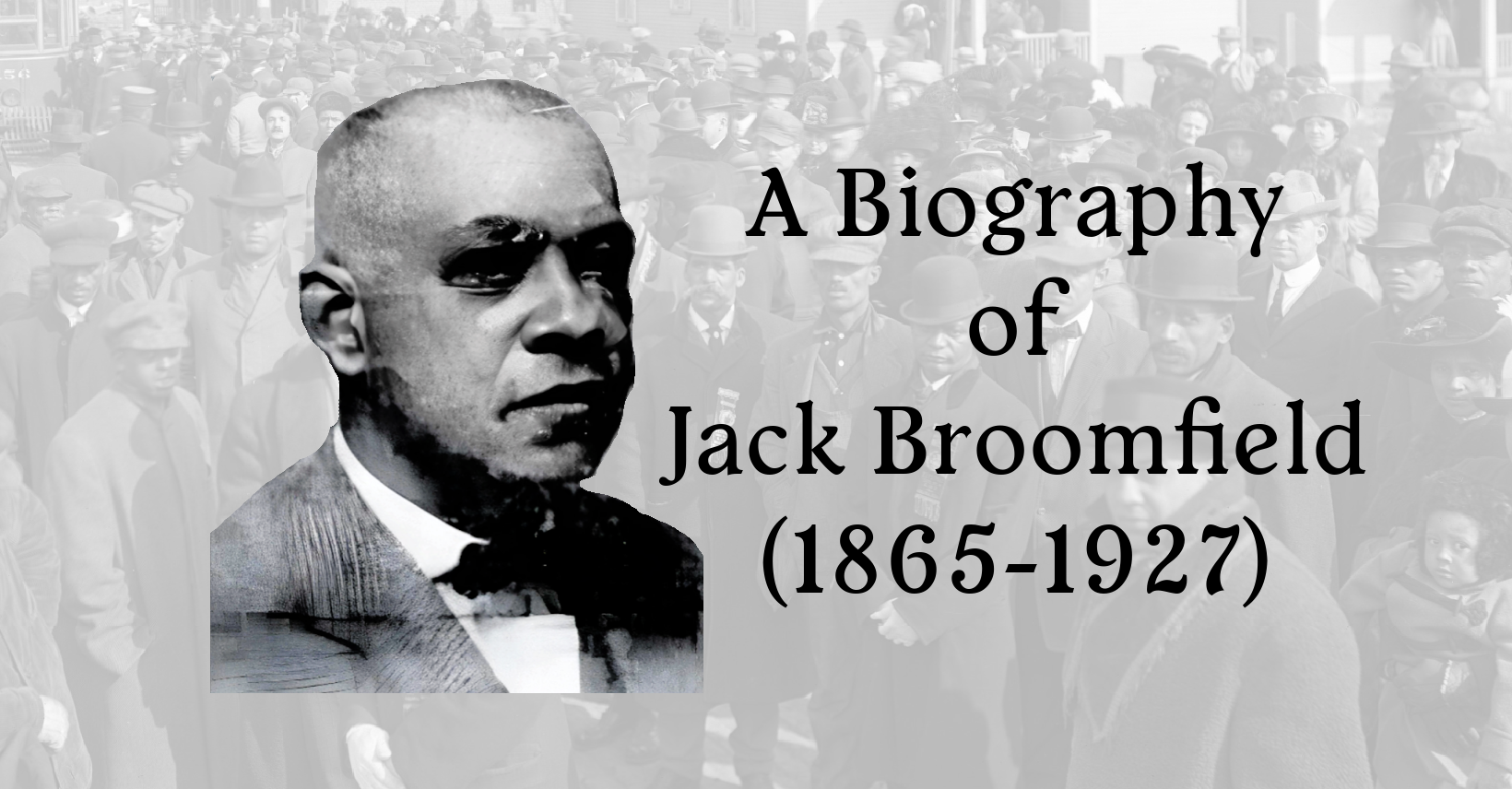
John Henry “Jack” Broomfield (1865-1927) was an African American businessman who was a political leader of Omaha’s Black community. He was also a reputed crime boss in North Omaha.
Arriving in Omaha

Born June 2, 1865 in Savannah, Missouri, Jack Broomfield’s life started at the end of the Antebellum era. With the Civil War ending, his parents Levi Broomfield and Louisa Powell Broomfield eventually moved their family to Red Oak, Iowa.
Once a Pullman porter, Jack’s career with the railroad ended he was in a train wreck that resulted in the loss of his leg. In 1882, Jack married Gertrude “Gertie” in Davenport, Iowa, and she was a key player in his enterprises for almost 20 years. They adopted LeRoy Chester “Roy” Broomfield (1902-1971), who was also called Lee early in his life.
After the family arrived in Omaha in 1887, they eventually lived at 2024 Lake Street on the edge of the present-day 24th and Lake Historic District. Jack’s father and some of his siblings eventually lived in Omaha, too.
He and Billy Crutchfield banded together as business partners in 1889, running a shady bar together until 1917.
In the early 20th century both crime boss Vic Walker and politician Dr. Matthew Ricketts left Omaha under suspicious circumstances. The previous leaders of the Black community, their absence left room for Broomfield to become the leader around 1904 after rising up in the ranks. In 1908, Jack and Gertie were divorced.

That’s when Omaha’s crime and political boss Tom Dennison granted Broomfield co-ownership of the notorious bar called the Midway at 12th and Davenport Streets, reputed for its criminal activities. In a report on the city in the late 1890s, suffragette leader Elizabeth Cady Stanton (1815-1902) called the Midway the “most notorious dive in Omaha.” In that era, the saloon was noted for its “opium smoking, gambling and licentiousness.” Faro, roulette, dice and other games were played too, all in front of a sign that notably said, “If you have a family that needs your money, don’t gamble here.” Its behavior didn’t change over the years.
Running the Midway

At some point, Jack acquired a large home at 2224 Lake Street. More than one report referred to his house as a “palatial residence.”
Located at 1124 Capitol Avenue in the notorious Sporting District, the Midway was a bar, gambling hall and drug den where criminals, prostitutes, gamblers and others hung out. Along with Crutchfeld, the men were indicted for gambling and other crimes repeatedly. With an opium den in the basement and a brothel upstairs, the building had open crap shooting, blackjack tables and more.
A wealthy man for decades, Broomfield was noted as being “the wealthiest colored man in the city” before he died. An obituary noted, “He was well liked by the people of his own race and he had unlimited friends among the white race.”
In 1912, reports on a raid on Broomfield’s Midway show how corrupt Omaha was during that era. Storming the joint in full force, Broomfield and several of his customers were cited and ordered to show up for court. Broomfield’s four trials were held in the Douglas County Court, all of them ending in hung juries. At the last one, when a juror didn’t show up, a substitute was chosen from the crowd. Coincidentally, he became the only member to vote to acquit Broomfield. After a grand jury ordered the case moved to district court, two more trials ended in deadlock, and the case was dismissed.

In modern times, Broomfield is remembered because he contracted local African-American architect Clarence W. Wigington to build the Broomfield Rowhouse at 2502-2504 Lake Street in 1913. Constructing an identical structure next door to Crutchfeld, the Broomfield Rowhouse is a duplex designed in a simple vernacular style.
In 1914, a newspaper reported that Jack’s ex-wife Gertie was warned to close her “private resort” at 11th and Douglas Street, which was an address shared with her ex-husband. This implications suggested that at that point she was a madame who ran a brothel.
By 1916, the Omaha World-Herald was barking again and calling Broomfield’s Midway, “the … most vicious of gambling and liquor joints to be found in this or any other city.” That year, Nebraska voters adopted Prohibition, and it took effect in May 1917, two years before the Eighteenth Amendment to the U.S. Constitution was adopted, nationally prohibiting alcohol production and consumption.
In the years before 1920, Omaha’s African American community wasn’t especially proud or congratulatory of Broomfield or his actions. During his reign over the Near North Side, newspapers such as The Monitor and The Enterprise complained that Broomfield was more interested in promoting his own interests than promoting the interests of his community. Broomfield was slipping: He said he would wrangle votes to keep Blacks in office, but allowed many positions formerly held by African Americans to be taken by whites.
In 1917, Broomfield and Crutchfield lost control of the Midway when the City of Omaha closed it down in the name of the Prohibition.
By 1919, he bought a farm in the Ponca Hills north of Florence, eventually acquiring more than 120 acres of land in the area. That year, he was still called the “Third Ward Boss” in local media.
Past the Old, Into the New

Jack’s son joined the US Army in 1919, and when he returned later that year he ran his father’s new business, the Monarch Billiards at 14th and Dodge Street. In early 1919, a Dallas newspaper reported that Broomfield was an advisor to an all-African American owned oil company based in Kansas City. In April of that year, he faced a rebuke from the Omaha City Council when they denied him a license to run a new soft drink parlor in the Sporting District. It stung.
It was around this time that Jack started providing financial support to the Negro Old Folks Home and getting lauded for his philanthropic behavior by Rev. John Albert Williams in The Monitor. Regularly applauded in columns, Jack apparently turned the corner and became seen as a positive force in North Omaha, at least by some.

However, it was also under his watch that the lynching of Will Brown occurred. While it is difficult to say whether any African-American leader could have prevented such mob terrorism, its not impossible to see Broomfield’s role. He apparently did nothing to prevent the subsequent redlining of the Near North Side and other forms of segregation throughout the city, too.
After the Midway closed, Broomfield became the owner of the Peoples Drug Store at 14th and Dodge Streets and started a real estate business he was president of called Dunbar Realty. Dunbar sold extensive holdings in Omaha real estate to African Americans. Broomfield was invested in other real estate too, including the Blackstone Hotel in Omaha.
Towards the End
After spending a few weeks in the hospital in 1925, Broomfield was revealed as having been diagnosed with heart disease. Soon after he began giving his money away, extensively depleting his funds. Soon after in 1925, Broomfield consolidated his real estate business with his son’s real estate business called L.C. Broomfield Real Estate. The new business was incorporated as J.H. Broomfield and Son Realty, selling real estate and insurance throughout the city and beyond.
By the time he died, Broomfield reportedly only had $50,000 in the bank. In 2024, that’s almost a million dollars, so his wealth during his years must have been vast. A month before he died, Broomfield was baptized by Rev. John Albert Williams and joined the St. Phillips Episcopal Church.
Broomfield died on September 7, 1927. Upon his death, the Lincoln newspaper said he was “supreme dictator of negro politics in Omaha.” There were two funerals for Broomfield, with a public one at St. Phillip’s Episcopal and the other at the Elks Club, of which he was a longtime member and supporter.
Dennison was a pallbearer at Broomfield’s funeral, where he said Broomfield was,
“one of the old school of political workers and he could always be depended upon to take care of the colored vote and he never failed… [Jack] was true blue and always loyal.”
When he died, Jack owned 113 properties in Gary, Indiana and Omaha. His Omaha properties included his home at 2124 Lake Street, the Broomfield Rowhouse, and a store at North 24th and Erskine. He also held stock in a building and loan association, mortgages and jewelry worth more than $10,000. When he died, his adopted son LeRoy inherited $50,000 dollars, which is worth almost $1,000,000 today.
In 1943, when his ex-wife Gertie would have been 75 years old, someone by her name lived at 2868 Miami Street. Levi stopped appearing in the written record after 1927 but may have gone on to become a noted dancer, performing worldwide in cabarets, ballrooms and exotic places in Hollywood, China, New York and Chicago.
Remembering Jack
Today, the Broomfield Rowhouse is listed on the National Register of Historic Places as part of the 24th and Lake Historic District. There are no other monuments or memorials to John H. “Jack” Broomfield in Omaha today.
Special thanks to Jake Seeman for contributing the pic of Broomfield!
You Might Like…
- A Biography of LeRoy Broomfield
- A History of Early 20th Century Crime Bosses in North Omaha
- A History of Community Leaders in North Omaha
MY ARTICLES ABOUT BLACK HISTORY IN OMAHA
MAIN TOPICS: Before 1850 | Black Heritage Sites | Black Churches | Black Hotels | Segregated Hospitals | Segregated Schools | Black Businesses | Black Politics | Black Newspapers | Black Firefighters | Black Policeman | Black Women | Black Legislators | Black Firsts | Social Clubs | Military Service Members | Sports
EVENTS: Stone Soul Picnic | Native Omahans Day | Congress of Black and White Americans | Harlem Renaissance in North Omaha
RELATED: Enslavement in Nebraska | Underground Railroad in Nebraska | Racist Laws Before 1900 | Race and Racism | Civil Rights Movement | Police Brutality | Redlining
TIMELINES: Racism | Black Politics | Civil Rights | The Last 25 Years
RESOURCES: Book: #OmahaBlackHistory: African American People, Places and Events from the History of Omaha, Nebraska | Bibliography: Omaha Black History Bibliography | Video: “OmahaBlackHistory 1804 to 1930” | Podcast: “Celebrating Black History in Omaha”
Elsewhere Online
- Jack Broomfield on Wikipedia
- Jack Broomfield on findagrave.com
BONUS

Notes on the Broomfield Family
An interesting thing happened while I was researching this article. Like many stories, written documents kind of show the Broomfield family simply emerging in Omaha and then disappearing from the city. But there were a lot of complicating factors that I had to unravel, and I’m sharing them here.
Jack Broomfield’, the story is complicated by many factors including ‘s complications included his successes as a Black businessman, his role in Omaha’s crime syndicate led by Tom Dennison, his philanthropy in the Black community, and his wealth, which for an African American man in Omaha, Nebraska in the early 20th century was uncommon and generally acceptable to the white power structure.
To understand the story of Jack Broomfield better, we should start by examining his family. In 1818, a Black woman was born in Missouri named Rachel (1818-1882?). Rachel was the mother of a son named Levi Broomfield (1842-1893), born in Missouri, too. He married Louisa Powell (1842-1893), who was also from Missouri. The couple were parents to several children, including Johnson “Jack” (1865-1927), George (1873-1937), Jacob “Jake” (1874-1916), Harry (1878-1910), Levi (1877-after 1922), Nathan (1879-1885), and Gertrude (1883?-1940?). Most of the children were born in Savannah, Missouri, while the youngest three were born in Kansas City, Kansas. Jack’s parents Levi and Louisa moved to Omaha. When Louisa died in 1893, the Evening World-Herald reported she was buried in the Laurel Hill Cemetery. I haven’t identified his father’s grave site yet.
As the eldest, Johnson Henry “Jack” started his career early and moved along quickly, as noted earlier. After he moved to Omaha, he brought his family with him, with several staying in Omaha permanently. He was married to Gertie from 1882 to 1908, and their adopted son was LeRoy.
Jack’s younger brother Jake moved to Omaha by the late 1880s, and in 1896 he lived at 2501 P Street with his wife Sallie. They had three children, Benjamin (1895-1912), Coresia, and a second unnamed son (1898-1898). After Jack died in 1916, Sallie remarried a man named Fred Payne and by 1917 was living at 4920 Railway Avenue. In 1918, she was living at 4930 South 27th Street. I don’t know when she died. Their children lived in Omaha. Benjamin “Bennie” Broomfield (1895-1912) was the 17-year-old son of Jake and Sallie Broomfield of Omaha, Nebraska. In December 1912, he was killed in an accident at the Savoy Hotel in downtown Omaha. He was buried on December 27th, 1912, at Forest Lawn Cemetery in Omaha. Coresia Broomfield was born after Bennie and in 1919 was married to a man whose last name was Shockley. The couple also had a third unnamed son born in 1898.
George was another brother of Jack’s who was born in Savannah in 1873. In 1896, he was the clerk of Mt. Pisgah Baptist Church and managed several musical and theatrical productions at the church. He was married to Delia E. Williams in 1900, and the couple had one daughter and two foster daughters. The family moved to St. Louis, Missouri sometime before 1910 and George died there in 1937.
Jack’s brother Harry was born in 1878 in Kansas, and eventually came to Omaha as a laborer. He moved to Omaha after his brother became a crime boss. Harry died in 1910 after a long illness and his funeral was held at St. Philips Episcopal Church. He was buried at Omaha’s Forest Lawn Cemetery.
Aside from Jack, the most noted of the siblings in the Broomfield family was probably Levi, born in Missouri in 1877. Performing as a classical singer throughout his life, he was a tenor who performed with some of the biggest names in Omaha including Dan Desdunes and Cecilia Jewell. In the 1920s, advertisements referred to him as “The Man Who Sings to Beat the Band.” He was involved in politics and lived at 1204 Dodge St, 1124 Dodge St. and 2115 N. 26th St. His wife (unnamed) and he lived at 2613 Patrick St. in 1922. Starting in 1923, Levi ran a business called the Smoke House at 1912 Cuming St, and offered a “Buick Sedan Taxi Service.” He was regarded as a successful businessman. Levi was an active member of the Black Elks. Levi was personal friends with Bill “Mister Bojangles” Robinson (1878-1949), an internationally known entertainer. Levi hosted Bojangles several times when his tours stopped in Omaha, including in 1923. Levi left Omaha after his brother died in 1927 and I have not found when or where he died.
Jack’s youngest brother was Nathan, who was born in Missouri in 1879. In 1919, Nathan was married and lived in Newton, Iowa. When Jack died, Nathan lived in Chicago.
There were still mentions of several Broomfield family members in Omaha in the 1930s, but after that point they dwindle to almost nothing. Jack divorced Gertie in 1908, and their son Levi disappeared from Omaha after his father’s death in 1927. Jack’s brothers George, Jake, and Harry all stayed in Omaha, but weren’t noted again after 1930. I have not found their graves yet. Nathan moved to Iowa and back to Omaha, and Jack’s only sister Gertrude died in Kansas City, Kansas, where she lived all of her life.



Leave a Reply