
Adam’s note: There were many burlesque theatres in Omaha’s history. According to Wikipedia, burlesques had three parts, including 1) songs and ribald comic sketches by low comedians; 2) acts like acrobats, magicians and solo singers; 3) chorus numbers and sometimes a political performance or a current play. The entertainment was usually concluded by an exotic dancer or a wrestling or boxing match.
This article highlights 15 different businesses in Omaha that featured burlesque, including theatres and ballrooms and more. It is a guest post comes from an expert on burlesque, Iona Fortune. It highlights some of the burlesque theatres throughout the city’s past. Thank you for sharing Iona! For readers, please leave any questions or comments below.
1. The Trocadero Theatre at 419 S 15th St.
The Trocadero Theater opened its first season with the Miaco’s Burlesque Circuit in 1899. It was located at 419 South 15th Street in Omaha, NE. Starting off, it was a theater within the Miaco’s Burlesque Circuit, which booked shows in conjunction with the Empire Circuit. It featured a new bill every week, each company bringing its own set, lighting, and cast. The orchestra was the only permanent installment. Prices for seats ranged from 10 cents to 75 cents. Matinees were given each Sunday, Tuesday and Thursday afternoons. (Omaha Hotel Reporter, August 1900)

Here is a brief and incomplete list of shows that performed at the Trocadero:
- Frank B. Carr’s Beauty Show (Omaha Morning World Herald, 1900)
- Indian Maidens Burlesque Company headed by Pearl Marquem (burlesquer) (Omaha Morning World Herald, 1900)
- Star Vaudeville Acts; Swan & Bambard, Cunningham & Smith, Bessie Phillips, Lamar Sisters, Mack & Matthews, and Belle Gordon. (Omaha Morning World Herald, 1900)
- Miss Dollie Rathbun-Chesley – Soloist (Omaha Morning World Herald, 1900)
- The Thoroughbred Burlesquers (Omaha Morning World Herald, 1902)
- Rosenthal’s Amateur Night (Omaha Morning World Herald, 1902)
- The Trocadero Opera Co. (Omaha Daily Bee, August 1899)
- H.M.S. Pinafore (Omaha Daily Bee, 1899)
- Cavalleria Rusticana (Omaha Daily Bee, August 1899)
- T.W. Dinkin’s Vagabond Burlesquers (Omaha Daily Bee, November 1900)
- A.H. Woodhul High Rollers (Omaha Hotel Reporter, August 1900)
- Sam Scribner’s ‘Gay Morning Glories’ (Omaha Hotel Reporter, August 1900)
- Ed Rushes’ Bon Ton Burlesquers (Omaha Hotel Reporter, August 1900)
2. Krug Theatre at 419 S. 15th St.
The Krug Theater was originally the Trocadero. It reopened as the Krug Theater in 1903 with a production of “Sweet Clover”, a comedic opera about the trifles of New England life. (Evening World Herald, Sept. 1903) In September of 1911 the Krug theater became ‘Home of the Folly’ operated under the Empire Circuit. Smoking was allowed on the lower floor of the theater with huge exhaust fans to combat the smoke. Two performances daily for a whole week was the new norm. “A Trip to the South Pole” by the Rector Girls Company was the first burlesque attraction to take place at the Krug Theater in January of 1911. (Omaha Daily News, January 1911)

(Omaha Morning World Herald. Krug Theatre Advertisement. Oct. 22, 1911)
1915 W.W. (Billy) Cole takes over management at the Krug again. He originally opened the Krug as the Trocadero and then opened Krug Park. (Omaha Daily Bee, November 1915) Broadway Gayety Girls opened at the Krug in March 1911. May Strehl performed a burlesque number. Carmel’s living model olio reproduced famous paintings using live models. A dozen or so were represented, like Millet’s L’Angelus and Banner’s Daphne. Georgia Campers was the headliner for the olio. (Omaha Daily News, March 1911) The Krug was added to the Empire Burlesque circuit, rounding out its 41 houses. Omaha was the farthest west of any of their theaters. In 1911 the lease had 2 and 1/2 years left. (Omaha Daily News, January 1911)

(Omaha Daily Bee, Krug Theatre Advertisement. Dec. 22, 1912)
Show Advertisements for the Krug Theatre:
- “Follies of the Day” – “The Garden of Girls” and Al Kaufman, the San Francisco heavy-weight and challenger of Jack Johnson will give sparring exhibitions. (Omaha Daily News, April 1911)
- The Jolly Girls burlesque troupe (Omaha Daily News, January 1911)
- “A Trip to the South Pole” by the Rector Girls Company (Omaha Daily News, January 1911)
- That Whirly Girlie Show “Follies of the Day” (Evening World Herald, April 1911)
- Cherry Blossoms Burlesque Co. (Evening World Herald, December 1911)
- Female wresting match between Ollie Martin and Estelle Sedal (heavyweight champions) (Evening World Herald, December 1911)
- William’s Ideal Burlesquers; A Whirly Girlie Show (Evening World Herald, Feb. 1907)
- Billy Watson and his Beef Trust Chorus in “Krousemyer’s Alley”. 30 girls with shapely shapes “Krug: Home of Family Burlesque – Catering to Polite Audiences” (Morning World Herald, Oct. 1911)
- Al Kaufman in Exhibitions at Every Performance (Omaha Daily Bee, April 1911)
- Gertrude Hays and the Dancing Bricktops and Louie Lacre “L’Obresponsible” (Omaha Daily Bee, April 1911)
- The Pacemakers; 4 Dancing Harmonists (Omaha Daily Bee, Jan. 1913)
- High Life in Burlesque with Pat White and Mlle. Marcia? 24 Girls; Country Store Friday Night (Omaha Daily Bee, Jan. 1913)
- The Rose Buds with Joe Adams, Helen Van Buren and a Garden of Girls in “A Circus Day” (Omaha Daily Bee, Nov. 1912)
- The Moulin Rouge Company in “The Toast of Paris”. Country Store Friday night, Ladies Daily Dime Matinee, Dainty Marie and the Yankee Doodle Girls. (Omaha Daily Bee, Dec. 1912)
- The Gay Girls of Gotham; with Sullivan and Abrahms, the Girl in Pink with her Dancing Musical Dolls and a Broadway Beauty Chorus (Omaha Daily News, April 1913)
- The Ducklings; all Broilers. 25 Dainty Dimple Darlings; “Oh You Lemon” performance and “Temptation” pantomime (Omaha Daily News, April 1911)
- Girls from Joyland: a Sirening Chorus of 55 Smile Coaxers, Special feature Blanche?
- The Merry Maidens; Harry Fields and Lilla Brennan (Omaha Daily News, January 1913)
- Zallah’s Own Company headed by Zallah; A Cabaret Rehearsal and the Unkissed Oriental (Omaha Daily News, March 1913)
- Gay Widows Company; The 5 alarcons and John Harat
- Miner’s Americans; the Big American Beauty Show with musical burlesque “A Yankee Doodle Girl”, 30 American beauties, See the Tango Dancers, 3 acts – longest in the circuit!
- Darlings of Paris (Omaha Daily News, February 1913)
- Lady Buccanaeers (Omaha Daily News, February 1913)
- The Rollickers (Omaha Daily Bee, July 1913)
- Whirl of Mirth company presents “In Cartoon Land” (Omaha Daily News, December 1912)
- Lew Hilton and Bert Lewis in “Pacemakers” (Omaha Daily News, January 1913)
- The Star Show Girls; “Florence Birthday Party” and “Helen’s Fate”. Carmelo’s Life Poses from Paris- Famous pictures from Louvre shown by Mons. Carmelo in living models. (Omaha Daily News, November 1911)
(Omaha Evening World Herald. Krug Theatre Advertisement. April 1911)

3. Gayety Theatre at 1514 Harney St. (1908-1931)
Originally called the Burwood Theatre, the Gayety quickly rose to infamy when it was renamed in 1908 and became a member of the Columbia Burlesk Circuit. The extravagance of the ‘Gayety Way’ was popular amongst patrons who enjoyed ‘cleaner’ burlesque and vaudeville acts. The Gayety wanted the shows to be seen as ‘cleaner’ and ads were placed with targeted wording, “Yes, indeed! Your wife or sister or sweetheart will be welcomed, entertained and NOT offended.” (Evening World Herald, Advertisement for Gayety Theatre. March 25, 1921)

4. Burwood Theatre at 1514 Harney St., 1908
Burlesque at the Gayety is written about in the New York Clipper in the Fall on 1914. Harry Hastings’ Big Show was playing the week of Wednesday October 7th, where a record breaking audience attended. E.L. Johnson, the manager, is written as a man determined to have a ‘clean stage’ in Omaha. He is reported to have traveled 15,000 miles and a total of 38 trips to Kansas City to see the circuit shows before they arrived in Omaha. An Omahan chorus dancer, Beatrice Dowling, was a cast member of the Big Show. “Usherettes” showed patronos their seats. Baby carriages were stored in the lobby, and smoking was prohibited (The New York Clipper. “Burlesque in Omaha” by KC. October 24, 1914)

Gayety Theatre, 1921. Daily Drover’s Journal Stockman
Note that the Krug Theatre, an Empire Burlesque Circuit theatre, was also operating at this time in Omaha. The Krug was not concerned with ‘clean’ productions. Omahans were able to see two new burlesque shows every week from two major burlesque wheels during the 1920s.

(Omaha Morning World Herald. Gayety Theatre Advertisement. Nov. 23, 1924)
Show Advertisements from the Gayety Theatre:
- “Whooping It Up” at the Gayety and “Knickerbockers” during the first week of the Ak-Sar-Ben activities. It was a funny show with bits and pretty girls—“No, no, one mustn’t forget that the big attraction at the Gayety is its girls—the stage is always filled with oodles of them.” Next week is the Carnival Parade week with Sam Howe and his “Love Makers”. Florence Bennet stars with a chorus of girls. The Article boasts that the Gayety is the most popular Theatre in Omaha. (Fillmore Weekly Chronicle, September 27, 1912)
- Gayety Real Burlesque: “Moonlight Maids” with Billy Hagan —Ama Toebe. Meet-you-at-the-gayety get-up-a-party. (Evening World Herald. January 2, 1928)
- The Gay Masqueraders in two act musical melange: “A Hot Old Time” “If It’s at the Gayety It’s Good.” Mlle. Ani – Society Gymnast, Flo Cushman and she can sing, 3 Melvin Bros. Marvelous Acrobats, Barney Duffy the Human Goat, Chorus girls’ contest Friday Night. (Omaha Daily Bee, December 1909)
- Trocadero’s “Finny at the North Pole” with Frank Finney, 24 unwrapped chorus of polar queens. Musical comedy (Morning World Herald, December 1910)
- The Big Gaiety Company. Amateur Night, cash prizes – audience to judge (Morning World Herald, April 1911)
- Ed. Lee Wrothe, Omaha’s Own Comedian, with his assemblage of live ones “the Ginger Girls” in “Janitor Higgins”. Saturday Night only Amateur Contest. (Omaha Daily Bee, 1911)
- The Golden Crook; introducing the Peer of Tramp Comedians— Billy Arlington— and 60 others in the clean, wholesome, Merry satire, “A Trip to the Moon.” Vaudeville by Whirls Comedy Harmonists, Arlington & Palmer, Jack Strouse, Edwin Trevor, Johnson & Buckley, Marshal & King, Harry Morton. The Spectacular Divertisement. The Ballet of the Seasons; a Veritable Fairyland Enchantment. Saturday night only: Amateur Contest, By gorgeously bedecked local gazelles. (Omaha Daily News, April 1911)
- Trocaderos led by Frank Finney, in speed-limit comedy, “Sweeney’s Vacation” with Minnie Burke and Sweet 16 Bunnie Scotch Lassies. (Morning World Herald, October 1911)
- “The theater that’s talked about home-coming week—Omaha’s own comic Ed Lee Wroth and his Extravaganza and vaudeville “Ginger Girls”— Snappiest of all fun shows. 2 1/2 hours of riotous mirth. Beauty Chorus. Ladies’ dime matinee every day.” (Evening World Herald, April 1911)

(Omaha Evening World Herald. Advertisement for Gayety Theatre. Jan. 4, 1924)
- Gayety, “Omaha’s Fun Center” Miss Barry Melton wears her Harem Skirt at every performance of Big Gaiety Co. Extravaganza and vaudeville. Including Sidney Dean & Co., Al Hermann, Rita Gould, Five Musical Gormans, and Sam Collins. Saturday night only: Amateur contest” (Omaha Daily Bee, April 1911)
- “Peter S. Clark’s Runaway Girls featuring John Burke Bros. In “the Maid of Montezuma.” (Morning World Herald, August 1912)
- Farewell tour of the Chalk Face Comedians Moore & Smith as “The Tin-Man” and “the Scare-crow” in “Merry Whirl”. Assisted by a company of 50, including American Parisienne, Petite William Fitzgerald and the Silk Stocking Chorus. (Omaha Daily News, November 1912)
- School Ma’ams Sessions in conjunction with the Broadway Girls. Geo P. Murphy “The Eminent German Dialect Comedian in a two act Musical Laugh-Fest”. Frank Wakefield and 30 beauty chorus. “Is das nicht ein Gartenhaus?” (Omaha Daily Bee, November 1913)
- Farewell Tour of Rose Sydell with her famous London Belles in a new musical farcical Satire “A Feast of Fun.” W.S. Campbell and Johnnie Weber. Your last chance to see the acknowledged Queen of Extravaganza Rose Sydell. Chew gum if you like but no smoking. Ladies Tickets 10 cents at any week day. Baby carriage garage in the lobby. Certified milk for the asking. (Omaha Daily News, April 1913)
- “Ak-Sar-Ben’s Undisputetd Diadem” “Luster without the Lust”. “Clean, Classy, Brilliant Musical Burlesque”, “The Gayety, ‘Omaha’s Fun Center’”, “Beauty Chorus of Bean-Eating Boston Girls” Charles H. Waldron’s Bostonians in “UP and Down Town”(Morning World Herald, September 1916)
- Jacobs & Jermon’s Burlesque Review; Harry K. Morton, Zella Russel, Danny Murphy, Flossie Everett, Julia DeKelty, “The Apple of Paris”, Travesty on “Uncle Tom’s Cabin.”, Dancing Beauty Chorus of Thirty. (Evening World Herald, March 1917)
- Jean Bedini’s “Twinkle Toes” Musical Burlesk and Jean Bedini’s Super-Burlesk “Peek-a-Boo” with Clark & McCullough. Ladies’ dime matinee week days. (Evening World Herald, March 1921)
- Jack Singer presents Burlesk’s most popular entertainer Lew Kelly and his own pick of Merrymakers. Mr. Kelly as “Fuller Bull”. Teems with brand new “Kellyisms” (Morning World Herald, December 1921)
- Jacobs & Jermon’s Golden Crook – A Fantastic, Bizarre Entertainment Crowded with Fun, music, Color and Spectacle. 100 Per Cent Girlie Chorus. Always a good show (Daily Drovers Journal Stock, February 1922)
- Cain and Davenport present the National Speed Show – Harry “Bananas” Steppe in “Dancing Around”. The Utmost in Musical Revue with America’s Foremost Colored Stars Buck and Bubbles (Courtesy of Nat Nazarro). Successors to Williams & Walker Highest Salaried Colored Performers in the World. Late stars on the Orpheum, Kieth and Shubert Circuits. Speed? Pep? Nothin’ but! Watch Bubbles Strut!! Hear Buck Play the Piano!! —and The Fastest Dancing Chorus in the World! Harry Steppe, who made bananas famous! (The Monitor, September 1923)
- Police inspection of New York’s theaters – “Columbia Burlesk is everything except what those who don’t attend think it is.” This week its “Hippity Hop” with Shannon and Leeming. (Evening World Herald, December 1923)
- Jack Reid’s “Record Breakers” with “Kewpie Doll Chorus” Midnight show with Election returns by special wire (Morning World Herald, October 1924)
- “Columbia Burlesk: Bathing Beauties with Clyde Bates, Jack Hunt, and a Big Cast of 22 Well Filled Bathing Suits. Aaron & Kelly- America’s Greatest Colored Singers and Dancers. Harry Evanston in “Giggles” in conjunction with the 10 musical spillers with St. Clair Dotson and Millard McConn. The Razziest, Jazziest Bouquet of Colored Folks who ever rolled into town on car wheels. BIG DOUBLE SHOW – 54 people – Count ’em Yourself. Don’t Hang Fire; Be Here Saturday Mat.” (Evening World Herald, January 1924)
- Jean Bedini’s “Peek-A-Boo” with Hairy and Willie Lander. Friday is “Garter Nite” and Columbia Burlesk’s 25th Anniversary Attraction ‘Happy Moments’ (Morning World Herald, February 1925)
- Columbia Burlesk’s 25th Anniversary Party “Happy Moments” with Lew White and Fay Herman. (Morning World Herald, February 1925)
- Gayety Real Burlesque: “Land of Joy” A Jolly Girlie Show (Evening World Herald, February 1927)
- A Real Peppy Fun Feast “Parisian Flappers” with Stelia Morrisey. You Simply Must See Our “Flossie?”- Flossie Devere (Morning World Herald, January 1927)
- Gayety Real Burlesque – Rube Bernstein’s Original “Bathing Beauties with Jack Hunt. See the Big Black and White Finale! (The Monitor, January 1927)
- Gayety Real Burlesk: Stone & Pillard, Omaha’s Most Popular Dancing Stars. Extra Added attraction: Darling Germaine the Queen of Quiver. (Omaha Evening Bee, March 1927)
- Gayety Burlesque now playing “Kandy Kids” with Jessie McDonald & Max Coleman. The sweetest show you ever did see. Ladies’ Mat. Every Day, 25 cents. (Omaha Bee News, October 1927)
- Gayety Real Burlesque: Now Playing “Girls from the Follies” with Fred (Falls) Binder and Gladys Clark. Ladies Matinee today. Get-Up-A-Party. (Omaha Morning Bee, February 1928)
List of Performing Groups in the ‘Far Reaching Columbia (Eastern Wheel) Circuit:
- Winning Widow
- Taxi Girls
- Social Maids
- Queens of Pair
- Ben Welch’s Burlesquers
- Girls of the Gay White Way
- Harry Hastings’ Big Show
- Girls from Happyland
- World of Pleasure
- American Beauties
- Star and Garter Show
- Robinson’s Crusoe Girls
- Sam Howe’s Love Makers
- Robie’s Knickerbockers
- The Trocaderos
- Beauty, Youth, and Folly
- AJ. Reeves’ Beauty Show
- Runaway Girls
- Jolly Follies
- Ginger Girls
- The Dazzler
- Mollie Williams
- Golden Crook
- Gaiety Girls
- Dreamland Burlesquers
- Cracker Jacks
- Bon-Ton Girls
- The Behman Show
- Gay Masqueraders
- Merry-Go-Rounders
- Midnight Maidens
- Columbia Burlesquers
- College Girls
- Merry Whirl
- Rose Sydell
- Bowery Burlesquers
5. Boyd Theatre at 1621 Harney St.

(Boyd’s Theatre. Photograph Postcard. Date Unknown. Photographer Unknown. Omaha, NE. History Nebraska)
In December 1890, the Boyd Theater hosted Kimball Opera-Comique and Burlesque Co. which featured a soubrette named Corrine. The company performed two productions: ‘Carmen’ and ‘Monte Cristo Jr.’–though the daily newspaper noted the scores bared no resemblance to the originals. The company was managed solely by Mrs. Jennie Kimball and was composed of 60 artists, including Bernard Dillon. Three acts composed Carmen; “Fostella’s La Surprise,’ ‘Grand March of the Picadores,’ and ‘Grand Bull Fight a la Mexicana.’ Corinne played Edmund Dantes in Monte Cristo Jr. (Omaha Daily Bee. Article and Advertisement for Boyd Theater. December 28, 1890)

6. Brandeis Theatre at 212 S. 17th St.

(Brandeis Theatre Postcard. Date Unknown. Photographer Unknown. History Nebraska)
Although the Brandeis Theatre typically hosted plays, musicals, and vaudeville productions, it dabbled in burlesque and a noteworthy ‘sex education’ photoplay. In 1924, “Some Wild Oats” showed at the Brandeis. The newspaper advertisements stated, “Men and women will not be admitted together. It shows everything. Calls ‘A spade a spade.’ Shows the naked truth. Special reels for Women Only. Special added attraction: Dr. L.A. Edwards of Chicago will lecture on Sex at All Performances. No children admitted. Actual scenes. Special Reels for Men Only.” (Omaha Evening World Herald. Advertisement for Brandeis Theater. January 4, 1924)

(Omaha Evening World Herald. Advertisement for Brandeis Theatre. Jan. 4, 1924)
The Brandeis brought the 9th Edition of Earl Carroll’s Vanities to Omaha in 1933. It had a company of 100, with 55 scenes, and 200 fan dancers! The advertisement in the Omaha World Herald stated, “9th Edition of America’s Greatest Revue- all new- Earl Carroll’s Vanities. 100 Laughs, 55 scenes. Original New York Production as seen last season on Broadway. Company of 100 with Al Trahan, Frank Mitchell, and Jack Durant. The Most Beautiful Girls in the World.” (Omaha World Herald. Advertisement for Brandeis Theater. January 13, 1933)

In 1934, the Theatre hosted “Fashion Follies of 1934.” The advertisement stated, “A Sensational Laugh Story Steps Out in gala Attire! The producers of ’42nd St.,’ ‘Gold Diggers’ and ‘Footlight Parade’ not offer their GREATEST! Fashion Follies of 1934 with this superb cast William Powell, Bette Davis, Frank McHugh, Hugh Herbert. 200 fan dancers! And on the same program: This year’s new blazing personality! See him in his first screen triumph! Francis Lederer in “Man of Two Worlds” with Elissa Land and Henry Stephenson. (Omaha World Herald. Advertisement for Brandeis Theater. February 21, 1934)
The theatre showed “Belle of the Yukon” with Gypsy Rose Lee in December 1944. (Evening World Herald. Advertisement. December 28, 1944)
Brandeis Theatre showed the films “Shockproof” and “Slightly French.” The companion feature “Slightly French” was described as a ‘gay romantic comedy with music.’ Dance routines included the French can-can and ‘carnival girlie show’ numbers. (Daily Record. “Theatre Program; Brandeis Theatre.” February 10, 1949)
In June 1952, the Brandeis showed the movie “She’s Working Her Way Through College.” (Morning World Herald. Advertisement. June 29, 1952)
7. Blackstone Theatre

Image from The Omaha Guide on May 20, 1944.
One production at the Blackstone Theatre is of importance to the history of burlesque in Omaha. In May 1944, the exotic dancer, Katherine Dunham, performed with her troupe in “Tropical Revue” at the Blackstone Theatre. A photograph of her likeness was included in the Omaha Guide.
8. Club Harlem at 2410 Lake Street

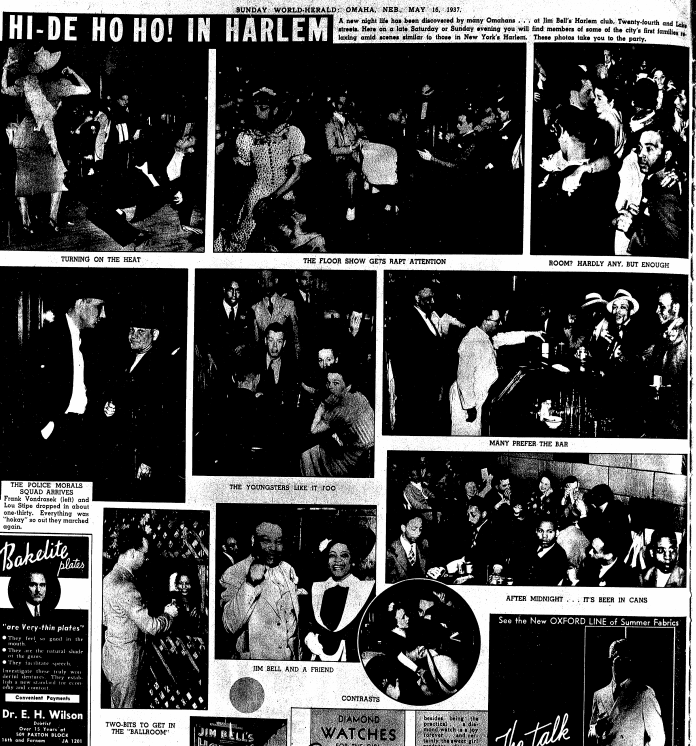
Although the entertainment history of 2410 Lake Street did not begin with Club Harlem, it was the first to advertise and host a burlesque dancer in the building. (The same location was previously the Diamond Theatre and then the Lake Theatre in the early 1900s.) Club Harlem was opened by Jim Bell (1884-1959), an African American restaurateur and entrepreneur, in 1933.

He opened multiple businesses in North Omaha, including the Midway Cafe and the Off Beat Cafe.

Image from The Omaha Evening Bee News on August 19, 1937.
The businesses were managed by Carrie Bell (1883-1964), his wife. Club Harlem employed a regular twelve-piece orchestra and a group of chorus line dancers, as well booking nationally known singers, musicians, and comedians. Club Harlem had an orchestra pit, a lunch counter with tables to serve food to patrons, and a grand space for dancing.

Image from the Omaha Star in 1938.
In 1937, Jim Bell’s Harlem hosted the ‘danseuse’ and songstress Daisy Boone. Miss Boone was an internationally known dancer with an unusual voice.

Image from The Omaha Guide on June 12, 1937.
Also in 1937, Bell hosted a boxing contest with the Catholic Youth Organization, along with vaudeville acts by “Jim Bell’s Harlem Revue.” Club Harlem continued to provide world-class entertainment for Omaha patrons until it’s close in 1938.
9. Swingland Cafe at 2410 Lake St.

In 1938, the location came under new management, Red Perkins, and renamed the Swingland Cafe.

Image from the Morning World Herald on November 30, 1938.

Image from the Evening World Herald on April 1, 1939.
It was then used by the 1000 Club for their headquarters until it was bought and renamed the Cotton Club in 1939.
10. Cotton Club at 2410 Lake St.

Image from the Evening World Herald on June 30, 1939.
Swingland Cafe was renamed not long after opening as The Cotton Club, which had a five piece orchestra, known as the Cotton Club’s Syncopators.
In September 1939, the Club hosted the shake dancer Jean Powell. There were two shows nightly at 10pm and midnight.

Article from The Omaha Guide on September 23, 1939.
11. Off Beat Club at 2410 Lake St.

Gerald Morris opened a new nightclub called the Off Beat Club in 1953 at 2410 Lake Street. The first floor was called “The Onyx Room” and the second floor became the “Skyroom Lounge” or “Skyroom Supper Club.” The Omaha Star stated, “This club brings to Omaha, the latest floor shows and bands. Such well known artists as Mable Scott, Savannah Churchill, Maxine Sullivan and Little Miss Sharecropper have appeared in the Skyroom Lounge.” The Off Beat boasted a professional kitchen and delicious food in addition to top-notch floor shows and entertainers.
The Off Beat was open every night except Mondays. They hosted floor shows every Friday, Saturday, and Sunday. Dancing for patrons was on Tuesday, Wednesday, and Thursdays with ‘Lil Green’ and Orchestra. Admittance was 75 cents to dance on those days.

Image from The Omaha Star on March 13, 1953.
In March 1953, the Off Beat hosted a “Midnight Ramble” featuring ‘Lil Green’ and Her Revue. Three floor shows took place Sunday night between 9pm and 1a.m. The cover charge was $1.50. No burlesque dancers are mentioned in this advertisement, though a few months later, in May 1953, a burlesque dancer would be advertised.

Image from The Omaha Star on May 28, 1953.
On May 29-30, 1954, the Off Beat hosted the blues Singer Willie Littlefield along with exotic dancer, Zelma. Admission was $1.50, the show ran from 10pm to 2am. November 26-28, 1954, Lavern Baker, “Little Miss Sharecropper”, performed at the Off Beat Club in two floor shows—a famous blues singer at the time. Zelma reportedly performed her “Dance of Fire” three times a night. This was the earliest advertisement of an “exotic dancer” I could find.
In November 1953, the Off Beat Club and the TMA Club (another popular nightclub) were raided by the Omaha morals squad, where 33 people were arrested and booked for liquor violations and keeping a disorderly house. The Off Beat Club did not have a liquor license though officers confiscated four boxes worth of alcohol.

Image from The Omaha Star on February 20, 1953.
In an attempt to rebrand, Morris launched the Off Beat Supper Club as a membership only-club in 1954, members could of course bring guests. This was in direct competition with another Black-owned membership club, the Carnation Ballroom, owned by Mildred Brown, the publisher of the Omaha Star Newspaper, as detailed above.

Image from The Omaha Star on September 30, 1955.
On Saturday October 1st, Raymond Buxton, an exotic dancer, was billed with Luther ‘Guitar’ Woodruff and Susie Whitehall (singer) at the Off Beat Club.
12. K-VETS Club at 2410 Lake St.

Image from The Omaha Star on October 28, 1955.
The Skyroom Supper Club (2nd story of the Off Beat Club), was rented by the K-VETS Club (Korean War Veterans), where they hosted a series of burlesque dancers, billed as “exotics.”
On Friday November 4th, the K-VETS hosted the Jim Keith Band and Betty Bond, an exotic dancer. Advance tickets were $1.25 and $1.50 at the door.

Image from The Omaha Star on November 11, 1955.
On November 12th, the K-VETS produced a floor show with music by Eddie Baker and performances by Josephine Bird and Tanya. Bird was billed as “The Original Aunt Jemima of Broadway” and Tanya as “Exotic Dancer.”

Image from The Omaha Star on November 18, 1955.
Then on Saturday November 19th, the K-VETS produced a floor show and dance featuring “Denise”, an exotic dancer, along with a drummer Burt Hurley and Speedy Huggins Band.

Image from the Omaha Star on December 30, 1955.
On Saturday December 31st, the K-VETS Club hosted a New Years Eve party featuring Princess Teeny “exotic shake dancer” along with the singer and dancer Wild Cat, accompanied by Cliff Dudley’s Band.

Image from The Omaha Star on January 20, 1956.
On Saturday January 21, 1956, the K-VETS hosted 2 floor shows featuring Christian Buckner, a blues singer, and Vera Masterson, an exotic dancer, with music by Cliff Dudley’s Orchestra.

Image from the Omaha Star on February 3, 1956.
On Saturday February 4th, the K-VETS brought the Mixers Quintet plus an exotic dancer by the name of Irene Autry, with music by Basie Givens’ Orchestra.

Image from The Omaha Star on April 20, 1956.
On Saturday April 21, the K-VETS brought an exotic dancer named Clarice Ford to perform along with “The Mighty Spoon; Mr. Blues Himself” and Big George’s Orchestra. There was a special admission price between 9:00pm and 9:30pm of $1. General admission outside of the time frame was $1.25. ‘Mr. Blues’ was Wynonie Harris.
13. Off Beat Supper Club at 2410 Lake St.

In 1957, Morris opened the Onyx Room as a “high-end” club with fancy furniture and a strict dress code. This version of the club lasted just a few years before it was re-incorporated into the rest of the Off Beat Club. In 1958, the Off Beat Supper Club hosted Tarza, an exotic dancer, and Kathia, an interpretive dancer, direct from the Flame Show Bar & the Club De Lisa.

On October 17-18, 1959, the Offbeat hosted Maurica Wheeler, singer and dancer, with “bongo list”, Odell White. A “sensational exotic dancer” is advertised but no name is listed. See Tarza dance her “Burlesque in Harlem” here.

This image is from The Omaha Star on October 16, 1959.

Image from The Omaha Star on April 29, 1960.
On April 29 and May 1-2, 1960, Anita Lopez, nationally famed dancer, appeared at the Off Beat Supper Club along with Delores Rio “fire dancer.”

Image from The Omaha Star on October 31, 1963.
On November 1-3, 1963, A Jazz Festival Revue was held with a new floor show entitled, “Bronze Cleopatra.” This show starred Francine and her Dancing Girls, Sonny Boy Williams (singer), Delia, an exotic dancer, and Little Leroy (singer).

Image from The Omaha Star on January 3, 1964.
On January 3-5, 1964 the Off Beat presented “Boys Will Be Girls Revue”, featuring Sherrie, “Goddess of Fire”, Faye LaBennett, vocalist, and Anita Lopez, exotic dancer. The show boasted $10,000 worth of costumes were featured from the National Theatre in Montreal, Canada.

Image from the Omaha Star on June 12, 1964.
From June 12-14th, 1964, Anita Lopez and her Motor City Revue were featured at the Off Beat Supper Club. Her dancers were called “impressionist dancers,” hailing from Detroit, MI. The other performers on the bill were, Sandra Gail, a risqué singer and emcee, Valerie Compton, an exotic dancer, Santa Devine, the “Male Della Reese”, and Anita Lopez, the “Spanish Bombshell.”
In 1965, exotic dancers and stripteasers were successfully banned in Omaha under a new city ordinance (for the time being)—as a result semi-nude go-go girls became the standard. In December 1965, the Off Beat Club paid for a wanted ad reading, “Go-Go-Girls; Apply to the Off Beat Night Club—3-7p.m. 2410 Lake.”

Image from the Omaha World Herald on December 12, 1965.
Finally, on December 21, the Chondalettes Club rented the Off Beat Supper Club for a “Pre-Christmas Dance and Show” starring “New Breed of Soul”, advertised as “Adults Only.” Suspicious- no exotics or go-go dancers are mentioned in the advertisement.

Image from the Omaha World Herald on December 20, 1968.
The Off Beat Club closed in the fall of 1969 and the building was demolished in the decade after.
14. Carnation Ballroom at 2710 N. 24th Street

The Carnation Ballroom was an entertainment venue opened by Mildred Brown, a Black woman, and the publisher of the Omaha Star newspaper, in 1948. The Carnation Ballroom was located at North 24th and Miami Streets. The building originally had two addresses, 2701 and 2711 North 24th Street. Both buildings were originally built in 1923 for $12,000. From 1925 to 1944, 2701 was an auto repair shop, and 2711 was the Adler and Forbes Bakery. The building first entered the social scene when it was rented by the Railroad Men’s Benevolent and Social Club in 1941. It was renovated to become one address into the Coconut Grove and then taken over by the AmVets Club in 1946 (which closed a year later). It originally opened as the “Carnation Lounge” in 1948 by Mildred Brown. By the 1950s, the Carnation Ballroom became one of three Black-owned entertainment venues that regularly featured burlesque dancers—billed as “exotics” or “shake dancers.” It was also a hub for local and national Black performers and musicians.
15. AMVET’s Club at 2710 N. 24th St.
The AMVETS Club hosted an “All-Star Floor Show” at the location of the soon-to-be Carnation Ballroom in May 1946. At the time, the AMVETS was a club for African-American Veterans of World War II. The Club booked an “exotic dancer” by the name of June Davis, who was billed as showing “acrobatic dancing.” The floor show appeared every night for two weeks, with the routine of the show changing every 3 days. Show times were 9:30pm and 11:30pm. The Omaha Guide newspaper reported the show had performed to a full house since its opening night.
16. The Carnation Lounge at 2710 N. 24th St.

Image from the The Omaha Star on March 11, 1949.
Burlesque was a tried and true form of entertainment during the 1930s, but many cities, including Omaha, had banned and barred it in theaters and clubs by the 1940s. “Exotic” and “shake” dancers became the norm in the Carnation Ballroom floor shows. On February 19th, the Sepia Trio performed at the Carnation Ballroom, with Carrie Mayo, a “sophisticated contortionist dancer.” The group performed for two weeks at the Carnation.

Image from The Omaha Star on March 11, 1949.
From March 18-20th, the Carnation Ballroom hosted two exotic dancers: Joy Doyle, (the Queen of the Fan), a white dancer, performed a “Javanese Fire Dance” and “The Most Outstanding Single Double Act of Illusion in America!; Iretha “Pepper Pot” Tucker, a nationally famous Black dancer performed well.

Image from The Omaha Star on March 31, 1949.
On April 2 & 3, 1949, Iretha “Pepper Pot” Tucker performed again, this time with Miss “Flick” Montgomery on the same bill.

Image from The Omaha Star on April 8, 1949.
On April 9 & 10, 1949, “Babe—The Queen of Them All” performed at the Lounge. She came from the DeLuxe Club in Chicago.

Image from The Omaha Star on April 22, 1949.
Then, on April 23 & 25, “Little Claudette” and “Mary Jane Johnson” appeared at the Lounge. They were billed as famous dancers though I couldn’t find any information on the pair. The photo in the newspaper advertisement shows two girls, one a young girl and the other a child, dressed in garb reminiscent of “orientalists.”

Image from the Omaha Star on April 29, 1949.
On May 1st brought 2 new floor shows featuring Henrienne (Congo) Bowler and Katherine (The Great) Montgomery (“Queen of the Sombi”) with Cliff Dudley’s Orchestra.
On May 7 & 8, “Betty” an exotic dancer from Detroit performed, as did “Lon Chaney” a contortionist. On May 14 & 15, Ada Jeane, “Sensational Modernistic Shake Dancer” performed at the Carnation Lounge. The Lounge also hosted weekly teen record dances and talent contests.

Image from The Omaha Star on May 13, 1949.
The Carnation ballroom’s dancing license was suspended in June 1949 because a patron was caught with a whisky bottle, which they had brought in without management’s knowledge. The Omaha City Council heard the case and held management responsible.
Lawrence P. Lewis put it best in his article in the Omaha Star entitled, “Along My Way.” He stated, “because a man, not acting as an agent of the management, testified and assumed complete responsibility for the entertainment and advertising for the promotion, the City Council took the only ground floor dance hall of any decent size from our community, they took tens of thousands of dollars from Negro entertainers throughout the United States—they took out of service the only establishment that gave this community entertaining floor shows—they took away employment from an already unemployed minority—they took away the only place that gave our children every week, a change to display their talent….The Carnation Ballroom employed policeman to search for guns and knives as we entered the door…The Members of the Negro race in Omaha have never asked for much. We realize that we are not socially accepted.”
15. The Carnation Ballroom at 2701 N. 24th St.

In 1950, Mildred Brown renovated the floors and changed the name to the “Carnation Ballroom”—keeping in line with the previous name’s popularity. Ms. Brown was well known for her carnation bouquet she wore daily with with outfits. She continually booked talented Black musicians and artists to perform at the Ballroom. Attractions such as Duke Ellington, Ray Charles, Ruth Brown, and the Preston Love Orchestra. The Ballroom was also frequently rented by Black social clubs of Omaha to host meetings, banquets, parties, and pageants.
The Carnation Ballroom reopened under Brown with performances by Preston Love and his orchestra on December 24, 1950. In addition to Love, they had a comedian, and two “shake dancers”—one of whom was Miss Melba Alexander, a nationally known dancer, perform on December 30 & 31, 1950 . Admission to the Cabaret Dance was $1.50 at the door or $1.25 in advance.

Image from The Omaha Star on December 15, 1950.

Image from The Omaha Star on January 5, 1951.
On January 6 & 7, 1951, Preston Love and his orchestra played a red hot floor show with shake dancer, Verona Doll, Bill the Blues Singer, and Everett the Comedian.

Image from The Omaha Star on January 12, 1951.
On January 13 & 14th, the Ballroom hosted John Sampson’s Hollywood ‘Sextet’ with an added gala floor show featuring shake dancers Virginia Holliday and Venice Doll. September 15th, the Carnation Ballroom brought in a 4-act burlesque show called “Cavalcade of Burlesk” plus “Gay Dawn”, “Septia Follies”, and “A Night in Paris”.

Image from the Omaha Star on September 7, 1951.
Two shows were performed, the first at 11:45pm and the 2nd at 1:20am.

Image from The Omaha Star on December 21, 1951.
On December 23 & 24, 1951, the Carnation Club hosted a Cabaret Dance at the Ballroom featuring Tommy Brown and his Combo, “Merisa”, an exotic dancer from the Club Delisa (in Chicago), and Jack Lee—a Tap Dancer and blues singer from Chicago.

This image from The Omaha Star on March 21, 1952.
On Saturday February 16th, the Carnation Ballroom presented “A Night in Paris” with Preston Love. On April 5th, the Ballroom was rented by the social club the “Silhouettes”. They hosted the “Star Revue of ’52” from St. Louis. It featured June Neal, an exotic and acrobatic dancer.

This image from The Omaha Star on May 23, 1952.
On May 30th (Memorial Day), the Flamingo Club presented their 2nd annual floor show at the Carnation Ballroom. There was a “Battle of the Blues” between Frankie Jordan and Ada Young. The exotic dancer, Pat Patton, was billed as “body beautiful.”

This image from The Omaha Star on December 19, 1952.
The Carnation Ballroom presented Valeria, the Body Beautiful, at a New Years Eve Cabaret Dance on December 31, 1952. On the same bill was Frank James, a one leg dancer and star of Ernie Field’s Band. It was James’ first time in Omaha.

This image from The Omaha Star on March 13, 1953.
On March 20th, the Carnation presented a Spring Style Show, Floor Show, and Cabaret Dance. Music was by Gene Franklin and his House Rockers. Susie Jenkins was billed as “Shake Dancer Deluxe; Direct from the West Coast.”

This image from The Omaha Star on December 18, 1953.
The Carnation hosted a “Pre-Xmas” dance featuring Johnny Ace and Willie Mae “Big Mama” Thornton.

This image from The Omaha Star on December 25, 1953.
That same year, they hosted a New Year’s Eve cabaret dance with Little Toni “Shake Dancer Deluxe” and Elmer Delano and His Dukes of Swing.

This image from The Omaha Star on January 8, 1954.
On February 1, 1954, three groups—the Omaha Star, “the Quacks” and the “Rattlers”, joined forces to produce a star packed floor show, with all proceeds going to the NAACP. Interpretive dancing was billed along with “Toni”, an exotic dancer. The groups raised $1,014.70 for the Freedom Fund.

This image from The Omaha Star on May 28, 1954.
On the morning of Sunday May 30th, the Carnation presented a “Breakfast Dance” that started at midnight and ended at 4:00am. The floor show featured “the Original Ebony Dancers” with music by Basie Given’s Band.

This image from The Omaha Star on October 15, 1954.
On October 16th, the Carnation was rented by the Rattlers, a Black social club, for their 4th annual cabaret ball and floor show. It featured Thelma Lee, an exotic dancer from Club Delisa in Chicago. The show as called “Opportunity Night.” On Thursday November 11th, the Carnation hosted the 1954 Sepia Pageant, dance, and floor show with Roy Brown and his band.

This image from The Omaha Star on November 5, 1954.
Advertising of burlesque dancers at the Carnation Ballroom was quiet from 1955-1957. However, the stars that graced the Carnation’s stage are noteworthy to mention.

This image from The Omaha Star on August 10, 1956
On August 19th, 1956, Ray Charles and his orchestra performed at the Carnation Ballroom.

This image from The Omaha Star on June 7, 1957.
On June 9th, 1957, Duke Ellington and his 15-piece orchestra performed at the Carnation Ballroom.

This image from The Omaha Star on April 25, 1958.
On April 26th, 1958, the Carnation hosted a Rock and Roll Dance featured an “exotic modern dancer” not named in the advertisement along with Jon Elronodo’s “Four star Combo” and tenor Melvin Morrison.
In 1959, Ms. Brown decided to close the Ballroom. The Rattlers social club continued to use the building. In 1961 the building was split into two addresses again. The 2701 side became the Huilt Gym and in 1964 the 2711 address became the Veterans Thrift Store. In 2018, the Carnation Ballroom was declared an official historic landmark by the City of Omaha. Funding for the research into what properties should be made landmarks came from the North Omaha Turnback Tax Grant, Restoration Exchange. In 2021, Ben Swan, a member of the North 24th Street Business Improvement District, began renovations to preserve the building and its cultural significance for the people of Omaha.
This history of 15 burlesque theatres in Omaha’s history was written by Iona Fortune and shared here with the author’s permission. Please leave any questions or comments below.
You Might Like…
- A History of Theatres and Movie Theaters in North Omaha
- A History of Music in North Omaha
- The Harlem Renaissance in North Omaha


Leave a Reply