
Omaha is a city that has a lot of parks, and several of the best locations are in North Omaha. One of the best in the entire city has a marina, sports fields, hiking and exercise areas, and other amenities, as well as a lot of history important to the entire community. This is a history of N.P. Dodge Park in North Omaha.
About N.P. Dodge, Jr.

Nathan Phillips Dodge Jr. (1872-1950) was an early real estate magnate in Omaha, Nebraska, responsible for developing more than 100 subdivisions across the United States. The son of a pioneer family in Douglas County, N.P. Dodge went to several elite East Coast schools before graduating from Harvard Law School in 1897. After practicing law in Boston for three years, he moved back to Council Bluffs to lead his family’s business.
N.P. Dodge moved the company from Council Bluffs to Omaha in 1900. At the time of his death the company had developed more than 200 subdivisions in 103 cities throughout the United States. Dodge was tied up in a lot of other things, too, including being a director of a bank and other business ventures. He was elected to the Nebraska Legislature in 1905 and served twice, and was a member of the MUD board of directors. He started the West Lawn Cemetery and the Hillcrest Memorial Park in Omaha, as well as the Cedar Lawn Cemetery and the Walnut Hill Cemetery both in Council Bluffs, and served as the president of West Lawn and Walnut Hill.
Dodge Jr. married Laura C. Whitney in Brookline, Massachusetts in 1907, and the couple had three children. A resident of Florence from 1947 to 1950, he died at home at the age of 78 and his funeral was at First Unitarian Church in Omaha. Buried in one of the cemeteries where he was president, his large family plot is at Walnut Hill in Council Bluffs. When he died, Dodge left large donations to Children’s Hospital, Masonic Home for Boys, Joslyn Art Museum, and Dodge Memorial Church in Council Bluffs.
The History of N.P. Dodge Park

Long before there was a Dodge Park, there was history on the land. For hundreds of years it was land where the Umoⁿhoⁿ (Omaha Nation), the Jíwere–Ñút’achi (Otoe-Missouria Nation), the Lakȟóta from the Očhéthi Šakówiŋ (Lakota of the Great Sioux Nation), and the Chatiks si Chatiks (Pawnee Nation) all hunted and traveled through, occasionally staying on the shores of the river or elsewhere.
This was why Dodge Park became a location of one of Lewis and Clark’s campgrounds on their expedition across the Louisiana Purchase in 1804. On July 27, 1804, the group set up camp at the present-day site of the park. While they were there, Captain Clark journaled that the group explored the surrounding natural environment and interacted with hunters from the local Jíwere. Clark described a pleasant evening breeze that would have been enjoyable were it not for the “raging” mosquitoes. This encounter set the stage for a formal meeting on August 3 with leaders from the Jíwere–Ñút’achi at the “Council Bluff” near modern-day Fort Calhoun.

Shortly afterward, a Spanish fur trader named Manuel Lisa established Fort Lisa to the northwest of the park. In the 1820s the American Fur Trading Company started Cabanne’s Trading Post to the north. After being parceled out to settlers between 1854 and 1870, the area became farms and was grown over with forests.
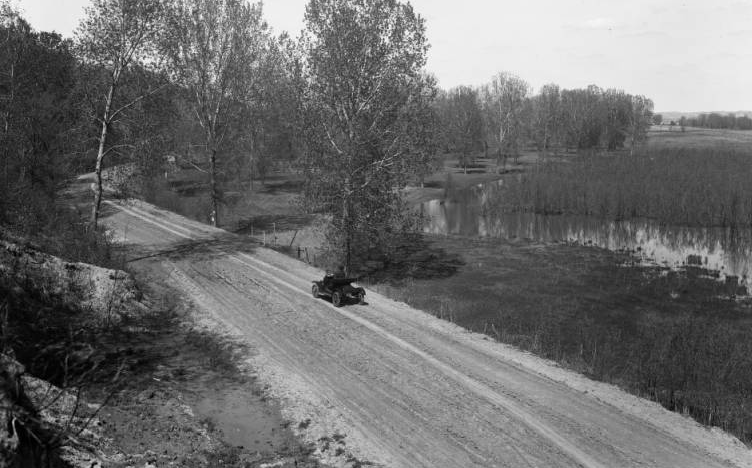
An east-west trail through the Ponca Hills led to the present-day intersection of Ponca Road and J.J. Pershing Drive, and from the settlement of Florence through the 1910s brought old-time wagon drivers and early “automobilists” to the area. Discovering the beauty tucked between the cliffs and the river, recreation-seeking Omahans started laying their eyes on the area at the beginning of the 20th century.

The location became particularly popular for city visionaries when Omaha considered installing a citywide River Drive to extend from Bellevue to the Washington County line in the 1910s. While the plan never came to fruition, it did draw the city’s attention to the area.
This led to the donation of the land to the City of Omaha, and in 1930 it was named Dodge Park in honor of N. P. Dodge (1874-1950), a local real estate magnate who donated the land to the City of Omaha for a park. A portion of the land donated is west of River Drive became Hummel Park.

In the early 1960s, a movement to turn Dodge Park into a city dump almost succeeded. Looking to use the land for three years to dump 190,000 tons of garbage annually, the city looked at a cost of operating the site for $225,000 per year. The proposal led to the Eppley Foundation recommending the installation of a new 1,000 acre park to the east of the airport to replace Dodge Park in 1964. Opponents shut down that proposal, leading to further use of the East Omaha dump.

Dodge Park remained a largely unused wilderness until the late 1960s. The park included about 150 acres of farmland that was rented to local farmers. A caretaker lived at the park too. Into the early 1970s, the only way to get to the river within the park was to follow a farm road. There were shooting areas in the park and “ruins of several shacks” used by squatters into the 1960s sat on the beach. With new plans re-inspiring Omahans about Dodge Park and the areas north, it was this era when new plans were drawn up for the development of a new River Drive and several new parks in the area, as well as an entirely new town north of the park!

A marina was built in the 1970s that eventually had “more than 500 cabin cruisers and speedboats using the landing on a good weekend day.” There were 74 permanent boat slips, and the city planned 225 more to be built that decade. Playgrounds and picnic tables were installed throughout the park too.
Dodge Park Today

Located at 11000 J.J. Pershing Drive, N.P. Dodge Park varies in popularity according to how well the City of Omaha maintains it. Flooding in 2019 decimated a lot of the park infrastructure, and it took the city five years to repair it. However, today the park is operating at full capacity. With 445 acres along the Missouri River, today Dodge Park includes fishing, water skiing and boating as well as hiking, baseball fields, soccer fields, horseshoe pits, tennis courts, and pavilions. There are also camping facilities, playground equipment, boat ramps and picnic shelters.
Development didn’t reach the north end of Douglas County the way visionaries anticipated in the 1920s or the 1970s. Instead, the Hummel Park was established alongside Dodge Park in 1930 but with better park facilities built there by the Works Progress Administration during the Great Depression. Neale Woods was later created and today, the north end of the county remains a nice, excluded place to visit with houses tucked away into the Ponca Hills.
There is a Nebraska State Historical Society historical marker at the park today, but little else is told of the park’s history. Maybe this article will raise awareness.
You Might Like…
MY ARTICLES ABOUT THE HISTORY OF PARKS IN NORTH OMAHA
PARKS: Adams Park | Miller Park | Fontenelle Park | Kountze Park aka Malcolm X Park | Hummel Park | Levi Carter Park | Jefferson Square Park
PRIVATE PARKS: Danish Vennelyst Park | Omaha Driving Park | Charles Street Bicycle Park | Omaha Rod and Gun Club | Carter Lake Club
AMUSEMENT PARKS: Kiddieland and the Pleasure Pier | Lakeview Amusement Park | Cortland Beach | Trans-Mississippi and International Exposition
RELATED: Kellom Pool | Omaha Municipal Beach | CCC Camp | Ames Avenue Bridge
My Articles About the History of Ponca Hills
Ponca Road | Ponca School | Latenser Round House | Blue Windows House | Pries Lake | Hummel Park | Cabannè’s Trading Post | Wyman Heights | Fort Lisa | Forgot Store | River Drive | J.J. Pershing Drive
Elsewhere Online
- Dodge Park article on Wikipedia
- N.P. Dodge Park Marina article from the Omaha Parks & Recreation Department
BONUS


Leave a Reply