
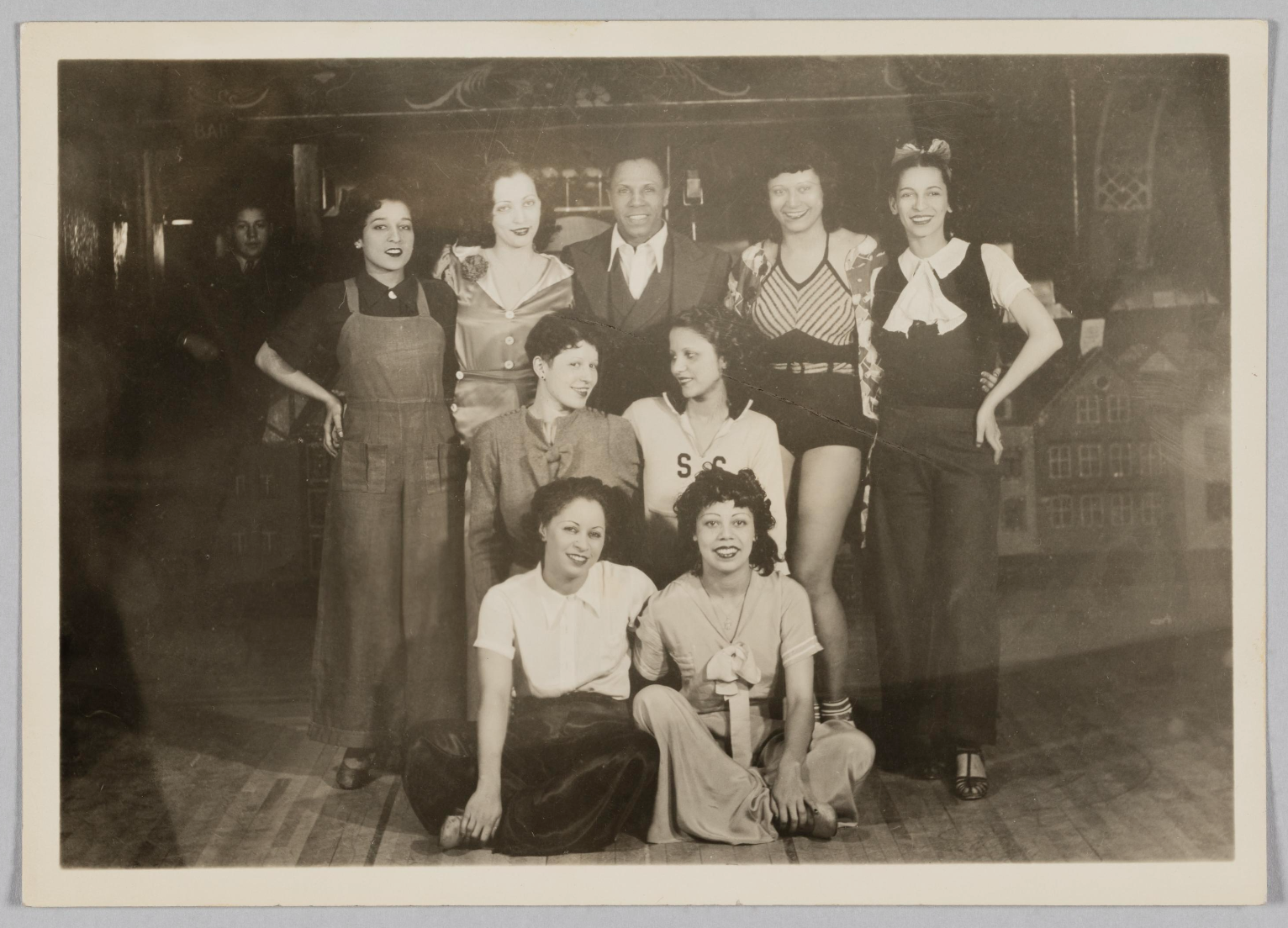
The Harlem Renaissance in North Omaha produced poets, musicians, actors and performers of all kinds. One of the most successful was the son of a notorious crime boss who took his inheritance and left town to travel the world and leave his mark. This is a biography of LeRoy C. Broomfield.
The Son of a Crime Boss

Adopted by John H. “Jack” Broomfield (1865-1927) and his wife Gertie, LeRoy Chester Broomfield (September 28, 1902–August 28, 1971) was raised at 2224 Lake Street. When Jack and Gertie divorced in 1908, LeRoy stayed with his father and likely attended the nearby Lake School. At some point between 1905 and 1925, young LeRoy saw a performance in Omaha by an touring African American performance revue called the Smart Set Company. Led by impressario Sherman H. Dudley (1872-1940), the performance featured singing, dancing and acrobatics, it was not a minstrel show. During a production in Omaha, LeRoy worked as chorus boy and was bitten by the show bug.
While he was a performer during the Harlem Renaissance in North Omaha, he met producers Salem Tutt Whitney and J. Tutt, known as the Tutt Brothers. Impressed with Broomfield and at the urging of his uncle Levi, the brothers took him with them to Broadway in New York City.

In 1919, he joined the US Army to serve during World War I, and when he returned his father set him up for work. He ran his father’s new business called the Monarch Billiards, evenutally taking the business over. In 1919, he was in charge of renting out rooms at his father’s residence at 2024 North 24th Street.
In 1922, LeRoy married Eula A. Gay at St. Phillip’s Episcopal Church. Rev. John Albert Williams married them, and Mr. and Mrs. Edward Killingsworth were the witnesses. LeRoy was running a real estate business housed in the Blue Lion Building at 2425 North 24th Street then, but that didn’t preclude his rise in the performance industry. Later, the couple had one child who was named Leroy Broomfield, Jr. In 1923, LeRoy appeared a Tutt Brothers theater production in New York City called How Come?
While there, LeRoy became a student of a noted dancer named Ted Shawn (1891-1971), and also met Aurora Borealis Greeley (1908-1983) who became his long-time dancing partner.

Jack Broomfield consolidated his real estate business with his son’s real estate business in 1925. The new company was incorporated as J.H. Broomfield and Son Realty, and it sold real estate and insurance throughout Omaha and beyond.
In 1927, LeRoy’s father died and left his adopted son $50,000 dollars, which is worth almost $1,000,000 today. LeRoy immediately took his inheritance and moved to Los Angeles and quickly became popular as an interpretive tap dancer.
Becoming a Star

Sebastian’s Cotton Club was located in Culver City, California. As the most popular jazz club in the L.A. area, it ran from 1926 to 1938 in the largest indoor entertainment venue in Southern California. According to one author, “What made Sebastian’s Cotton club ahead of its time was the fact that it was one of the very first jazz clubs to play exclusively all-black bands and orchestras.”
For almost 15 years, Leroy Broomfield and Aurora Greeley became the regular producers of shows there. In her later autobiography, one of their dancers wrote, “They looked enough alike to be brother and sister, both Black and about 5’4″ or 5’5″… As a pair, Broomfield and Greeley were the best show producers in town and produced the Cotton Club shows for many years… They did everything, including the choreography. They had a line of about a dozen chorus girls and would have four or five different routines. LeRoy kept up with all of the latest New York musicals and what was new on the screen in the way of music and picked up on these to incorporate for the shows.”
LeRoy’s art spanned media including live performance tours, movies and stage shows. His films started with The Lady Fare in 1929. During this same time period, LeRoy and Aurora toured venues around the world such as the Ubangi Club in Harlem, Minsky’s on Broadway, and in Los Angeles, Frank Sebastian’s Cotton Club and Club Alabam (renamed for a time Club Congo), as well as internationally including Shanghai, China.

After a long string of successes working with internationally famous Black performers, their run at the Cotton Club ended in 1935.
After he was released from the Cotton Club, LeRoy performed with Greeley in The Virginia Judge (1935), So Red the Rose (1935), and Close Shave Artist (1942). They performed several numbers in Close Shave Artist. Writing about that production, one reviewer of that time described several songs: “Hot and swingy is this jive number which stars… Aurora Greeley and LeRoy Broomfield along with a chorus of synchopating sepia steppers. It’s hot from Harlem…” Of another song they wrote, “[Greeley and Broomfield], with a chorus of colored strutters, do a zany dance routine in Close Shave. It is a typical Harlem night club feast, loaded with swing music and fast swing dancing.”
From 1942 to 1944, LeRoy and Aurora produced shows at the Bal-Tabarin Café in the whites-only enclave of Gardena, California. After that, they kept a dance studio in the L.A. area and taught another generation of dancers before retiring by 1960.

LeRoy was in poor health for the rest of his life. Living in Los Angeles, there was a gathering of his former dancers and students in 1963 where he was celebrated for his teaching and influence. When LeRoy died, his death was noted in the media and credit was given for his many accomplishments. I have not been able to located a grave though.
Remembrances

As I write this in January 2025, there are few notes about LeRoy online or in print. I could only find one clip of a movie performance, which I posted below. His wikipedia article is anemic at best, and nobody has a fan page devoted to his art.
Today, there are no acknowledgements that LeRoy Broomfield ever lived in Omaha either. The duplex his father built at North 26th and Lake Street is called the Broomfield Rowhouse, but its for Jack Broomfield, not LeRoy. Otherwise, there’s not a school, street, class or event that mentions he ever existed.
Perhaps someday in the future someone will acknowledge this icon of the Harlem Renaissance from North Omaha.
You Might Like…
- A Biography of Jack Broomfield
- A History of the Harlem Renaissance in North Omaha
- A History of Music in North Omaha
Elsewhere Online
BONUS


This clip is from a stage number choreographer by and starring LeRoy Broomfield and his dance partner, Aurora Greeley.


Leave a Reply