
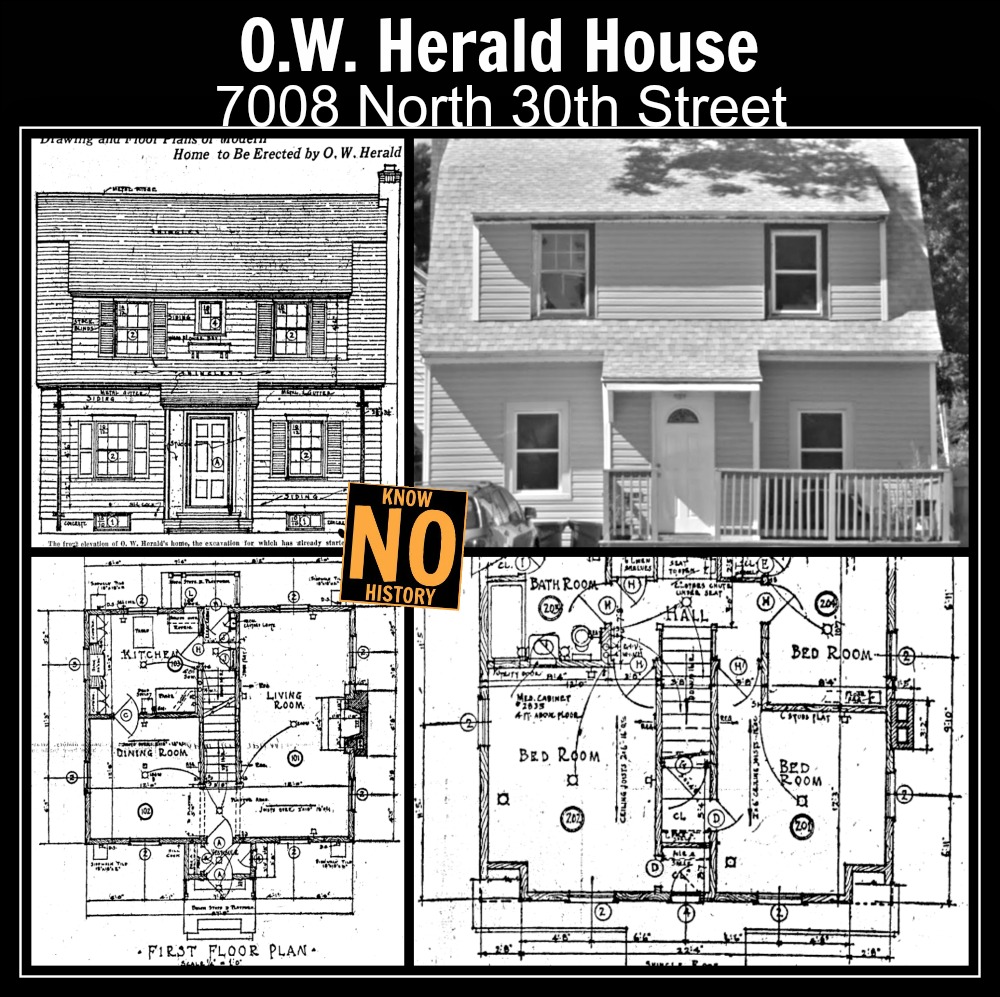
The developer of the Florence Field neighborhood presented the City of Omaha mayor’s officer with a plan for the “Own Your Own Home Movement” in 1923. This is a history of the fashionable contest prize called the O.W. Herald House, located at 7008 North 30th Street.
Reporting on Process

The Omaha World-Herald launched a campaign to give away a new home in Florence Field in March 1924 during the Omaha Home Show. The plan had been put into motion almost a year earlier when Florence Field developer Charles Martin needed to sell more lots and houses in his development. Martin, who famously developed the Minne Lusa neighborhood for the previous decade, had successfully sold many homes to working class people and knew to appeal to them for his newest project.
He conceived of the idea of using the Omaha World-Herald to promote his development extensively by building the so-called O.W. Herald House, and then holding a contest to give it away.

About the Architect
This is Fredercik S. Stott (1889-1968), the architect who designed the O.W. Herald House at 7008 North 30th Street in the Florence Field neighborhood of North Omaha. Stott’s other work in North Omaha included St. John’s A.M.E. Church at 2402 North 22nd Street, which is listed on the National Register of Historic Places; and the Saratoga Elementary School at 2504 Meredith Avenue. Both buildings stand today as a testament to his vision. Designed in the Dutch Colonial Revival style, there were several homes throughout North Omaha that shared a similar design.
Stott designed other buildings in Omaha, too, and was active in California as well.
Martin got everyone on board with his plan. First was architect Stott, whose previous work focused on large scale buildings like schools and office buildings. The president of the Omaha Real Estate Board, Clinton B. Stuht (1884-1974), was involved, as was popular local builder Alex Gustafson (1890-1953). Mayor James Dahlman, the shady stooge of crime boss Tom Dennison, broke ground on the construction site, and the newspaper proceeded to hype their every step.

Starting in December, the newspaper ran a series of articles and features “to stimulate building,” and explained each part of the house’s construction. Playing the conceit of having “O.W. Herald” as being a reporter for the paper, the newspaper used the character to describe the process.
The area for the construction was a wooded single lot along the west side of North 30th Street, and was described as “one of the most picturesque locations in Florence Field…” “Every detail in the purchase of the lot, selection of the plans, method of financing, and erection of the dwelling will be explained by Mr. Herald. Its between Whitmore and Vane Streets. To be given away at the 1924 Omaha Building Show between March 31 and April 5, 1924, at the old Civic Auditorium, the house’s construction had to be finished in three months.

The newspaper painstakingly described every detail of the process, detailing how it selected the architect, chose a contractor, saved money, and started building. Writing in the first person throughout the entire process, in December O.W. Herald wrote, “Despite my firm determination to build that comfortable little home with every possible convenience, I found out that it could not be done with the amount of money I had to invest, and I had practically exhausted my resources. I could not expect much assistance in that direction.” This was just feigned exasperation though, and the process continued.

Builder Gustafson continued construction throughout the coldest days of winter. In the articles he explained the building process and choices that were made. The paper noted that he sought to “make a name for himself” through the construction process and publicity. The initial construction estimate was $5,996.
In February the newspaper began crowing about finishing the house. Dedicating $200 to the interior decorations for the house, an article in the paper speculated about light fixtures and the color of window blinds as if those decisions hadn’t already been made. Advertising “a pleasant ride on the Florence [street] car line,” they began encouraging people to come visit the house.
“Fresh and new, dainty and appealing, the house will be thrown open to public view, under present plans, around March 20, and open house will be kept until the building show, when it will be given away, the first week of April,” the newspaper excitedly shared at the beginning of March 1924. After that was published, the newspaper shared that builder Gustafson had committed to 20 other buyers to build identical homes for them throughout the city.
Finishing, Open House & a Winner

When they opened the house for visits, the paper said visitors would be greeted at “A terraced porch, an inviting vestibule [which] lead one from the east entrance of the home into a hallway, arched in three places; directly ahead where steps lead to the second floor, to the right into the dining room, and to the left into the living room.” The paper hyped the house’s fireplace and played up the woodwork throughout the house, and really made it sound spectacular. At the end of construction the paper said, “The whole house represents an investment of $7,250.” In the two weeks after it opened for visits on March 25, the house reportedly had more than 5,000 visitors.
L.C. Reeves won the house at the Omaha Builders Convention. He won the contest for the best essay on “How Can Omaha Best Be Served,” which was judged by the superintendent of OPS, a director of the Omaha Chamber of Commerce, and the president of the Omaha Real Estate Board.
In June 1924, Mr. Reeves and his wife opened their house for visitors after finishing acquiring their furnishings from Orchard and Wilhelm, a premier store in Omaha. Living there with their daughter, the Reeves held an eight-day open house with visiting hours from 2pm to 9pm daily. In October 1924, the Charles W. Martin Company said they’d sold more than 24 new homes in the Florence Field neighborhood in the prior season, marking the contest a success.
The Reeves family sold the house within a year though, and it went on living a normal house life after it’s construction. In 1955 it was advertised as “Striking 2-bedroom Colonial, one of the really beautiful homes in Minne Lusa.”

The house was built at 7008 North 30th Street, and stands still today. The house has almost 1,400 square feet, with two bedrooms and one bathroom. There’s a deck on the front of the house, and there isn’t a garage there. Its value today is placed at $125,200.
There is no acknowledgment of this normal house’s interesting history, and the role it played in making the once-suburban Florence Field neighborhood more popular. Maybe someday the Omaha World-Herald will partner with the Omaha Home and Garden Expo and the Omaha Chamber of Commerce to restore it, and restore some confidence in this area of the city once more.
You Might Like…
- A History of Florence Field in North Omaha
- A History of the Minne Lusa Historic District in North Omaha
MY ARTICLES ABOUT NORMAL HOUSES
3155 Meredith Ave. | 5815 Florence Blvd. | 6711 N. 31st Ave. | 3210 N. 21st St. | 4517 Browne St. | 5833 Florence Blvd. | 1922 Wirt St.
| 3467 N. 42nd St. | 5504 Kansas Ave. | Blue Windows House | 2003 Pinkney St. | Hoyer House | O.W. House
BONUS




Leave a Reply